
I keep seeing the same pattern emerging in AI conversations right now. Everyone says: we need better tools but, when you dig into what the leading firms are saying – McKinsey, IBM, Bain, Boston Consulting Group, Accenture, Anthropic and OpenAI – they’re all coming to the same conclusion:
It’s not the technology that’s broken. It’s the organisational model.
We are moving from AI as a feature to AI as an operating system. The challenge isn’t adopting AI. The challenge is reinventing the enterprise for a world where machines don’t just support decisions, but increasingly make them.
This is why only a small group of firms are really getting value from AI, and they’re not the ones experimenting faster. They’re the ones redesigning how the organisation actually works.
What does that mean in practice?
First, AI isn’t a tool anymore. It’s becoming part of the team. That raises awkward questions: who is accountable when an AI agent makes a decision? How do you define roles, incentives and trust boundaries between humans and machines?
Second, most firms are still layering AI on top of messy, legacy processes. That’s like putting having a Ferrari pulled by a horse. It looks impressive, but it doesn’t move the business forward.
Third, the real work is the boring stuff: data quality, governance, execution discipline, and integration into core workflows. Not demos, pilots or chat interfaces, but building infrastructure for decision-making.
It means we are moving from AI as a feature to AI as an operational system.
Here is a quick summary of each of the reports and a nice pic, courtesy of Justin R on LinkedIn:
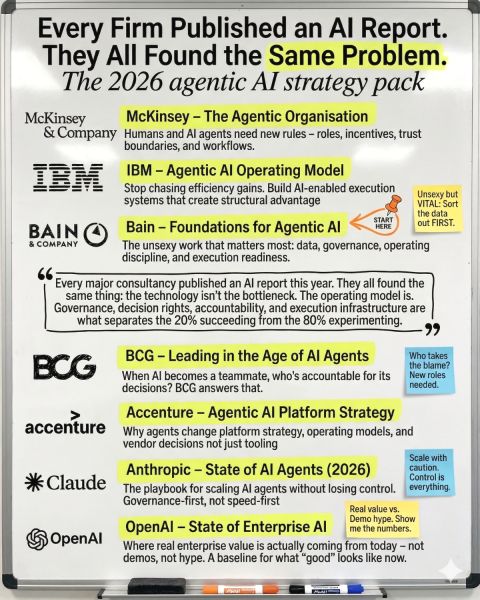
IBM: Agentic AI’s Strategic Ascent
IBM’s report makes a simple but powerful point: agentic AI isn’t just another tool – it fundamentally changes how organisations operate. Instead of humans managing tasks step by step, AI agents can set goals, make decisions and execute work autonomously, effectively becoming a digital workforce. The real challenge isn’t the technology, but redesigning the operating model – fixing data, governance and workflows – so humans and machines can work together. In short, success with AI isn’t about better pilots; it’s about rebuilding the organisation for a world where machines don’t just support work, they do it.
McKinsey – The Agentic Organisation
McKinsey’s take on the “agentic organisation” is pretty clear: AI isn’t just changing work, it’s redefining the firm itself. Instead of hierarchical structures and siloed functions, organisations become networks of small, outcome-driven teams powered by AI agents, where humans supervise and orchestrate rather than execute tasks. The real shift is from using AI as a tool to embedding it into the core operating model – integrating humans, machines and data into a single system that can act in real time. In other words, competitive advantage no longer comes from deploying AI… it comes from redesigning the organisation around it.
Bain – AI leaders are expanding their edge
The core message is that agentic AI creates an accountability problem most firms aren’t ready for. When AI agents start making decisions that impact customers, risk and revenue, it’s no longer clear who owns the outcome – the human, the model, or the system.
So, the real challenge isn’t deploying agents – it’s designing governance around them: defining decision rights, setting guardrails, and making sure there’s clear responsibility when things go wrong. In other words, as organisations move from AI that suggests to AI that acts, success won’t come from better models… it will come from clear accountability in a world where machines are making decisions.
Accenture – the new rules of platform strategy in the age of Agentic AI
The big message is simple: enterprise platforms weren’t built for an AI-first world – and they’re now holding businesses back. Legacy systems are too rigid, too fragmented and too focused on stability, which limits the value of agentic AI. To unlock growth, firms need to reinvent their platforms into integrated, cloud-based ecosystems where data, AI agents and humans work together in real time.
Agentic AI changes how work gets done – automating routine tasks, making decisions, and collaborating with humans – so organisations shift from process-driven models to outcome-driven, hybrid human-AI operations. But most firms aren’t ready. Only a small minority have aligned their AI, platform and business strategies, which is why many are stuck in pilots with low returns.
The winners are doing three things differently: modernising their digital core (clean data, unified platforms), redesigning workflows around AI agents, and reshaping their organisation and culture to support a digital workforce. Platforms themselves are evolving from passive systems of record into active systems of action, orchestrating agents across the enterprise.
This isn’t about replacing platforms – it’s about reinventing them as intelligent operating systems for the business.
Claude – The 2026 State of AI Agents Report
The story for 2026 is clear: AI agents have moved from experiment to enterprise infrastructure. Firms are no longer just automating tasks – they’re deploying agents to run multi-step, cross-functional workflows across the business, from coding and customer service to finance, compliance and cybersecurity. The result is real ROI: most organisations are already seeing measurable value, with faster execution, lower costs and productivity gains across the board.
What’s changed is scale and ambition. Over 90% of firms now use AI in software development, many trusting agents to lead workflows, while use cases are rapidly expanding into data analysis, reporting, supply chains and decision-making. This is creating a hybrid workforce, where AI handles routine and analytical work, freeing humans to focus on strategy, relationships and oversight.
But it’s not frictionless. The biggest barriers remain integration, data quality and cost – meaning the winners aren’t those with the best models, but those who can embed AI into real systems and workflows.
We’ve crossed the line from pilots to production. AI agents are no longer tools – they’re becoming the operating layer of the enterprise.
OpenAI – the state of enterprise AI
The message from The State of Enterprise AI 2025 is simple: AI has moved from experimentation to embedded infrastructure inside firms. Usage is scaling fast – up 8x in activity and 320x in deeper reasoning workloads – as companies integrate AI into real, multi-step workflows rather than one-off tasks.
The impact is already tangible. Most workers report saving close to an hour a day, improving quality and even doing tasks they couldn’t do before – like coding or data analysis – blurring traditional role boundaries.
But the big story isn’t adoption – it’s the gap. A small group of “frontier” firms and workers are using AI far more deeply and getting disproportionate value, while most organisations are still scratching the surface.
The bottom line? AI isn’t just boosting productivity – it’s reshaping how work gets done. And the winners will be those who move fastest from using AI as a tool… to embedding it as a core capability across the enterprise.

Chris M Skinner
Chris Skinner is best known as an independent commentator on the financial markets through his blog, TheFinanser.com, as author of the bestselling book Digital Bank, and Chair of the European networking forum the Financial Services Club. He has been voted one of the most influential people in banking by The Financial Brand (as well as one of the best blogs), a FinTech Titan (Next Bank), one of the Fintech Leaders you need to follow (City AM, Deluxe and Jax Finance), as well as one of the Top 40 most influential people in financial technology by the Wall Street Journal's Financial News. To learn more click here...