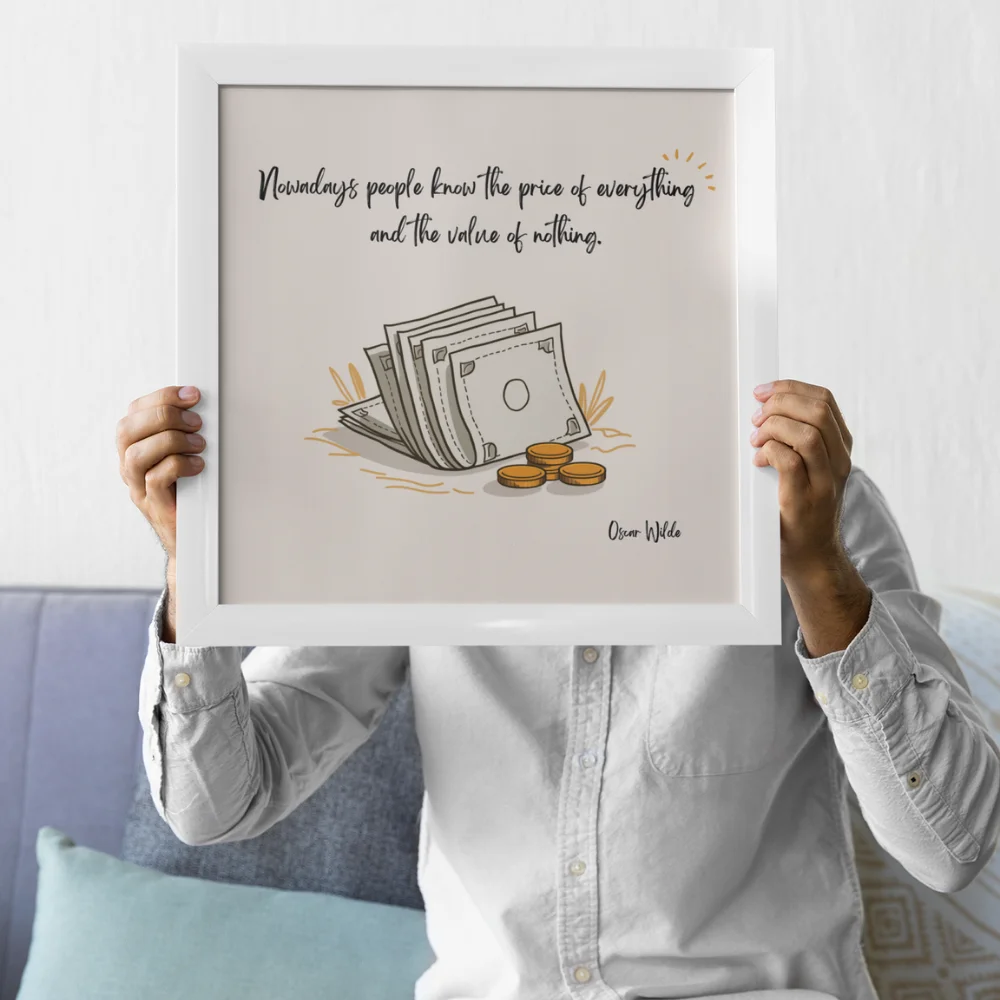
I’m not big on theology but did stumble across Mammon the other day and am surprised I didn’t know more about this ancient character. He appears in the Bible quite often, and Jesus makes clear that ‘you cannot serve both God and Mammon (Matt 6.24 as well as Luke 16.9, 11 and 13).
Mammon promotes the ‘deceitfulness of wealth’ which is one of the three causes of the unfruitfulness of the seed in the Parable of the Soils (Mark 4.19). That’s the parable about the farmer sowing seeds and much of it falls on fallow ground. The point of that parable is simple: the “seed” is truth or wisdom, and the “soil” is how people receive it. Some ignore it, some embrace it briefly, some let it get crowded out by life and wealth, and a few truly absorb it and act on it. The first groups are those who struggle with money; the last group are those who truly believe and, as an aside, there are around 500 verses in the Bible on prayer and faith, but more than 2,000 on money.
Is money the root of all evil and who is this Mammon?
Mammon is the focus of the accumulation of wealth. One’s life becomes a quest to accumulate more and more wealth and property until it becomes a religious practice supplanting all other things, and wealth becomes the object of worship. This is why Jesus put Mammon and God in stark opposition to each other.
It is clear in many religious teachings that worshiping wealth, money and the accumulation of riches is the opposite to being a good person.
This led me to thinking about Shakespeare’s The Merchant of Venice.
The Merchant of Venice isn’t really about money. It’s about what money does to people — and, more importantly, what happens when we confuse money with value.
At the centre of the play is a simple financial deal: Antonio borrows money from Shylock to help his friend Bassanio, but the collateral is grotesque. If Antonio doesn’t pay it back, then he pays with a pound of flesh. That’s Shakespeare taking a basic loan contract and stretching it to absurdity to make a point: if you reduce everything to a transaction, you can end up inhuman.
What does that tell us?
First, money is never just money. It’s about trust and relationships. Antonio borrows freely because of friendship. Shylock insists on strict terms because he’s been excluded and mistreated. The contract isn’t just financial; it’s emotional, social, even political. Strip away trust, and finance becomes cold and dangerous.
Second, the play exposes the tension between law and equity. Shylock sticks rigidly to the letter of the contract. Portia, disguised as a lawyer, flips the situation by arguing for mercy, saying that justice without humanity is flawed. In modern terms, it’s the difference between code-driven execution and human judgement.
Third, it highlights how money amplifies inequality and prejudice. Shylock, as an outsider, is both demonised for his role as a moneylender and trapped within it.
Fourth, risk and speculation sit quietly underneath the story. Antonio’s wealth is tied up in ships at sea where everything is uncertain, volatile nad exposed. It’s an early nod to global trade risk: diversification, liquidity, and the dangers of overextension. When things go wrong, the whole structure collapses quickly.
And finally, Shakespeare draws a line between price and value. A pound of flesh has a price in the contract, but no real value in human terms. Love, loyalty, mercy. These are the things that ultimately resolve the drama, not money.
If you step back, the message is surprisingly modern. Finance works when it’s embedded in trust, empathy and judgement. When it becomes purely transactional – when everything is priced, coded, and enforced without context – it risks becoming something darker.
Apologies for getting deep into this, you can close this tab now if it’s too much, but Mammon, Jesus, Shakespeare and Shylock made me realise so much learning from out past that can change our future.
Mammon isn’t a character in the way Shylock is. It’s an idea – a loaded one – that “you cannot serve God and Mammon.” You cannot believe in money and God. At its core, Mammon is the personification of wealth when it becomes an object of worship. Not money as a tool, but money as a master.
The message is blunt. Money is useful. Necessary, even. But the moment it becomes the thing you serve – the thing that defines your decisions, your identity, your sense of worth – it stops being neutral. It becomes a rival to God, or more broadly, to any higher moral purpose.
That’s the first insight: money competes for allegiance. It’s not passive. It shapes behaviour. If you organise your life around accumulation, everything else – relationships, ethics, community – become secondary.
The second is about illusion. Mammon promises security and control, but the biblical narrative keeps undercutting that. Wealth looks solid, but it’s fragile as markets crash, fortunes disappear, power shifts.
The famous image of the camel passing through the eye of a needle isn’t really about geometry; it’s about how wealth can trap you into believing you’re self-sufficient when you’re not.
“It is easier for a camel to go through the eye of a needle than for a rich man to enter the kingdom of God.” [Matthew 19:24, Mark 10:25, and Luke 18:25]
Third, Mammon reframes the idea of value versus virtue. In a Mammon-driven mindset, success is measured in numbers in terms of how much you have. It is not measured by how you got it or what you do with it. The spiritual critique is that this hollows out meaning. You can be rich and empty at the same time.
And finally, there’s a governance point hidden in all of this. Mammon warns that systems built purely around money tend to distort human priorities. If everything is priced, then everything is tradable and, once that happens, you start putting a price on things that arguably shouldn’t have one.
The takeaway isn’t “money is bad.” It’s that money is a powerful servant, but a terrible master.
Chris M Skinner
Chris Skinner is best known as an independent commentator on the financial markets through his blog, TheFinanser.com, as author of the bestselling book Digital Bank, and Chair of the European networking forum the Financial Services Club. He has been voted one of the most influential people in banking by The Financial Brand (as well as one of the best blogs), a FinTech Titan (Next Bank), one of the Fintech Leaders you need to follow (City AM, Deluxe and Jax Finance), as well as one of the Top 40 most influential people in financial technology by the Wall Street Journal's Financial News. To learn more click here...