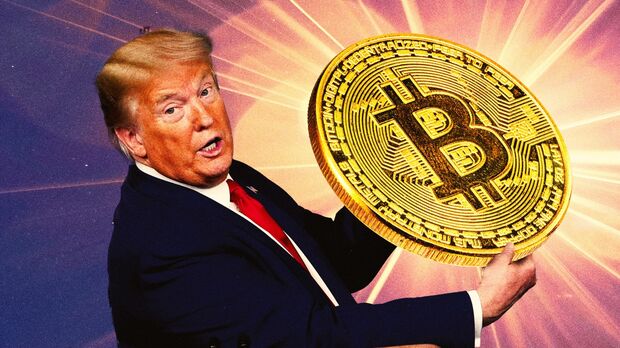
There was a time when Donald Trump was not particularly keen on cryptocurrencies. In 2019, he declared that he was “not a fan” of Bitcoin and other cryptocurrencies, arguing that they were highly volatile, based on thin air and potentially useful for unlawful activity.
How things change.
Today, President Trump is arguably the most important political supporter of cryptocurrency anywhere in the world. His administration wants America to become the global centre for digital assets. His government has pushed through stablecoin legislation. He has hosted cryptocurrency executives at the White House and is urging Congress to pass further legislation to clarify how digital assets should be regulated. Meanwhile, Trump and his family have substantial commercial interests in crypto themselves.
That last sentence is where things get complicated.
Because there are two stories here.
One is about an American president deciding that cryptocurrencies, stablecoins, tokenisation and digital assets are strategically important technologies that the United States should embrace rather than suppress.
The other is about an American president helping to reshape the regulation of an industry in which he and his family have significant financial interests.
Depending upon your viewpoint, Donald Trump is either dragging America into the financial future or creating one of the biggest conflicts of interest in modern presidential history.
Perhaps he is doing both.
From crypto sceptic to crypto president
Trump's conversion to cryptocurrency has been remarkable. During his second administration, the White House has moved digital assets from the fringes of financial policy towards its centre.
The administration's argument is straightforward: America should be the world's cryptocurrency leader rather than allowing the next generation of financial infrastructure to migrate elsewhere.
That means giving cryptocurrency companies clearer rules, allowing legitimate digital asset businesses access to banking and capital markets, encouraging stablecoins and tokenisation and ending what the industry regarded as the regulatory hostility of the Biden years.
The White House has explicitly talked about making America the “crypto capital of the planet” and a Bitcoin superpower.
Last week Trump reinforced that message by hosting another gathering of cryptocurrency executives and regulators at the White House and urging Congress to move forward with the CLARITY Act, which aims to establish a clearer regulatory structure for digital assets.
The markets noticed.
Bitcoin climbed above $70,000 while Ethereum and cryptocurrency-related shares also rallied.
Reuters reported that Bitcoin rose above $70,000 for the first time since June as Trump's intervention added to optimism generated by Treasury market action. Coinbase, Strategy, Circle and other crypto-related stocks rose as well.
It would be wrong to attribute the entire rally to Trump. Treasury intervention in the bond market and wider liquidity expectations were important factors. Nevertheless, the political message was unmistakable: Washington is becoming considerably friendlier towards crypto.
For the industry, that matters enormously.
The argument for Trump
Put the politics and personalities aside for a moment and there is a legitimate economic argument behind what the Trump administration is doing.
Crypto has spent much of its existence operating in regulatory uncertainty. Is a token a security? A commodity? A currency? Who regulates it? The Securities and Exchange Commission? The Commodity Futures Trading Commission? Banking regulators? State regulators? All of them?
Businesses cannot build confidently when they do not know which rules will apply. Trump is therefore pushing Congress to establish clearer market structures.
The CLARITY Act is intended to provide greater certainty about how different digital assets are classified and regulated. Trump argues that Congress needs to take the next step if America wants to retain its leadership against international competitors but, and this is a critical point, there is a bigger geopolitical argument.
Stablecoins may look like a threat to traditional money, but dollar-backed stablecoins can also reinforce the international role of the dollar. A dollar stablecoin is still, ultimately, a dollar. If billions or trillions of dollars circulate around blockchain networks through dollar-backed stablecoins, global demand for dollar assets could increase rather than decrease.
From Washington's perspective, digital dollars could therefore become another distribution mechanism for the American currency.
Another piece here is that Trump signed the GENIUS Act in July 2025, creating a federal framework for payment stablecoins. He argues that this will help accelerate adoption of dollar-backed stablecoins.
Then there is innovation.
Tokenised securities, programmable money, decentralised finance, blockchain settlement and stablecoins are increasingly being explored by mainstream financial institutions. America has an obvious interest in ensuring that companies developing these technologies establish themselves in New York, Silicon Valley and Miami rather than Singapore, Dubai, Hong Kong or elsewhere.
Seen through this lens, Trump's crypto policy is not particularly radical.
It is industrial policy.
America dominated the internet economy. Why wouldn't it want to dominate the blockchain economy?
That is the strongest argument for what Trump is doing but the problem is World Liberty Financial.
Trump and his family are financially connected with cryptocurrency, and a company affiliated with Trump family members owns over a third of World Liberty Financial Trust Company. World Liberty has now received conditional approval from the Office of the Comptroller of the Currency to establish a national trust bank. This is not a conventional bank. It will not be taking insured retail deposits and turning them into mortgages and business loans. Instead, among other activities, it will be able to issue a stablecoin – USD1 – directly.
The economics of stablecoins can be extremely attractive. Customers effectively exchange their dollars for digital dollars while the issuer invests the reserves backing those coins in safe liquid assets such as US Treasury securities and earns the resulting interest … but it creates an obvious question. What happens when the President of the United States promotes an industry, signs legislation affecting that industry and appoints officials responsible for regulating that industry … while his family simultaneously owns a substantial interest in a company operating within it?
Critics say the conflict is unprecedented.
Supporters say that does not mean the regulatory decisions themselves are corrupt.
The OCC has specifically rejected allegations of improper interference. It says career staff reviewed World Liberty's application against statutory and regulatory requirements, and that government ethics officials were consulted. World Liberty itself argues that seeking a national charter demonstrates that it is moving towards stronger regulation and permanent federal supervision, rather than attempting to avoid oversight.
The thing is that there is a difference between a potential conflict of interest and evidence that a regulator has been improperly instructed to approve something. Those things should not be casually conflated.
The optics are extraordinary.
Can you buy influence with a stablecoin?
This is where the debate becomes particularly uncomfortable.
Critics argue that USD1 creates a mechanism through which companies, wealthy individuals or even foreign interests could establish a financial relationship with a business connected to the president.
The Guardian cites several academics and regulatory experts who question why someone would choose USD1 over much larger established stablecoins unless Trump's involvement itself was part of the attraction. World Liberty rejects that characterisation and argues that USD1 has established itself among stablecoins compliant with the new US regulatory regime.
USD1 remains much smaller than the global market leaders. The Guardian reports around $4 billion in circulation, compared with roughly $183 billion for Tether and more than $70 billion for Circle's USDC. That does not make USD1 insignificant. Four billion dollars is hardly pocket money … but it raises the key question: what exactly are customers buying?
A digital dollar? Access to a growing American stablecoin ecosystem? A Trump-branded financial product? Or proximity to political power?
Those are very different propositions and proving motivation is extremely difficult.
Someone purchasing USD1 may simply believe it is a well-backed regulated stablecoin. Another might be a Trump supporter who likes the brand. A third might regard Trump's political support for cryptocurrency as giving World Liberty a competitive advantage. Critics worry that another participant might hope that doing business with an enterprise connected to the president creates political goodwill.
That is the problem with conflicts of interest.
The issue is not simply whether corruption takes place. It is whether outsiders can confidently know that it hasn't.
Then there is the money
The numbers make the issue harder to ignore.
Recent reports estimate that Trump has earned well over $1 billion from cryptocurrency-related ventures, with some estimates of his broader earnings since returning to office running substantially higher. Reuters reported that Trump has earned more than $1.4 billion from crypto ventures.
This has inevitably become part of the political battle over cryptocurrency legislation.
The real question is how America should regulate digital assets and whether the president should personally benefit from the industry whose regulatory environment his administration is reshaping.
You can believe that America desperately needs coherent cryptocurrency regulation while simultaneously believing that presidents should not maintain significant commercial interests in businesses affected by those regulations.
Equally, you can believe Trump's commercial interests create serious ethical questions while accepting that his administration's underlying cryptocurrency policies may ultimately benefit the American financial system.
Politics encourages us to choose one side. Finance turns out to be more complicated.
What Trump has undoubtedly achieved
Whatever you think of Donald Trump, he has achieved something extraordinary for cryptocurrency.
He has normalised it.
Bitcoin has moved from something governments wondered whether they should ban to something being discussed inside the White House alongside national economic competitiveness.
Stablecoins have moved from regulatory grey areas towards formal federal legislation.
Cryptocurrency executives who once worried about enforcement actions now sit around tables with senior government officials.
Regulators are increasingly discussing how digital assets should operate within the American financial system rather than whether they should operate at all.
Markets understand the significance. Bitcoin's latest rally was driven by several factors, but Trump's renewed push for crypto legislation was clearly one of them.
For the cryptocurrency industry, Trump has therefore delivered something incredibly valuable.
Legitimacy.

Chris M Skinner
Chris Skinner is best known as an independent commentator on the financial markets through his blog, TheFinanser.com, as author of the bestselling book Digital Bank, and Chair of the European networking forum the Financial Services Club. He has been voted one of the most influential people in banking by The Financial Brand (as well as one of the best blogs), a FinTech Titan (Next Bank), one of the Fintech Leaders you need to follow (City AM, Deluxe and Jax Finance), as well as one of the Top 40 most influential people in financial technology by the Wall Street Journal's Financial News. To learn more click here...