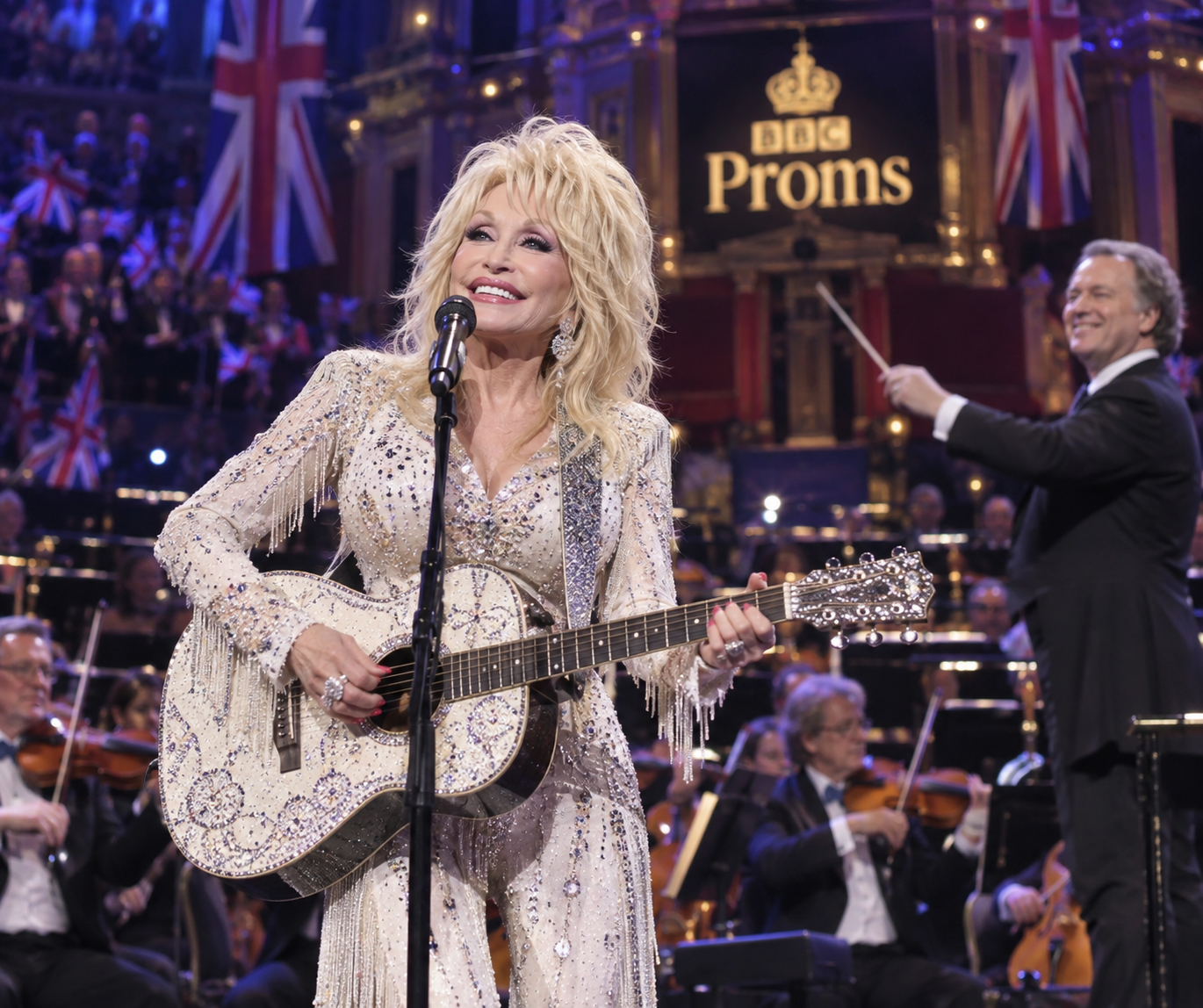
I just watched Sakari Oramo conducting the Last Night of the Proms. It is a massive annual jamboree at the Royal Albert Hall in London and, among all the music, spectacle, flags and celebration, it was something he said that stayed with me.
There was a special tribute to Dolly Parton, and Oramo used the moment to reflect on something Dolly once said about herself:
“I look totally artificial, but I am totally real, as a writer, as a professional, as a human being. A rhinestone shines just as good as a diamond.”
What a wonderful statement.
Dolly Parton spent a lifetime surrounded by rhinestones. They glitter, sparkle and shine, but nobody pretends they are diamonds. In fact, that is the whole point. Dolly openly acknowledged that the image is artificial, while insisting that the person underneath is completely real. The clothes, hair, make-up and rhinestones are theatre; the writer, professional and human being are authentic.
More importantly, there is integrity in that distinction. She knows who she is, she owns who she is and she does not pretend to be something else. Authenticity is about being true to yourself. Integrity is about standing behind who you are and what you create.
Oramo then underlined that Authenticity and Integrity is what humans aspired for in AI, not artificial intelligence.
We are entering a world where machines will create extraordinary things. AI will write novels, compose symphonies, paint pictures, make films, design buildings, create advertising campaigns and produce songs. Some of those creations will be technically brilliant. Some will be indistinguishable from things created by humans. Some will be better than most humans could ever produce.
So, where does that leave the artist?
It leaves the artist with the rhinestone.
The greatest mistake artists will make in the age of AI is to compete with machines on perfection. Machines will win that game. They will write cleaner sentences, correct musical imperfections, balance colours, analyse audiences and optimise everything for maximum engagement. They will produce a million variations while you are still staring at the blank page.
But perfection was never the point of art.
The point of art is that somebody was there. Somebody lived something, felt something, lost something, loved something, hated something, feared something or dreamed something, and then found a way to express it so that another human being could feel it too. The crack in the voice matters, the strange brushstroke matters, the sentence that breaks the rules matters and the chord that should not work but somehow does matters, because behind all of those things is a human being saying: this is me, this is what I believe and I stand behind it.
That is authenticity with integrity.
And I think those two qualities are going to become increasingly valuable in the age of AI.
Authenticity tells me that the voice is yours. Integrity tells me that you mean what you say. Authenticity tells me where the work came from. Integrity tells me that you are prepared to put your name against it. Authenticity gives art its identity, while integrity gives it its meaning.
AI changes the economics of creativity because it makes competence abundant. We spent centuries valuing the ability to create because creation was difficult. Writing a book took months or years. Painting required years of practice. Composing music demanded knowledge, skill and enormous patience. Film required crews, cameras, studios and money. AI is collapsing those barriers.
When competence becomes abundant, something else becomes scarce.
Authenticity and integrity.
That is why I suspect the AI revolution will produce a strange reversal. We have spent years worrying that artificial intelligence will make human creativity worthless. I think it will make authentic human creativity with integrity more valuable.
There will be billions of AI-generated songs, images, articles, books and videos. They will flood our screens. They will be polished, personalised and optimised. Much of it will be excellent, but we will increasingly ask different questions when something moves us: who made this, why did they make it and do they stand behind it?
Not which model generated it, which prompt produced it or which algorithm optimised it, but who is behind it? What do they believe? What have they experienced? Why did they create this? What are they trying to tell me?
This is where integrity matters, because authenticity without integrity risks becoming another performance. We already live in a world of manufactured personalities, influencers, brands and carefully curated identities. AI will make manufacturing those identities infinitely easier. Anyone will be able to manufacture the appearance of brilliance, beauty, wisdom, humour or artistic talent.
The technology will manufacture diamonds by the billion ... which is why I increasingly want the rhinestone.
I want the writer whose sentences occasionally wander because that is how their mind works. I want the musician whose voice contains the evidence of a life lived. I want the painter whose work carries an obsession that no algorithm would optimise. I want artists who use AI without allowing AI to erase them, and who are willing to put their names, beliefs and reputations behind the work they produce.
That distinction matters.
Being authentic and maintaining integrity in the age of AI does not mean rejecting AI. A musician uses a synthesiser without becoming a synthesiser. A photographer uses Photoshop without surrendering authorship. A writer uses a word processor without giving Microsoft ownership of the thought. AI is another extraordinary instrument, and artists will use it to explore things that were previously impossible.
The question is whether the technology amplifies the artist or replaces them.
If I ask AI to make me sound like everyone else, I disappear. If I use AI to make me more intensely myself, it becomes an amplifier. But there is another question I have to answer: am I willing to stand behind what it produces in my name?
That is integrity ... and this applies far beyond art.
It applies to writers, musicians, bankers, entrepreneurs, teachers, politicians and leaders. As AI becomes embedded in almost everything we do, intelligence itself becomes less distinctive. Access to knowledge becomes less distinctive. The ability to create a competent presentation, report, image, song or argument becomes less distinctive.
What remains distinctive is you: your judgement, experience, mistakes, humour, values, eccentricities, scars and view of the world. And what matters is whether you have the integrity to stand behind them.
Your rhinestones.
There is something wonderfully human about the fact that Dolly Parton understood this long before anyone started talking about generative AI. She never needed to convince the world that the rhinestones were diamonds because the value was never in the stones.
The value was in Dolly.
Her authenticity made her recognisable. Her integrity made her believable.
That is the lesson I took away from Sakari Oramo’s words at the Proms.
Artificial intelligence will give us an age of manufactured perfection, and much of it will be astonishing. We should embrace it, experiment with it and use it and be augmented by it, but artists should never allow the machine to polish away the things that made their work worth experiencing in the first place: their authenticity and their integrity.
Do not try to become the perfect diamond that an algorithm thinks the world wants.
Be the rhinestone.
Shine because you are unmistakably you, and have the integrity to stand behind it.
Chris M Skinner
Chris Skinner is best known as an independent commentator on the financial markets through his blog, TheFinanser.com, as author of the bestselling book Digital Bank, and Chair of the European networking forum the Financial Services Club. He has been voted one of the most influential people in banking by The Financial Brand (as well as one of the best blogs), a FinTech Titan (Next Bank), one of the Fintech Leaders you need to follow (City AM, Deluxe and Jax Finance), as well as one of the Top 40 most influential people in financial technology by the Wall Street Journal's Financial News. To learn more click here...