I have spent much of the last few years listening to people asking the wrong question about artificial intelligence. Will AI take my job? Will AI replace bankers? Lawyers? Accountants? Programmers? Journalists? Consultants? The question assumes that AI competes with professions. Increasingly, I think it competes with something else entirely: normality.
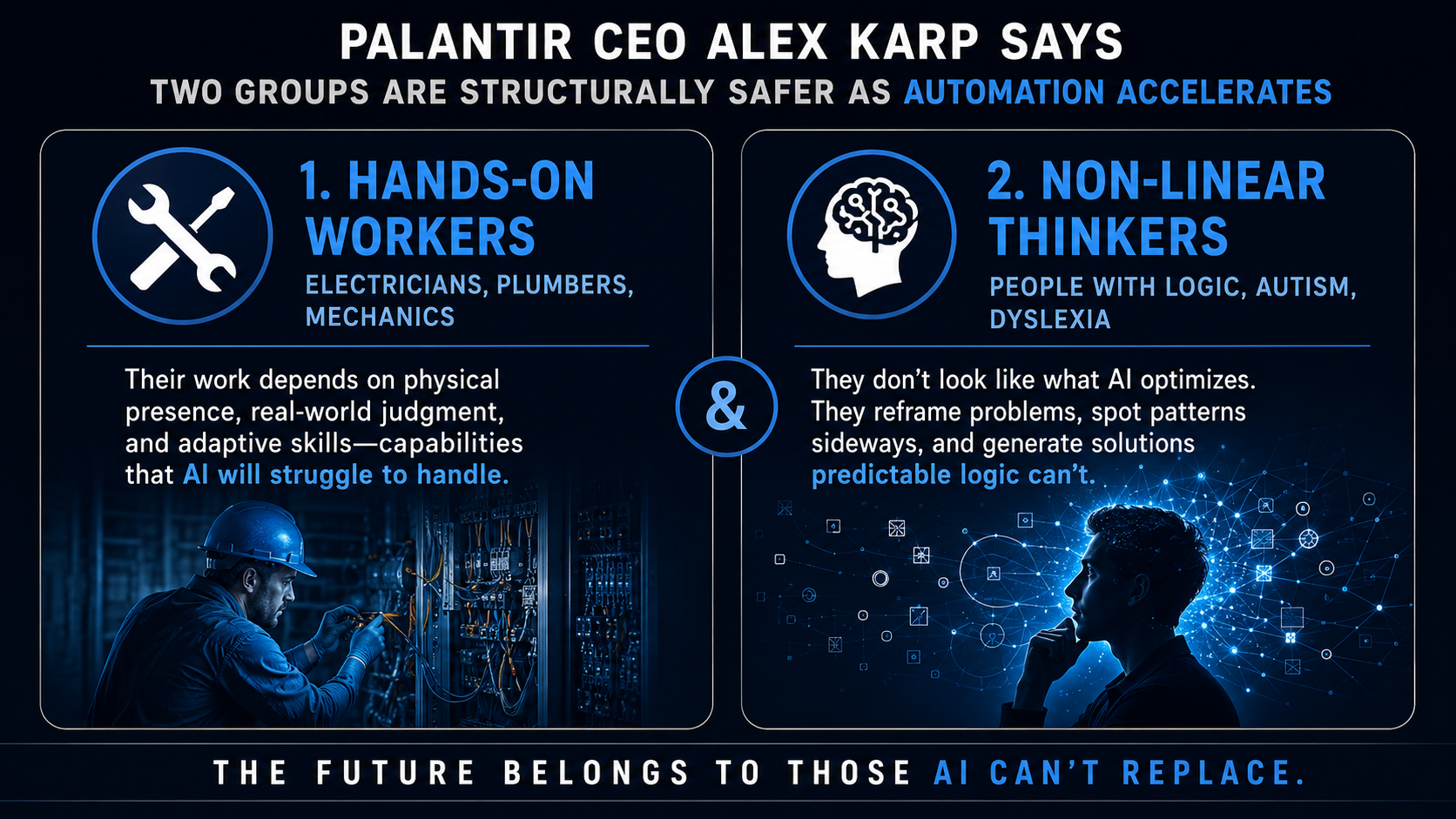
That thought struck me when I saw that Palantir CEO Alex Karp says that there will only be two types of people in the future.
The first are people who work with their hands in unpredictable physical environments: electricians, plumbers, mechanics and others whose jobs require presence, dexterity, judgement and the ability to deal with whatever strange problem appears when they open the cupboard, lift the floorboards or take the engine apart.
The second group are people who don't think normally.
In other words, the future belongs to weirdos.
I mean that affectionately. In fact, I mean it as a compliment.
For the industrial age, we spent more than a century creating systems designed to eliminate weirdness. Schools taught children to sit in rows, follow instructions, pass standardised examinations and produce the expected answer. Universities refined the process. Corporations then hired the successful products of that system and placed them into hierarchies where they followed processes, attended meetings, completed forms, produced reports and gradually climbed the ladder by demonstrating that they could operate effectively within the machine.
The corporation wanted predictability. If you joined a bank, insurer, accounting firm or multinational company, there was a process for almost everything. There was a correct way to approve a loan, assess a risk, reconcile an account, write a report, conduct an appraisal, manage a project and produce a presentation. The more senior you became, the more sophisticated the processes became, but much of corporate life remained based upon following established patterns.
Then along comes artificial intelligence.
And what is AI spectacularly good at?
Patterns.
AI can absorb the procedures, regulations, reports, spreadsheets, emails, presentations, manuals, research papers and accumulated knowledge of an organisation and identify what normally happens next. Give it enough examples and it becomes remarkably good at producing the answer that a competent, well-trained, conventional employee might have produced.
That should make us uncomfortable because we have spent decades training humans to behave exactly like machines just as machines have become capable of behaving like those humans.
The most vulnerable person in the AI economy may therefore not be the least educated worker. It could be the highly educated, highly competent, highly predictable knowledge worker.
If your job consists largely of receiving information, processing it according to established rules and producing an expected output, AI is coming straight at you. That includes an extraordinary amount of what happens inside banks. Credit analysis, compliance reviews, customer correspondence, financial analysis, coding, reporting, research, documentation, reconciliation, administration and even chunks of management itself are based upon recognising patterns and applying rules.
We call much of this knowledge work.
AI may call it training data.
This is where the weirdos become interesting.
Every organisation has them. They are the irritating people who sit in a meeting while everyone agrees and ask why. They are the developer who ignores the specification because they think the specification is stupid. They are the analyst who looks at the same numbers as everyone else and sees something completely different. They are the entrepreneur who thinks an industry that has worked one way for fifty years could work another way entirely.
Corporate structures have traditionally struggled with these people because weirdos don't fit neatly into boxes. They question processes rather than follow them. They make connections between things that don't seem connected. They can be obsessive about subjects nobody else finds interesting. They disappear down rabbit holes. They challenge assumptions that everyone else has stopped noticing are assumptions.
They can be bloody annoying.
They may also become incredibly valuable.
AI is fundamentally built upon what already exists. Even when generative systems create something that appears new, they are working from vast landscapes of human-created information and identifying relationships within them. They are extraordinarily powerful engines for navigating possibility, but humans still have an advantage when somebody decides that the map itself is wrong.
That is where non-linear thinking matters.
The person who asks why does a bank need branches? changes banking.
The person who asks why does money need to be issued by governments? creates cryptocurrencies.
The person who asks why does a payment need a card? creates alternative payment systems.
The person who asks why does software need somebody operating it? starts thinking about autonomous agents.
The interesting breakthroughs rarely begin with somebody saying: “I have carefully followed the industry's established best practice.”
They begin with somebody saying: “This is stupid. Why are we doing it this way?”
That is a weirdo question.
It also explains why neurodiversity could become an increasingly important corporate advantage. For years, businesses have talked about diversity largely in terms of fairness and representation, which are important in themselves, but AI introduces another dimension. Organisations may need cognitive diversity because having thousands of people trained to think in broadly similar ways becomes considerably less useful when a machine can reproduce conventional thinking at enormous scale.
The competitive advantage becomes difference.
Different ways of recognising patterns. Different ways of framing problems. Different obsessions. Different questions. Different connections between ideas.
There is an irony here because many corporations spent the twentieth century systematically recruiting intelligence and then systematically removing individuality. They hired brilliant graduates and taught them the corporate way. They created competency frameworks, methodologies, procedures, committees and governance structures designed to make sure everybody behaved consistently.
Consistency was considered a strength.
In the AI age, excessive consistency may become a weakness.
If everyone in your organisation thinks the same way, dresses the same way, went to the same universities, studied the same subjects, reads the same management books and produces the same answer to the same problem, you haven't built an intelligent organisation. You have built a biological large language model, and the electronic version is about to become much cheaper.
This does not mean expertise disappears. Quite the opposite. Deep expertise combined with unusual thinking may become enormously valuable because AI gives the expert leverage. One strange person with a deep understanding of finance, biology, physics, engineering or software and access to powerful artificial intelligence may be able to achieve things that previously required a department of hundreds.
That changes the organisational equation.
The future of work is not people doing jobs. It is people orchestrating intelligence.
And the best orchestrators may not be the people who are best at following the score.
They may be the people who hear music nobody else can hear.
For banking, this matters enormously. Banks have spent decades recruiting people who are good at compliance, process, risk management and operational discipline, and for obvious reasons. You don't want someone being wildly creative with the general ledger or experimenting with whether customer deposits really need to be returned.
But banks now face competitors built around entirely different assumptions about money, identity, payments, credit and financial intermediation. AI accelerates that challenge because it dramatically reduces the cost of building, operating and scaling new financial services.
The bank therefore needs two personalities simultaneously. It needs machines and disciplined humans to make sure the institution works, while creating space for the strange people who ask whether the institution needs to work that way at all.
That may be harder than deploying AI.
Buying technology is relatively easy. Changing a culture that has spent decades rewarding conformity is much harder.
Perhaps this is why the discussion about AI and employment needs to move beyond which jobs disappear. The more interesting question is which human characteristics become more valuable when intelligence itself becomes abundant.
Curiosity, imagination, contrarianism, empathy, judgement, obsession.
The ability to connect things that have never previously been connected.
The confidence to ask a question everyone else thinks is ridiculous.
These characteristics are difficult to put into a corporate competency framework, and that may be precisely the point.
We spent the industrial age teaching people to behave more like machines.
We are now building machines that can do that much better.
So maybe the great career advice for the AI age is not learn to code, become a prompt engineer or understand machine learning.
Maybe it is much simpler.
Be harder to predict.
Be curious. Question things. Develop strange interests. Learn about things outside your profession. Talk to people who disagree with you. Follow ideas down rabbit holes. Connect finance with philosophy, technology with psychology, economics with biology, banking with science fiction.
Don't compete with artificial intelligence by trying to process information faster than it does.
Give it something more interesting to work with.
The twentieth century belonged to the organisation man.
The twenty-first century may belong to the machine and the misfit.
The future belongs to weirdos.
Chris M Skinner
Chris Skinner is best known as an independent commentator on the financial markets through his blog, TheFinanser.com, as author of the bestselling book Digital Bank, and Chair of the European networking forum the Financial Services Club. He has been voted one of the most influential people in banking by The Financial Brand (as well as one of the best blogs), a FinTech Titan (Next Bank), one of the Fintech Leaders you need to follow (City AM, Deluxe and Jax Finance), as well as one of the Top 40 most influential people in financial technology by the Wall Street Journal's Financial News. To learn more click here...