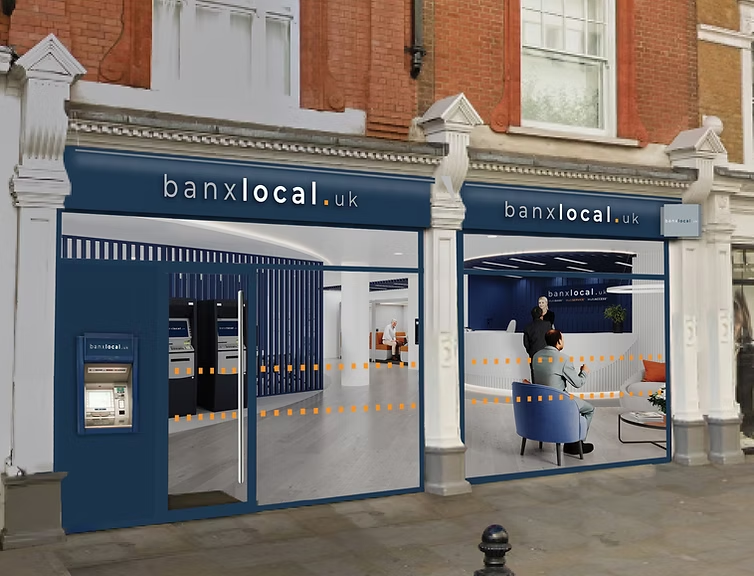
I’ve recently joined the advisory board of a startup focused upon opening financial branches called banxlocal. Why the hell would anyone open branches? Well, it’s all about human needs for human services as that creates trust.
I’m a big believer in banking and finance for consumers still providing High Street access in a store or branch. Why? Well, it’s nothing to do with transacting. It is all about trust.
Kevin Smith, the founder of banxlocal – the startup I’ve joined – articulates it well. Here is his story:
Why branches matter
There are now more than 23 million people in the UK who are struggling to access, or are effectively excluded from, the financial system due to the closure of thousands of branches over the past decade. That figure alone suggests something isn’t working as intended. It raises questions about the decisions that were made and the trade-offs that were quietly accepted over time.
Yet much of the debate around bank branch closures still frames the issue as one of changing consumer preference. Customers have “moved online”. Footfall has declined. Branches are no longer used in the way they once were. Everyone is now digital, online and using mobile apps. The conclusion, therefore, is that physical banking is no longer needed.
The problem is that this conclusion is largely built on what is easiest to measure – branch visits - but not on what actually matters – trust and relationships.
What we chose to measure and what we chose to remove
I’ve worked in retail banking and financial services for just under 30 years. I started at 16, on the front desk of a Nationwide Building Society branch in Farnham, Surrey, and spent the next decade working through branches across the South East, finishing as a regulated financial consultant.
Later, I moved into senior management and senior sales roles but quickly realised that progressing further meant playing a particular corporate game. What some saw as sideways career moves were, for me, a conscious decision to stay closer to customers and day-to-day reality.
In 2006, I left the corporate world to open a building society branch agency and work as an independent financial adviser. It gave me a front-row seat to the relationship between banks and customers just as that relationship began to fracture. After all, this was the moment that the monster of online banking started to take over.
From 2008 onwards, branch “rationalisation” accelerated. Two forces collided: the financial crisis and the rapid migration of everyday banking to digital channels. But to understand how we arrived where we are today, you have to go back further, to the late 1980s and the demutualisation of building societies.
The Building Society Act of 1986 triggered a wave of demutualisation’s and consolidation. Abbey National (1989), Halifax (1997), Northern Rock (1997), Alliance & Leicester (1997), and Bradford & Bingley (2000), all converted to banks from mutuals, to name just a few. A critical point here is that all of those firms have now disappeared through M&A or liquidation.
Branch networks overlapped. Shareholder pressure increased. Cost efficiency moved up the agenda. In the early 1990s, there were more than 21,000 bank and building society branches serving a population of around 57 million.
Then came internet banking in the late 1990s, the iPhone in 2007, and a steady shift of transactions away from physical locations. The critical moment, however, came much later.
The blind spot in the data
It wasn’t until 2015 that the FCA (Financial Conduct Authority) introduced the Access to Banking Protocol. Even then, the data used to assess branch closures was narrowly defined. Transaction volumes, deposits and withdrawals were the key measures. Later, some consideration of vulnerable customers.
What was missing were the harder-to-measure elements of branch value. Customer numbers; account openings; retail deposit growth; loan and mortgage applications; advice, reassurance and above all: TRUST.
In effect, branches were judged almost entirely on transactional decline, even as their role shifted towards more complex, emotional and higher-value interactions. This is why the same message continues to be repeated whenever a branch closes:
“We have monitored customer usage and seen a continued decline.”
Technically correct, perhaps. But materially incomplete.
I’ve stood in branches with queues out of the door while being told those branches were underused. Transactionally, usage may have declined. In human terms, it hadn’t.
The system removed what it could see declining, while overlooking what it had stopped measuring.
Digital efficiency and human trust are not opposites
Over the past decade, digital banking has become exceptionally good at handling transactions. Faster payments; self-service; automation; convenience.
But convenience is not the same as confidence.
As financial products have become more fragmented, customers now hold accounts, savings, pensions, insurance and credit across multiple providers. Brand loyalty has weakened. Complexity has increased. At the same time, financial literacy remains low, particularly among younger adults and digital exclusion continues to widen.
Trust, reassurance and judgement haven’t disappeared. They’ve become harder to deliver at scale.
This is not a rejection of digital channels. It’s an acknowledgement that efficiency alone does not meet all needs, particularly in moments that involve risk, emotion or long-term consequence.
Which brings us to a common objection.
“You can’t make money on the high street”
This argument is often treated as self-evident. Physical presence equals cost. Digital equals margin. But that logic only holds if physical space is poorly designed.
Waterstones is a good counter-example. Not because it is nostalgic, but because it is commercial.
In its latest results, Waterstones reported revenue up 7% to £565.6 million, with operating profit rising to £49.7 million. The business now operates 316 stores, with net new openings rather than closures.
It hasn’t achieved this by chasing speed or convenience. It has gone the other way. Fewer titles. Physical spaces designed for browsing and discovery. Knowledgeable people talking to customers. Above all, Waterstones has designed a comfortable consumer space. That is their USP.
That approach does more than generate goodwill. When customers trust the judgement behind what is being offered, they are willing to pay for it and to return. Waterstones uses digital channels effectively. But growth is anchored in places where trust is easier to form and easier to see. This isn’t about rejecting technology. It’s about an intelligent business model design.
What this means for banking
Neither traditional banks nor digital-only players have solved this problem.
Incumbent banks only sell and service their own products. Digital challengers cannot provide the reassurance that comes from physical presence when customers face complexity or uncertainty.
The result is a growing gap between efficiency and confidence; between scale and personalisation; between ROE and customer need; between cost and trust.
The wider impact is now visible. Banking deserts are increasing. High streets lose footfall. Local businesses suffer secondary effects. Exclusion compounds.
The question is no longer whether digital banking works. It clearly does. The question is whether we have allowed what is easy to measure to override what is essential to sustain trust in the system.
When over a third of the population struggles to access financial services, the issue is no longer consumer preference. It is system design. When the design determines that human interactions do not matter – it can all be done far more efficiently and cheaply through digital self-service – a trick is missed. The trick? Human needs for human access.
The pendulum swings back
In periods of rapid change, pendulums tend to swing too far before settling. Banking began as physical. It has swung hard towards digital. The next phase is not reversal but rebalancing.
Digital efficiency and human interaction are not competing ideas. They are complementary capabilities. The opportunity now is to design models that recognise both. Not because we want to return to the past but because the future demands it.

Chris M Skinner
Chris Skinner is best known as an independent commentator on the financial markets through his blog, TheFinanser.com, as author of the bestselling book Digital Bank, and Chair of the European networking forum the Financial Services Club. He has been voted one of the most influential people in banking by The Financial Brand (as well as one of the best blogs), a FinTech Titan (Next Bank), one of the Fintech Leaders you need to follow (City AM, Deluxe and Jax Finance), as well as one of the Top 40 most influential people in financial technology by the Wall Street Journal's Financial News. To learn more click here...