One of the biggest themes that recurs over and over again is the wealth divide in societies. I’ve talked about this often, and we all should have heard of the 1% by now or the fact that six men have more wealth than half the population of the planet combined.
It is an important subject, as it really illustrates that old statement about money makes the world go around. Money is power. Wealth creates more wealth. Meanwhile, for the masses, it is unsustainable.
Think of the French Revolution of the 1700s and the overthrow of the monarchy; the Russian Revolution of 1917 and the overthrow of the Tsar; the Chinese Communist Revolution of 1945 and the ambition to have equality for all; or the Arab Spring of 2011 where leaders in Tunisia, Egypt, Libya, Yemen, Syria and Bahrain were challenged with uprisings due to their autocratic rule . There are many other examples you could cite throughout history:
- The Social War (Roman Republic, 91–88 BC)
- The Jacquerie (France, 1358)
- The English Peasants' Revolt (1381)
- The German Peasants' War (1524–1525)
Throughout history, it is clear that massive inequality creates instability and that is, in some part, what we see in Iran right now. There has always been tension within Iran. I have friends there, and remember a specific comment one of them made to me that went something like this: “we all want a better life and object to that fact that our country is ruled by one man”.
The man he references is Ayatollah Ali Khamenei, who has held the position of Supreme Leader of Iran for more than 35 years since Ayatollah Khomeini's death in 1989.
Anyways, I don’t want to get into too much political conversation. Instead, let’s look at the movies.
So many movies and books are based upon the challenge of wealth divide and societal inequality. My early favourite is Fritz Lang’s Metropolis from 1927.
It tells the story a futuristic city where the wealthy live a utopian life above ground whilst the working classes are all underground, doing their best to provide the infrastructure for those above, but suffering severe poverty and health challenges in the process. You can guess the eventual outcome.
These themes are repeated in many other works:
- Charlie Chaplin’s Modern Times (1936)
- The Grapes of Wrath (1940)
- Brazil (1985)
- Gattaca (1997)
- Children of Men (2006)
- District 9 (2009)
- In Time (2011)
- The Hunger Games (2012)
- Snowpiercer (2013)
- Elysium (2013)
- Sorry to Bother You (2018)
- The Platform (2019)
- Parasite (2019)
In fact, this blog entry was triggered by watching a Russian movie Major Grom: Plague Doctor on Netflix, where a wealthy technologist is literally getting away with murder. Sound familiar?
The bottom-line is that wherever you have major social divide, it does not last. Something that those with power and wealth should always remember as, if half the population of the world has nothing whilst a few men have everything, there will always be a likelihood of revolution.
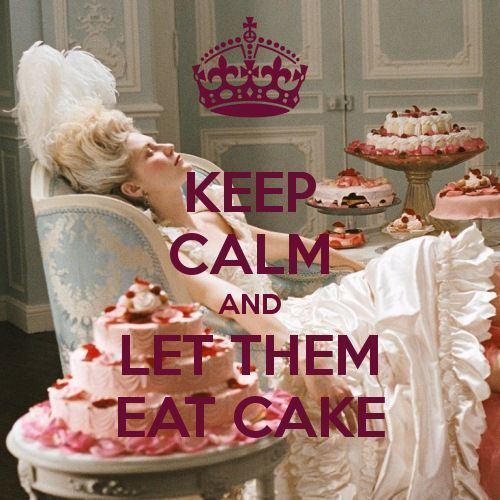
Just ask Marie Antoinette.
Postnote: The phrase "Let them eat cake" is widely attributed to Marie Antoinette, but historians overwhelmingly agree she never said it! It was propaganda used to portray her as out-of-touch, originating from Jean-Jacques Rousseau's writings about a different princess decades earlier, and only linked to Marie Antoinette much later to symbolize the monarchy's indifference to the starving poor during the French Revolution.
Chris M Skinner
Chris Skinner is best known as an independent commentator on the financial markets through his blog, TheFinanser.com, as author of the bestselling book Digital Bank, and Chair of the European networking forum the Financial Services Club. He has been voted one of the most influential people in banking by The Financial Brand (as well as one of the best blogs), a FinTech Titan (Next Bank), one of the Fintech Leaders you need to follow (City AM, Deluxe and Jax Finance), as well as one of the Top 40 most influential people in financial technology by the Wall Street Journal's Financial News. To learn more click here...