Five hundred years ago, merchants in England had silver coins to trade with but, as Byron Gilliam notes, the system was open to abuse.
There were several tricks to try.
One was “sweating” the coins: putting them in a bag and shaking them until friction caused silver dust to fall to the bottom of the bag — dust you could sell to a silversmith while still spending the coins at something close to face value.
Another was clipping them: cutting bits of silver off the edge of a coin while leaving the coin intact enough to pass inspection.
Others simply counterfeited them.
The most consequential trick, however, was played by the Crown itself: minting copper coins, “washing” them with a thin covering layer of silver, and then putting them into circulation at the value of pure silver.
These came to be known as “coppernose coins” because the silver would first rub off of the nose of the King’s portrait, revealing the base metal underneath.
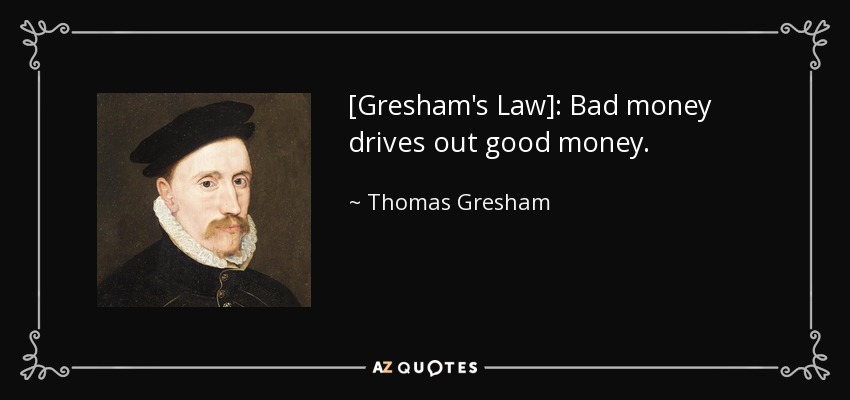
This created a thing known as Gresham’s Law, which is that bad money drives out good. What is that law?
Gresham’s Law is when two forms of money with different values are circulated as having the same face value. The result is that the currency with the lower metallic content (bad money) stays in circulation, while the higher-value, pure metal currency (good money) is hoarded or exported.
Sounds a bit like bitcoin?
Byron’s contention is that there is an awful lot of bad money around today from stablecoins to even the US dollar, and cites a legal scholar, Dan Awrey, who defines “good” money as money that’s guaranteed to be accepted at face value.
Dan Awrey’s written a book about it called Beyond Banks.
, but what inspired me is to think about what good and bad money is. If bad money is fake and good is trusted, why would anyone trade fake money?
Well, you can google a lot of the background on this, but the gist is that people trade with whatever is accepted. We trade with paper notes that have no intrinsic value; we use plastic cards that are meaningless, except for the trust in the backing of those cards by a bank and card company; we invest in digital coins that have zero backing, except for their digital representation. You get the idea.
In fact, as I was thinking about Gresham’s Law – bad money drives out good – I was reminded of Thier’s Law – good money drives out bad.
The two ideas are that, if we are generally trading and bargaining, Gresham’s Law applies. We don’t care if the money has been clipped, sweated or coated, as long as it is accepted for the transaction itself. That’s pretty much the state we live in with cards, cryptocurrencies, wallets and more.
But, if times are tough, we move to Thier's Law. We want to see what’s behind the currency. We want to see the asset. Thier's Law is usually what we see during hyperinflation or severe economic collapse, when trust in the state currency or digital token is broken.
For me, this is why most states today are investing in gold. The gold price has been pretty turbulent over the last year, but I see many governments building their gold reserves as this is a real asset rather than a notional one.
China Chases Gold Supremacy As It Builds A U.S. Dollar Alternative
Poland to increase gold reserve to world’s 10th largest
Sky News gains rare access to Bank of England's gold vaults
The thing is that gold has finite resources and is valued as such, but then bitcoin has finite resources (only 21 million coins) and could be viewed as digital gold for that reason?
It’s a fascinating debate and the old laws of money still apply … or do they?
You can read Byron’s full article here: https://mail.blockworks.com/p/gresham-s-new-law

Chris M Skinner
Chris Skinner is best known as an independent commentator on the financial markets through his blog, TheFinanser.com, as author of the bestselling book Digital Bank, and Chair of the European networking forum the Financial Services Club. He has been voted one of the most influential people in banking by The Financial Brand (as well as one of the best blogs), a FinTech Titan (Next Bank), one of the Fintech Leaders you need to follow (City AM, Deluxe and Jax Finance), as well as one of the Top 40 most influential people in financial technology by the Wall Street Journal's Financial News. To learn more click here...