I hesitate to write this, as my Polish friends have been asking me to keep it secret – that is the Polish way, humble but hopeful – but, as a Brit who moved to Poland in 2018, I can see it: Poland is the leading country of Europe today.
It is the country that supported Ukraine, stands in the centre of the battle between Europe and Russia, and is the most progressive economy in Europe of all. Between 1990 and 2026, Poland’s economy grew by a factor of seventeen from $66 billion in 1990 to $1.1 trillion in 2026. In 1990, Poland’s economy was smaller than Ukraine’s. Today, it’s larger than the economies of 14 Eastern European countries combined.
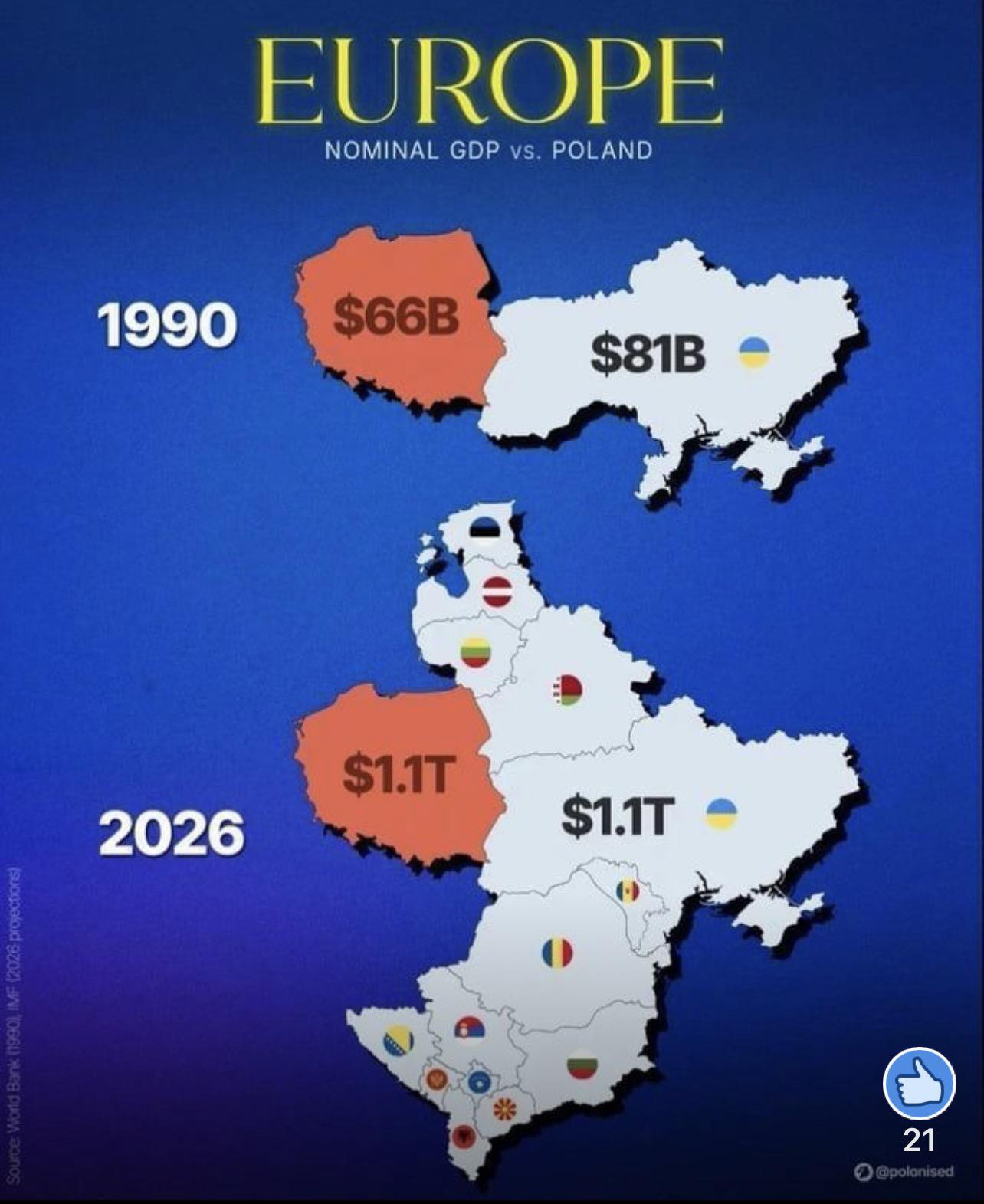
On a per-capita basis, Poland is now roughly as wealthy as Japan . This is an amazing story of transformation that has made Poland the #1 growth story of Europe.
But what made Poland so successful?
Germany.
Who would have thought that Germany would be central to Poland’s economic success after what happened in 1939, but it has.
By way of example, I remember that Commerzbank was a major strategic investor in Poland's banking sector since the early 1990s, establishing a long-term partnership with BRE Bank (now known as mBank) and holding a majority stake for decades. Commerzbank provided its Polish unit with stable funding, regarding it as a key operation in Central and Eastern Europe.
More than this, Germany became an anchor customer, investor and supply-chain engine to Poland across many areas, which resulted in Poland becoming a core partner in much of German industry over the past 35 years.
German firms invested, outsourced, built factories, bought Polish components and integrated Polish workers, engineers and suppliers into Europe’s manufacturing machine. That helped Poland move from cheap labour to serious industrial capability: cars, machinery, furniture, electronics, logistics, business services.
The numbers show the depth of the link. Germany is Poland’s biggest export market, taking 27.2% of Polish exports in 2024. In early 2024, conversely, Poland even overtook China as a market for German exports but Germany was only one part of the story. Poland’s success is also clearly due to EU membership.
In the last round of infrastructure funds the EU allocated €135 billion to Poland to encourage entrepreneurship, education, stable institutions and the domestic market. That makes a major difference.
This funding is due to the fact that, since joining the EU in 2004, Poland has been one of Europe’s standout growth stories, with per-capita income rising sharply toward the EU average. Some people call this the “Polish miracle”, and it is the result of deep structural reforms and strategic integration into Western markets.
Since 1989, Poland has maintained the longest period of uninterrupted economic expansion in European history, reaching a trillion-dollar GDP in 2025.
There is even more to this underneath the surface.
For example, in the early 1990s, the Balcerowicz Plan rapidly transitioned Poland from a centrally planned system to a free-market economy. It was seen as shock therapy, and involved abandoning price controls, scaling back state power, and encouraging a private business sector that became the primary engine of growth. Specifically, Poland's government in the early stages of opening markets invested heavily in financial markets infrastructure from the Warsaw Stock Exchange to the payments markets with Krajowa Izba Rozliczeniowa (KIR) faster payments.
Bear in mind that, until 1990, Poland was a Soviet state system and everything was run by government. Yes, this was a shock, but the shock worked.
Then there was the support of the European Union. Since joining the EU in 2004, Poland has been the largest recipient of EU structural and cohesion funds. These billions have modernised infrastructure, such as roads and railways, and integrated Poland into the European Single Market.
Add to this that the Polish are not stupid. In fact, they are a highly skilled workforce. Poland's universal education system produces a large pool of skilled professionals, with 31% of 25–34 year-olds holding a master's degree which is nearly double the OECD average. High PISA scores consistently rank Polish students among the best in Europe. The result of this is that Poland has become a strong nearshore hub for Western companies like HSBC and Samsung.
Then there is the law of supply and demand. Poland has a large internal market of 38 million people – more than 40 million today, after the influx of Ukrainian immigrants after the Russian aggression of 2022 – and this provides a cushion against global downturns. Strong domestic demand and rising real wages have kept the economy growing even when major partners like Germany faced stagnation.
The result of all of these factors – investment, integration with Europe, standing on the borders of Russia and being a key to NATO, strong growth and a highly ambitious economy and peoples – have made Poland a great place to focus upon.
That’s why I live there!
Chris M Skinner
Chris Skinner is best known as an independent commentator on the financial markets through his blog, TheFinanser.com, as author of the bestselling book Digital Bank, and Chair of the European networking forum the Financial Services Club. He has been voted one of the most influential people in banking by The Financial Brand (as well as one of the best blogs), a FinTech Titan (Next Bank), one of the Fintech Leaders you need to follow (City AM, Deluxe and Jax Finance), as well as one of the Top 40 most influential people in financial technology by the Wall Street Journal's Financial News. To learn more click here...