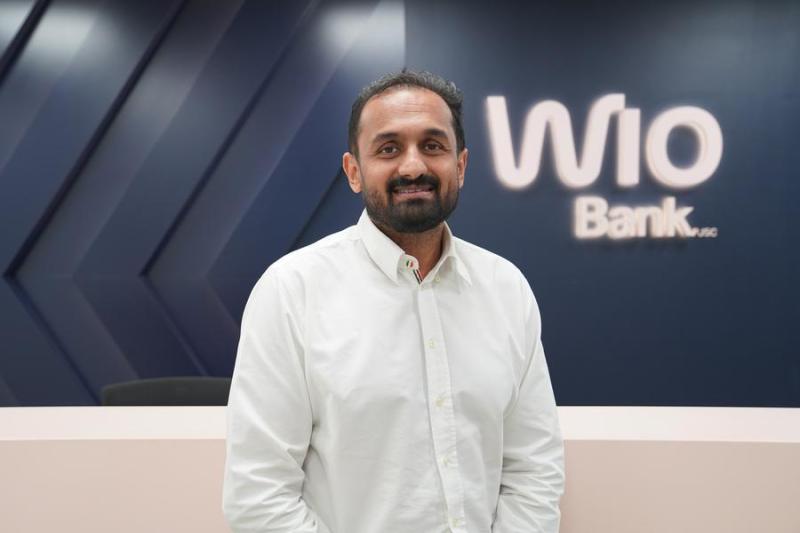
Jayesh Patel: It started just over five years ago now, when our shareholders and the government recognized that a new economy powered by digital was emerging. This would require a lot of new capabilities, including infrastructure. This led them to believe that we needed a digital bank that enabled this new economy and supports the new types of businesses and individuals who would be part of it.
As part of that vision, the shareholders decided to explore how a new bank can support this ambition.
The objective of the new bank wasn't to just build existing banking products, but to rethink everything – from the technology to the product and proposition.
So Wio Bank launched about three and a half years ago in 2022, just after Covid, with a focus on SME banking. This is often the hardest area to crack, but we felt it was a customer segment that probably needed the most amount of service.
We launched with that focus and now have the largest number of SMEs banking with us in the UAE. Around two out of five new small companies choose us, and over 70% of the customers join us through referral.
Then we expanded into retail banking, which has been incredibly successful for us. We now have over 350,000 customers across all segments – and this continues to grow.
Chris: what about yourself? I see that you have worked in Qatar and various other countries. How did you end up with Wio bank?
Jayesh: It's a great story. I had an engineering undergrad and a master's, and then I realized the business side is where a lot of the decisions get made, so I decided to complement my engineering background with an MBA.
I did a little bit of consulting for about four years in the US, but my focus was always on innovation and changing industries. I then got an opportunity in 2008 to move to the UAE to work on a startup in fintech – at a time when the word fintech wasn't even widely used.
It involved an incredibly exciting group of folks from all over the world, so I joined this fintech. But then the financial crisis hit.
We learned a few great lessons from it – especially what not to do when building a new business.
Following that, I spent some time in Qatar before getting an opportunity to join Emirates NBD about 14 or 15 years ago. There was a unit they had formed that looked at new businesses and opportunities, so I joined them. I ended up in retail strategy by accident and later helped launch a digital bank for them.
When the position at Wio came up, the shareholders asked if I would be interested, and it felt like a fantastic opportunity that I couldn’t turn down.
Chris: What's interesting as you talk through your background is that I've dealt with Emirates NBD, Mashreq and other banks in the region, and there is a pretty competitive market across the region. So, when you're positioning and talking about Wio, how does it match up against those older banks?
Jayesh: I get this question a lot with people asking whether our technology is better. I fundamentally believe that when new digital platforms succeed, it's more the principles that are different. It’s not that the technology is better looking or “sexier”.
At Wio, we are in the business of serving customers and we happen to do banking. Whereas traditional banks are in the business of banking and they happen to serve customers. Our capabilities, processes, and organisation are built to make sure the customer succeeds, and we believe that if our customers succeed, we will succeed too. Everything we build and do – from our design experience to the products we build, and even the products we choose not to build – is based on that.
Consultants have always used the term “customer-centric”, but we try very hard to make sure the customer's best interest is at heart. This means that, if you look at our products, they are simpler. Our experience is super transparent. We bring the power back – power that has been taken away from customers, we bring it back. We give you simple, clear knowledge, so that you can make the right financial decisions for yourself.
So, our responsibility is to give you the insights – and it's your choice how you act on them. We work very hard to bring these capabilities to our customers. For example, we launched a wealth platform alongside our retail banking platform to help our customers build for a better tomorrow. You don't just live today; you need to prepare for the future, and we want to help make that process simpler.
The aim is to help you save up enough so that your tomorrow doesn't become tougher, and the seamless way information is presented on the platform helps you make decisions confidently. We remove a lot of the jargon – and I think that is what customers really want.
Customers are smarter than they've ever been. They can get information instantly through AI platforms like ChatGPT and others, sometimes better than we bankers can give, which makes it our responsibility to give them easily digestible information and good choices. What they decide is up to them, but we spend a lot of time making sure the inputs are right.
So, what is the difference?
It comes down to the principles that guide how new digital banks and some businesses operate. We may not offer the same depth of products as traditional banks, but for the products we do offer, we want to make sure we do them exceptionally well. That's the learning from the best digital platforms across industries.
Chris: What's the vision of where the bank is going? Will you upscale or will you stay in your niche?
Jayesh: We decided, at least on the business segment, that smaller businesses struggle to get a bank account. Our approach is that we don't want to just open bank accounts – we want to provide an operating system for businesses to run. Entrepreneurs start a business because they have a vision and passion for a particular area – not to learn banking or buy accounting software. What we do is build operating systems with modules made by us, and where others offer better modules, we incorporate them. We make life easier for entrepreneurs, help them make better financial decisions, run their business, and be more successful.
We started with sole proprietors and single-owner companies. Then we added multi-partner companies, and now more complex business structures. We will progressively move up the curve over time.
I do think that, at the right time and with the right maturity of our platform, we will serve large corporates. But before we go there, we need to make sure we are serving our existing customers well. There's opportunity here, and there's still work for us to do to serve them better – and that's our focus.
A simple example: we have a great generic platform that works for every customer. What we want to do now is seamlessly build and orchestrate deeper, industry-specific capabilities so customers can focus on growing their businesses – that's where we’re concentrating. This year, we’ve chosen four or five industries and, eventually, we will move up to corporates.
Chris: I was looking at some of your reviews, and a lot of small businesses are saying that there's been issues with KYC. Is this because the regulatory regime in UAE has changed, or what's going on?
Jayesh: We are in a country where over 80% of people come from different nationalities, and we have quite a few licensing zones. This means that we hold a responsibility to the country and the economy, as well as to our regulators and shareholders, to make sure we bring in the right customers. Depending on the risk rating, we ask more questions and try to understand the nature of the entity and the kind of business you plan to run.
We often get cases where the nature of the business isn’t clear to us, so we need to take appropriate action. We understand this can sometimes frustrate customers, but understanding what a business does is a basic requirement of banking. When we’re not certain about what we’re seeing, it's hard for us to open up an account for you.
We are integrated into multiple digital data sources, and the UAE has a fantastic digital ecosystem. We can access identity information, company details and background information, and we integrate all this into models to assess: “Are these the right customers to serve?”
Maybe we could do better – and we constantly try to improve – but we are in a regulated industry, and we have a responsibility to ensure the nature of businesses that join us are genuine.
Chris: if I look at Europe with Monzo and N26 and other challenger banks, they've had the same issues, which is onboarding customers, converting them to full bank services, and then the regulator steps in and says, No, you need to do more background checks. Have you had the same experience?
Jayesh: We have a very supportive regulator, and we engage with them continuously. They give us ideas for enhancement, and the environment is evolving at the fastest pace it ever has. Every day I wake up, there's something new. So we work closely with the regulator to enable new capabilities.
We’re also in a market with a large number of trading enterprises. As a trading hub, it's important to understand the different aspects of the businesses operating within it. Getting that information isn't always easy. Where we can get it, account opening is fairly simple – and we open many accounts within 24 hours. But where we don't have sufficient information, we go back and request more.
I’m a big believer in regulated industries. Maybe I'm one of the few people who feel this way, but I believe regulation protects the customer and the economy – and it is absolutely essential.
You look at social media, for example, where platforms can operate with very few boundaries, which is sometimes bizarre. This is why I value regulated industries. As regulations and requirements evolve, we adapt. We learn a lot from the regulator and from our peers.
We have a very strong regulatory environment here in the UAE and a supportive, collegial banking environment. It's a good place to be.
Chris: I think it's funny in that as we talk about how things are changing, I always go back to my favourite quote from Vladimir Lenin, the leader of the revolution in Russia a century ago, who said that there are decades where nothing happens and weeks where decades happen. And I just feel right now, technologically, that that's where we're at with AI, quantum computing and all the stuff that's going on. What? What's your view?
Jayesh: Technology is changing at a pace like never before. We look at the shelf life of our software and what we release. A few years ago, you'd buy a system, keep it for eight to ten years, amortising it over seven. If you tell me today that a system will still be effective in seven years, I would be very surprised.
Systems and operating models are changing. Everyone is moving from capital investment to more operational, consumption-based models, which allow you to switch out different capabilities more easily. There is a general change in how companies are built and run, and this shift allows technology to move faster and gives customers more choice.
I also think, with AI capabilities maturing, some of the things we used to do through traditional coding are no longer as effective. We have a group of young students from top colleges around the world. We give them tough problems which they solve in a few weeks – and their solutions are decent. Five years ago, that same problem would have taken my amazing software engineers at least six months, with five engineers working on it, and it would only work in around 60% of the cases.
Things are moving quickly and it's going to change the nature of the industry. I'm one of those optimistic people who believe AI is going to help us serve customers better. For years we've talked about “the segment of one” – “How can I serve my customer better?” But it's just not been possible. That's the reality of it. Everyone has similar banking needs, but also specific situations. We've been very good at the former, but AI helps us address the latter more effectively.
We’re very excited by AI, but also a little worried because the pace is so fast – we have to keep up every day. The result is that it will change existing organisations and lead to the emergence of new ones that are built differently. Their propositions will be so strong for the customer that it becomes hard to compete. It's both an opportunity and a threat.
Chris: I just did a webinar yesterday around the third revolution in FinTech, and saying that the first was the back office with the mainframe automation of mundane processes, and the second was the digital revolution through cloud and smartphone to build a new customer experience connection. And now we're in this intelligence revolution, which I think is a fundamental change to the whole industry. It's not just an add-on or a new development. It's revolutionary.
Jayesh: I fully agree with you. I think, Chris, most people haven't understood exactly what you just said and the impact of it. It's not just one more thing you do. It really is going to redefine how you operate. Many companies haven't realised this.
Chris: Regarding your plans for the future, looking to expand into Saudi Arabia and Qatar and other countries?
Jayesh: We'd love to expand regionally and globally. One of the advantages of a digital platform is that you can scale, and many of the newer banks like Revolut have shown this.
But right now, we see so much opportunity in the UAE. We're serving individuals, doing wealth, SME banking, and we want to go deeper into payments. There’s a lot of opportunity to broaden here, and as opportunities arise, we will look at expansion.
Banking is more complicated when you cross borders, and we still have a lot to gain in our home market. We're a small team - we've grown, but we’re still small – and we remain super focused before expanding.
Chris: It’s funny because I didn't see that much innovation in other GCC countries compared to the UAE, but now everywhere is catching up. Saudi Arabia is a particular hotbed of innovation. So, there is a kind of race for the chase across the region.
Jayesh: If you look at us relative to banks in the region and globally, we achieved profitability in our first year of operations. We have over 350,000 customers. Our strategy is incredibly focused, we serve customers with $10,000 and above in value, and we want to help them build longer-term wealth.
My team jokes about longevity and, right now, that’s what we’re building for financial services. We want to build financial health for our customers. We've launched family banking, which we are incredibly proud of, and this allows you to bring your spouse and kids onto one platform to manage spending together. It's one app, and you assign rights for what each person can see, just like you would on social media.
We want to help customers achieve more of their financial and life goals and support them with the financial needs that come with that. We're very excited about our products and building them out.
We are also the biggest digital bank in the region in terms of revenue and profitability. Our NPS is around 76. We serve customers well, but we’re not complacent – we know there’s room to improve. There are customers we let down at times, and we’re focused on solving that.
As we scale, one of our biggest priorities is making sure we don't let our customers down – and this is where we are seeing AI do some really interesting things for us.
This is one of the differences between traditional platforms and digital platforms: the obsession with serving the customer and the customer experience remains constant, regardless of stage of growth. I speak to founders of some of the biggest digital platforms and I see it from them. The obsession remains – “How can I do the best for my customer?” It's difficult to stay on that path, but it's absolutely necessary.
Chris: Final question. In 2036, what do you think things will look like?
Jayesh: First, I think about the topic of AI. I believe the fundamental banking experience will change. I see a more interactive, customised experience where the app disappears and instead, I talk to my AI – whichever one that is.
People will have their own AI: It knows me, my behaviours, what's important. It shows me content in a manner I understand and that is relevant to me. It won’t just help me understand decisions; it will also be able to take action on my behalf.
That’s what I see as the future proposition.
Sometimes we can't serve the smallest niches because we don't have enough data. I think this problem will get addressed, and we’ll be able to go smaller and smaller, whether it's credit or other areas where much more customisation becomes possible. That significantly expands our ability to serve customers.
For Wio, hopefully we’ll be operating in multiple countries and across multiple financial services verticals – with customers who say “I'm happy I'm with Wio because they helped me manage my money better”. That's what I see.
Chris: Oh, and why is the bank called Wio?
Jayesh: It was picked by an AI. Our bank’s name was generated five years ago by an algorithm, based on key criteria such as affinity, trust, simplicity and being digital. That’s what it's all about.
Chris M Skinner
Chris Skinner is best known as an independent commentator on the financial markets through his blog, TheFinanser.com, as author of the bestselling book Digital Bank, and Chair of the European networking forum the Financial Services Club. He has been voted one of the most influential people in banking by The Financial Brand (as well as one of the best blogs), a FinTech Titan (Next Bank), one of the Fintech Leaders you need to follow (City AM, Deluxe and Jax Finance), as well as one of the Top 40 most influential people in financial technology by the Wall Street Journal's Financial News. To learn more click here...