The funny thing about AI in banking is that the headlines are completely wrong.
Every week there’s another breathless prediction claiming that AI will “replace banks”, “eliminate core systems” or “create autonomous financial institutions”. Reading these articles, you would think that we are just months away from robo-banks running the global economy whilst human bankers quietly disappear.
We’re not.
What is happening is far more interesting because it is far less science fiction and more operational reality.
I spent some time looking at where the major AI platforms are genuinely gaining traction across banking and payments, and the picture that emerges is surprisingly clear.
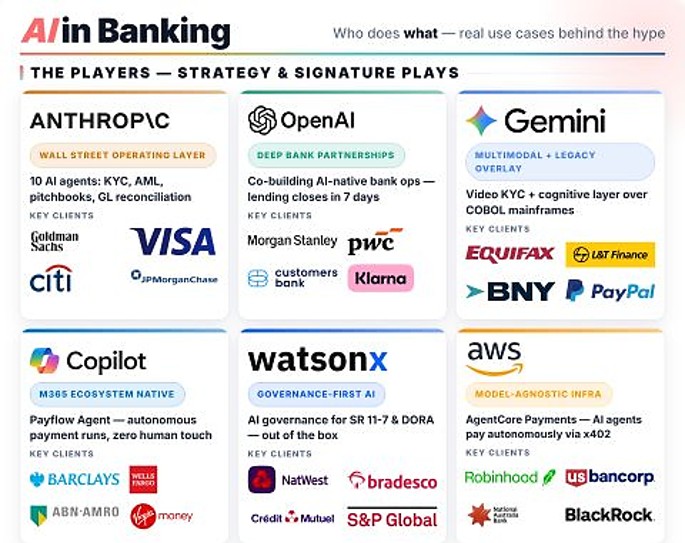
Anthropic is finding its sweet spot in the ugly but critically important plumbing of financial services in areas such as KYC, AML, reconciliations, financial crime investigations and operational workflows. In other words, all the areas bankers have spent billions over the years trying to improve.
OpenAI is steadily embedding itself into banking workflows through partnerships, enterprise deployments and advisory ecosystems. The most visible example is with Morgan Stanley, where AI-powered knowledge systems for financial advisers became one of the first large-scale proof points that generative AI could actually improve productivity inside a regulated financial institution without causing complete chaos. What matters here is not the chatbot. It is the retrieval, summarisation and operational support layer sitting underneath.
Then there is Google’s Gemini, which is positioning heavily around multimodal intelligence through video KYC, document analysis, legacy system overlays and internal operational copilots. Both BNY Mellon and Citigroup have publicly discussed Gemini-related AI initiatives, which tells you something important: the future battle is not just about text generation. It is about AI systems that can simultaneously process documents, images, video, voice and workflows across fragmented banking architectures built over the past forty years.
And then there is the quiet giant in the room: Microsoft.
Most banks already run on Microsoft infrastructure somewhere inside the organisation. That makes Microsoft Copilot incredibly powerful because it does not require banks to reinvent everything. It simply layers intelligence across existing workflows. Payment operations, internal productivity, reporting, workflow automation and operational support. Institutions including Barclays and Wells Fargo are leaning into this model because it fits the banking mindset perfectly: evolutionary rather than revolutionary.
At the other end of the spectrum sits IBM with watsonx, which feels less like Silicon Valley disruption and more like enterprise governance engineering. And honestly? That may turn out to be a huge advantage in banking.
Financial institutions do not just care whether AI works. They care whether regulators can audit it, explain it, govern it and hold someone accountable when it fails.
Meanwhile Amazon Web Services and Bedrock are becoming the infrastructure layer underneath much of this transition. Not the shiny front-end AI everyone talks about, but the orchestration environment where agentic workflows, scalable AI services and enterprise integration actually happen. In many ways, AWS resembles the electricity grid of enterprise AI: invisible to consumers but essential to everything running above it.
And that brings us to the most important observation of all which is that nobody is replacing core banking systems with AI. Every serious deployment today sits on top of existing infrastructure.
This means that the AI layer is acting as intelligence middleware wrapped around decades-old systems that still process deposits, payments, ledgers and settlement. The COBOL mainframe has not died. It has simply gained an AI assistant working beside it. That is because banks do not replace core systems lightly. Core banking is not a mobile app. It is the beating operational heart of regulated financial infrastructure. You do not casually unplug it because a chatbot demo looked impressive at a conference in Las Vegas.
What AI is actually doing is attacking the middle office: AML; KYC; reconciliation; document processing; exception handling; fraud investigations; operational workflows; and related administratively intensive areas. In other words, all the boring areas that consume enormous numbers of people, enormous amounts of money and enormous operational effort.
The real AI revolution in banking is not humanoid robot bankers serving coffee in branches. It is intelligent infrastructure quietly removing friction from the machinery of finance.
This blog entry was inspired by Vadym Ivanenko

Chris M Skinner
Chris Skinner is best known as an independent commentator on the financial markets through his blog, TheFinanser.com, as author of the bestselling book Digital Bank, and Chair of the European networking forum the Financial Services Club. He has been voted one of the most influential people in banking by The Financial Brand (as well as one of the best blogs), a FinTech Titan (Next Bank), one of the Fintech Leaders you need to follow (City AM, Deluxe and Jax Finance), as well as one of the Top 40 most influential people in financial technology by the Wall Street Journal's Financial News. To learn more click here...