
Every conference I attend these days seems obsessed with the same question: how many jobs will AI destroy?
It’s understandable. The headlines are dramatic and every week brings another announcement of a company replacing people with algorithms, yet I increasingly think we’re asking the wrong question as the bigger issue is not what happens when AI replaces a human task. The bigger issue is what happens when billions of autonomous agents begin making decisions, exchange information, influence opinions and conduct transactions on behalf of humans.
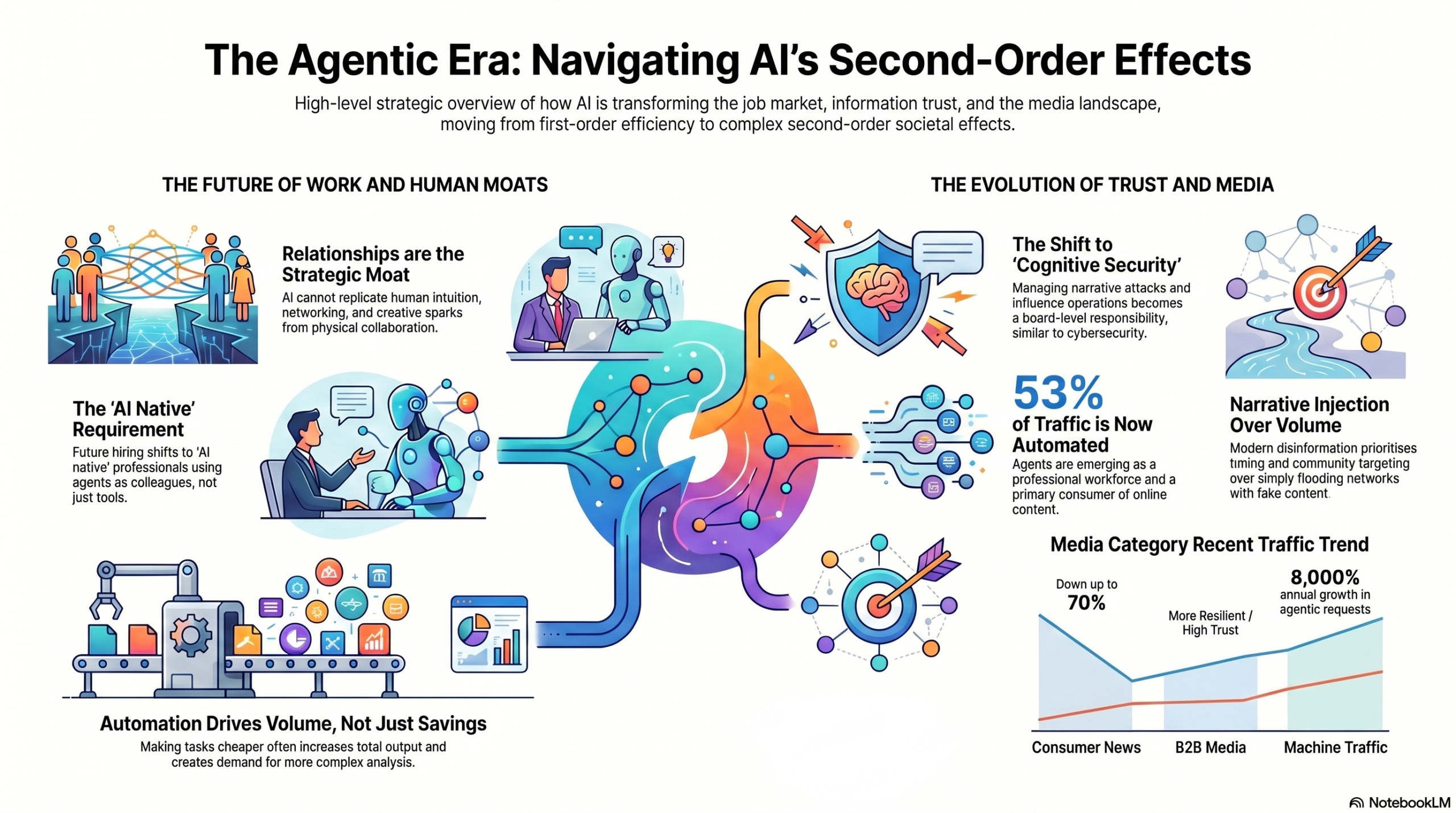
That is a fundamentally different challenge, and one that few organisations appear prepared for. So, when I received a summary of a call I had with a bunch of folks led by Richard Lander of Citywire, I was intrigued with what he then sent me, which is a paper titled Mapping the Second-Order Effects of the Agentic Era . It does an excellent job of highlighting why few organisations appear prepared.
For most of the past fifty years, technology has focused on digitising information. We moved paper records into databases, branches onto websites and processes into software. The result is what we have a digital economy today but, what we are now building, is something quite different. What is that? An economy with inbuilt intelligence.
The implications are profound.
The most interesting observation in the paper is that the immediate threat may not be mass unemployment at all. In fact, history suggests that automation generally creates more jobs than it destroys. What worries me more is the disappearance of the apprenticeship layer of the economy.
For generations, professions have depended upon a pipeline of junior employees learning their craft through repetition. Young lawyers drafting documents or entry-level analysts building spreadsheets. The point was learning through experience and yet, today, those are precisely the tasks that AI performs best.
If AI writes the first draft, performs the analysis and generates the report, where does the next generation gain experience? How do you produce experts if the route to expertise disappears?
This may become one of the defining economic and social challenges of the next decade. The issue is not replacing the senior professional but creating the future senior professional.
The same pattern appears when we think about security.
For years we have treated cybersecurity as a technical problem. We built firewalls, intrusion detection systems and identity controls. We invested billions protecting networks and data. Yet the next wave of attacks may not target systems at all but will target humans and our beliefs.
One of the most compelling sections of the paper argues that we are moving from information warfare to cognitive warfare. The objective is no longer simply spreading misinformation but to influence how decisions are made.
Imagine a future where autonomous agents continuously monitor financial markets, social media conversations and political developments. They identify moments of uncertainty, generate highly tailored narratives and distribute them through networks that appear entirely authentic.
The paper also raises an issue that should challenge some of the more enthusiastic narratives around tokenisation and decentralisation.
For years, fintech has celebrated the elimination of friction but perhaps friction sometimes performs a valuable function.
When you buy a house, the process is cumbersome, expensive and slow. Nobody enjoys it. Yet much of that complexity exists because multiple institutions are verifying that the transaction is legitimate. The lawyers, registries, banks and regulators all contribute to a trust framework that underpins ownership rights.
Tokenisation removes much of that friction which is undoubtedly valuable, but the real question is not how quickly an asset can move. The real question is who verifies that the asset exists, who guarantees ownership and who resolves disputes when something goes wrong. Technology can accelerate transactions, but it does not automatically solve governance.
This distinction matters because we are simultaneously witnessing another dramatic shift: the collapse of the traditional web economy.
For decades the internet operated on a simple model where search engines directed users to websites and websites monetised traffic. Publishers produced content and everyone understood the rules.
AI is breaking that model.
Increasingly, people no longer click through to websites. They simply receive search and receive answers and soon they won’t even need to search. They will just think the question and the answer will appear in their glasses.
This means that the value migrates from the source of information to the system that synthesises it. The paper describes this as “fracking the bedrock of the internet”, a phrase I rather like because it captures what is really happening. AI is extracting value from information in much the same way energy companies extract value from the ground beneath us.
The consequences are enormous.
This brings us to what I believe is the most important conclusion of the entire paper which is that the future belongs to those who provide what machines cannot. The authors call this the “Human Premium”. I would describe it as the emergence of a new economic hierarchy where human value increasingly resides in emotional intelligence, intuition, creativity, relationships and trust-building. The routine work moves to machines. The uniquely human work becomes more important, not less.
This is why I remain optimistic about the future because every major technological revolution ultimately increases the value of what makes us human.
The challenge for banks, governments and businesses is not building better AI, but building institutions that remain trusted in a world where intelligence is abundant, content is synthetic and decisions are increasingly delegated to machines.
Here’s the report:

Chris M Skinner
Chris Skinner is best known as an independent commentator on the financial markets through his blog, TheFinanser.com, as author of the bestselling book Digital Bank, and Chair of the European networking forum the Financial Services Club. He has been voted one of the most influential people in banking by The Financial Brand (as well as one of the best blogs), a FinTech Titan (Next Bank), one of the Fintech Leaders you need to follow (City AM, Deluxe and Jax Finance), as well as one of the Top 40 most influential people in financial technology by the Wall Street Journal's Financial News. To learn more click here...