Crypto has turbo-charged the Ponzi scheme
There is something wonderfully predictable about a Ponzi scheme. It invariably begins with an extraordinary opportunity, usually involving a market, technology or investment strategy that is sufficiently complicated to discourage too many questions. It offers returns that make conventional investing look painfully dull, attracts a charismatic promoter who explains why the old rules no longer apply and, crucially, produces early investors who enthusiastically tell everyone else how much money they have made. For a while, everything works beautifully. Money arrives, returns are paid, confidence grows and more money arrives.
Until it doesn't.
That is why the headline Alleged cryptocurrency Ponzi scheme mastermind to appear in US court immediately caught my attention.
According to the US Department of Justice, Edward Zimbardi has been charged over an alleged $165 million cryptocurrency Ponzi scheme known as The Crypto Program.
Prosecutors allege that thousands of investors were attracted by promises of a guaranteed 25% monthly return from supposedly buying advertising packages, with investors transferring cryptocurrency into wallets that Zimbardi secretly controlled.
Twenty-five per cent a month is quite a number. If you invested $10,000 and genuinely compounded a return of 25% every month, you would have around $145,000 after a year. Continue for another year and you would have more than $2 million. Keep going and Warren Buffett would soon be asking you for investment advice.
That is the wonderful thing about compound interest and the terrifying thing about Ponzi promises: run the numbers for long enough and their absurdity becomes obvious.
Prosecutors allege that more than $165 million flowed into the scheme.
Rather than being invested in the way customers believed, more than $34 million was allegedly gambled on risky foreign-exchange trades, substantial amounts were lost, later investors' money was used to pay earlier investors and at least $10 million was spent on personal expenses including property, luxury vehicles and alimony.
Zimbardi has been charged, not convicted, and these allegations will now be tested through the American courts, but the alleged mechanics of the operation are fascinating because they are so familiar.
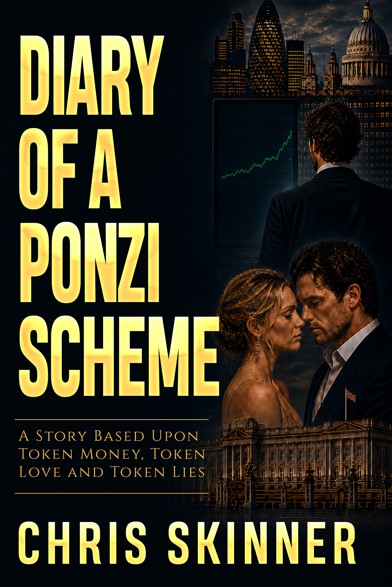
After all, I recently wrote a book called Diary of a Ponzi Scheme.
The book is fiction, but the mechanisms behind it are very real as evidenced by Zimbardi, and the question that interested me was never simply how criminals steal people's money. The much more interesting question is why intelligent, sensible and financially experienced people can be persuaded to believe things about money that, viewed from a distance, seem almost unbelievable.
The Ponzi machine
A Ponzi scheme is often described as a financial fraud, but I think that misses its most important characteristic. A Ponzi scheme is primarily a psychological machine with a very simple financial mechanism underneath it. New money arrives and some of that money is paid to earlier investors as supposed investment returns. Those investors now have something far more convincing than a brochure, website, influencer or sales pitch. They have money in their bank account. They have proof.
That proof changes everything because the investor becomes part of the sales operation.
Imagine that somebody approaches you promising a return of 20% a month and you sensibly tell them to go away. Then your friend invests $10,000 and receives $2,000. He invests another $20,000 and receives another payment. He shows you his account and tells you that he has already recovered a significant part of his original investment. Suddenly the proposition doesn't look quite as ridiculous because somebody you trust has actually been paid.
Your friend tells his brother, his brother tells somebody at work and somebody at work posts about it online. The fraudster gradually becomes less important to the sales process because the investors are doing the selling. Confidence creates investment, investment finances apparent returns, apparent returns create more confidence and that confidence attracts more investment. The scheme becomes increasingly convincing at precisely the same moment that its underlying financial position is becoming increasingly dangerous.
That is the genius of the Ponzi scheme. It doesn't simply exploit greed. It exploits trust, social proof, envy, friendship, aspiration and our deeply human fear that everybody else has discovered something wonderful that we have somehow missed.
Then crypto arrived
I can already hear the crypto enthusiasts complaining, so let me make something absolutely clear. I am not saying cryptocurrency is a Ponzi scheme. Bitcoin, Ethereum, stablecoins are not automatically Ponzi schemes and tokenisation is rapidly becoming part of the mainstream infrastructure of global finance. In fact, one of the most interesting developments of the past few years has been watching crypto move away from its anti-bank origins and gradually become integrated into banking, payments and capital markets.
The problem is different. Crypto provides an almost perfect environment in which Ponzi schemes can flourish because it combines technological complexity, enormous price movements, global money transfer, online communities and a widespread belief that conventional financial rules are being rewritten. That is an extraordinarily powerful mixture for anyone trying to persuade people that exceptional returns are plausible.
A successful Ponzi operator needs a story that sounds sophisticated enough that most investors cannot easily challenge it. Crypto provides plenty of those stories. The operator needs enormous potential returns to seem plausible, and anyone who has watched cryptocurrencies rise by hundreds or thousands of per cent has already seen extraordinary returns happen. The operator needs money to move quickly across borders, needs communities capable of turning customers into evangelists and needs investors to believe they are participating in something the traditional financial establishment does not yet understand.
Above all, the operator needs a narrative in which greed can be reframed as insight. You aren't chasing ridiculous returns because you are greedy. You are getting in early. You aren't ignoring centuries of financial experience because you are naive. You understand the future. The banks don't get it, governments cannot control it, Wall Street arrived too late and your neighbour has already made $50,000. Why shouldn't you?
That combination of greed, envy, technological confusion and fear of missing out is immensely powerful.
Every Ponzi scheme eventually becomes a bad bank
There is another reason these schemes fascinate me as someone who has spent most of his life writing about banking. Strip away all of the marketing, technology and theatre and every Ponzi scheme eventually encounters the oldest problem in banking: liquidity.
The scheme has liabilities to investors but insufficient genuine assets capable of meeting those liabilities. As long as new investment exceeds withdrawals, that mismatch can remain hidden. Investors receive their money, testimonials circulate, impressive returns appear on dashboards and more customers arrive. The operator appears increasingly successful and, ironically, the apparent success attracts exactly the new money required to maintain the illusion.
Then something changes. New investment slows, withdrawals increase, markets fall, somebody asks an awkward question or regulators begin investigating. The balance between money entering and money leaving reverses and suddenly the magnificent investment machine is revealed to have been held together almost entirely by confidence and incoming cash.
This is also why I find the repeated claim that regulation is simply an obstacle to financial innovation rather tiresome. There are reasons why banking developed capital requirements, liquidity rules, independent auditing, custody arrangements, disclosure requirements, segregation of client assets and regulatory supervision. Those structures did not appear because bankers and regulators enjoy bureaucracy. They developed because financial history consists partly of several thousand years of human beings discovering increasingly ingenious ways of losing, misusing or stealing other people's money.
Crypto does not repeal those lessons. If anything, it makes them more important.
The technology changes. The story doesn't.
According to prosecutors, when The Crypto Program collapsed in August 2023, Zimbardi fled to Fiji in July 2025 and remained there for more than a year before Fijian authorities deported him to the United States on August 14, 2026. He now faces twelve counts of wire fraud, twelve counts of money laundering and one count of money-laundering conspiracy. Again, these are allegations and it will be for the courts to determine what happened.
What interests me is how timeless the underlying story is. Charles Ponzi used international reply coupons. Bernie Madoff used a sophisticated options strategy. More recent schemes invoke cryptocurrencies, foreign-exchange trading, staking, yield farming, artificial intelligence, proprietary algorithms or whatever technological language makes the proposition sound sufficiently complicated that ordinary investors feel slightly embarrassed to admit that they don't really understand it.
That embarrassment is one of the fraudster's greatest weapons.
If I don't understand something but everyone around me appears to understand it, I begin to wonder whether the problem is me. If those same people then show me the money they have made, my scepticism becomes even harder to maintain. Complexity creates uncertainty, social proof suppresses doubt and financial success appears to provide the final evidence.
This is not actually a cryptocurrency problem. Only days before the Zimbardi court appearance, another Georgia Ponzi case reached its conclusion when Todd Burkhalter, founder of financial advisory business Drive Planning, was sentenced to twenty years in prison over a scheme that prosecutors said caused thousands of investors to lose nearly $400 million. That scheme was not fundamentally about crypto, which is precisely the point.
Crypto isn't the disease. Human behaviour is.
Every generation invents new financial technologies, and every generation produces people who discover how to exploit them. Railways created investment manias. Property created them. Investment trusts created them. Dotcom companies created them. Structured finance created them. Crypto created them. Artificial intelligence will almost certainly create them too, and I would be amazed if we do not eventually see spectacular frauds built around supposedly proprietary AI investment engines offering extraordinary returns generated by algorithms that nobody outside the company is allowed to examine.
The language changes while the proposition remains remarkably consistent: trust me, give me your money and don't worry too much about how it works.
The most dangerous word in finance
People often say that the four most dangerous words in finance are this time is different. There is plenty of truth in that, but when it comes to investing I think there is another word that should immediately make the hairs on the back of your neck stand up.
Guaranteed.
Real markets do not guarantee extraordinary returns. Businesses fail, currencies move, interest rates change, governments intervene, technologies break, cryptocurrency prices collapse and unexpected events happen. Investment returns exist because investors accept risk. If somebody removes the risk while simultaneously increasing the promised return to extraordinary levels, you should not be asking how quickly you can transfer your money. You should be asking why somebody who can generate guaranteed returns of 25% a month needs your money in the first place.
That is really why I wrote Diary of a Ponzi Scheme. I wanted to get inside the machine rather than describe it from the outside, to explore how a scheme begins, how people become convinced, how early success attracts more money and how the person running it gradually becomes trapped by the monster they have created. Ponzi schemes are fascinating because their collapse is mathematically inevitable, and yet while they are growing they can appear almost unstoppable.
More than a century after Charles Ponzi gave his name to the scam, we now have blockchain, artificial intelligence, instantaneous global payments, smartphones, digital identity and access to more financial information than any previous generation could have imagined. We can move millions around the world in seconds and analyse markets using computing power that would have been inconceivable when Ponzi was selling his scheme.
Yet someone can still allegedly promise investors a guaranteed 25% return every month and thousands of people will hand over their money.
That tells us something important. Financial technology changes constantly, but the forces that drive financial bubbles and frauds have barely changed at all. Greed, trust, envy, fear, aspiration and FOMO are as powerful in the age of blockchain as they were in the age of Charles Ponzi.
That is why there was another Ponzi scheme yesterday, why there is probably one operating somewhere today and why, whatever technologies we invent tomorrow, there will always be another one.
Technology changes. Money changes. Markets change. Human nature doesn't.
My novel Diary of a Ponzi Scheme explores exactly how one of these financial machines can be created, why people believe in it and what happens when the money finally stops flowing.
Diary of a Ponzi Scheme on Amazon

Chris M Skinner
Chris Skinner is best known as an independent commentator on the financial markets through his blog, TheFinanser.com, as author of the bestselling book Digital Bank, and Chair of the European networking forum the Financial Services Club. He has been voted one of the most influential people in banking by The Financial Brand (as well as one of the best blogs), a FinTech Titan (Next Bank), one of the Fintech Leaders you need to follow (City AM, Deluxe and Jax Finance), as well as one of the Top 40 most influential people in financial technology by the Wall Street Journal's Financial News. To learn more click here...