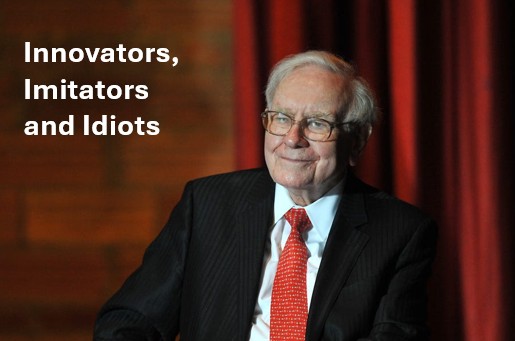
Warren Buffett observed years ago that every market eventually sorts itself into three groups: innovators, imitators and idiots. It is deliberately unfair but, like most good aphorisms, it contains more than a grain of truth.
The innovators invent something genuinely new. The imitators wait until the innovators have proved there is money to be made and then rush in with their own version. The idiots continue insisting that everything is fine while wondering why customers keep disappearing.
Reading two very different articles recently …
Five questions banks must ask to unlock tech value
How Revolut's new bets division thrives on 'pivoting, fighting and hustling'
… it struck me that they are really describing the same industry from opposite ends of the telescope. One asks why banks spend so much on technology without creating much value. The other explains why one of Europe's most successful fintechs keeps searching relentlessly for the next opportunity. Together they expose a truth that many incumbents still struggle to acknowledge.
The EY report asks a deceptively simple question: why does so much technology spending fail to generate meaningful returns?
It is hardly a new question, yet it becomes more relevant every year because bank technology budgets continue to rise at extraordinary rates.
Large institutions now spend billions annually on IT, but very little of that money actually reaches customers in ways they can see or appreciate.
The report highlights the uncomfortable reality that most expenditure is consumed by keeping ageing infrastructure operational, satisfying regulatory obligations and maintaining systems that should probably have been retired years ago. By the time those essential costs have been covered, only a relatively small proportion of the budget remains available to build anything genuinely new. In other words, many banks are investing enormous sums simply to stand still.
That is the trap that almost every mature industry eventually falls into.
Success creates complexity, complexity creates technical debt, and technical debt slowly consumes the organisation's ability to innovate. Every merger leaves duplicate systems. Every regulatory change adds another layer of code. Every product launch introduces another integration that nobody dares remove because nobody is quite certain what might break if they did.
Eventually technology stops being an engine of growth and becomes an exercise in preservation.
The institution convinces itself that spending billions demonstrates commitment to innovation, when in reality much of that investment is little more than the cost of keeping yesterday alive.
Contrast that with the culture described by David Tirado at Revolut.
What stands out is not the technology itself but the attitude towards opportunity.
Revolut appears comfortable placing multiple bets simultaneously, fully expecting that many of them will fail. Failure is not treated as evidence that innovation should slow down but as evidence that experimentation is working. Teams move quickly, products evolve continuously and ideas are judged by the value they might create rather than by how neatly they fit into an annual budgeting process. It is an organisation that behaves like a venture capitalist inside a regulated financial institution, constantly asking where the next source of growth might come from rather than how efficiently it can protect the last one.
That difference is far more significant than whether one company uses a better cloud provider or a more sophisticated AI model.
Technology has become remarkably accessible.
Almost every bank can buy access to hyperscale cloud infrastructure. Almost every bank can integrate the same large language models. The software itself is rapidly becoming commoditised. The scarce resource is no longer technology. It is imagination, combined with the organisational willingness to act upon it. What separates innovators from everyone else is not that they possess tools unavailable to their competitors. It is that they ask different questions.
Traditional banks often approach innovation as a capital allocation exercise. A proposal arrives, projected returns are calculated, risks are assessed, committees meet, governance frameworks are reviewed and eventually, if everything aligns neatly with the existing strategy, funding is approved. It is a perfectly rational process designed to minimise mistakes.
The problem is that genuinely innovative ideas rarely look rational when they first appear. They are uncertain by definition. Their markets may not yet exist, customer demand is difficult to forecast and financial models rely more upon assumptions than historical evidence. By optimising for certainty, many banks unintentionally optimise against innovation.
That is why Revolut appears to optimise for optionality.
Rather than assuming today's products will remain tomorrow's growth engines, it continually searches for adjacent opportunities. That explains why it has expanded from foreign exchange into current accounts, investing, crypto, insurance, business banking and now an increasingly diverse collection of financial services. None of those moves guaranteed success, but collectively they create an organisation that is constantly exploring rather than defending. The mindset is fundamentally different. One organisation assumes change is exceptional and must therefore be carefully controlled. The other assumes change is continuous and therefore builds itself around adaptation.
This is where the distinction between innovators and imitators becomes particularly interesting.
History suggests that banks rarely ignore innovation forever. Once a new model has proved commercially successful, they usually respond with impressive speed.
Open Banking is an obvious example.
For years it attracted limited enthusiasm outside a handful of pioneers. Then fintechs began demonstrating practical applications and suddenly every incumbent wanted an API strategy.
The same pattern repeated with mobile banking, embedded finance, Buy Now Pay Later and, more recently, generative artificial intelligence. Banks eventually embrace almost every significant innovation. The difficulty is that by the time they do, someone else has already defined the market.
Being an imitator is not necessarily a bad commercial strategy.
Plenty of successful businesses have been built by observing what works and executing it well.
Apple was not the first smartphone manufacturer. Google was not the first search engine. Facebook was not the first social network.
Execution matters enormously.
The problem for banks is that imitation is becoming increasingly difficult because technology cycles are compressing. By the time a large institution has completed its procurement, governance and implementation process, the innovators have often moved on to the next opportunity. Catching up becomes a permanent state rather than a temporary one.
That leaves the final category: the idiots.
The word is intentionally provocative because it has very little to do with intelligence.
Banks employ extraordinarily talented people. Their executives are experienced, highly educated and perfectly capable of understanding technological change. The problem is organisational behaviour rather than individual capability. Institutions become convinced that activity is equivalent to progress. They establish innovation labs, AI centres of excellence and digital transformation programmes, yet customers notice remarkably little difference.
Projects proliferate, presentations multiply and consultants remain permanently busy, but the underlying business changes surprisingly slowly. Technology becomes something the organisation talks about rather than something that fundamentally reshapes how it operates.
The irony is that artificial intelligence is likely to amplify this divide rather than eliminate it.
Every bank will have access to increasingly capable AI models. Every bank will be able to automate routine processes, improve customer service and generate software more efficiently. Those capabilities will become table stakes. The real competitive advantage will come from institutions prepared to redesign themselves around what AI makes possible rather than simply inserting AI into existing structures. There is an enormous difference between using artificial intelligence to reduce the cost of a call centre and using it to rethink what a financial institution actually is.
That, ultimately, is why I found these two articles so complementary. EY focuses on governance, investment and value creation, while Revolut demonstrates what happens when an organisation is culturally comfortable with experimentation. One diagnoses why incumbents struggle. The other illustrates what an alternative mindset looks like. Together they reinforce something that has been true throughout every major technological revolution.
Innovation is rarely constrained by access to technology. It is constrained by leadership, incentives and the willingness to challenge assumptions that once made perfect sense.
Perhaps that is the real lesson behind innovators, imitators and idiots. Technology does not determine which category you occupy. Your culture does. Organisations that see technology as an opportunity to reinvent themselves become innovators. Those that wait for certainty become imitators. Those that believe buying more technology automatically creates transformation eventually discover that software has never been the problem. It was the way they thought about change all along.

Chris M Skinner
Chris Skinner is best known as an independent commentator on the financial markets through his blog, TheFinanser.com, as author of the bestselling book Digital Bank, and Chair of the European networking forum the Financial Services Club. He has been voted one of the most influential people in banking by The Financial Brand (as well as one of the best blogs), a FinTech Titan (Next Bank), one of the Fintech Leaders you need to follow (City AM, Deluxe and Jax Finance), as well as one of the Top 40 most influential people in financial technology by the Wall Street Journal's Financial News. To learn more click here...