Over a cup of tea this morning, looking out into the garden, something struck me.
Animals scale through evolution.
Humans scale through institutions.
Money is the operating system of institutions.
It wasn't a thought I'd expected to have over breakfast.
Well, I was watching the birds in my garden. A robin was hopping around looking for worms whilst a thrush seemed more interested in food from the bird feeder. Neither appeared particularly concerned about inflation, mortgage rates or whether the stock market would open higher. Why would they be? Animals don’t need money.
That’s when it struck me. No animal on Earth worries about money … except us.
That sounds obvious until you stop to think about it as every other species has to solve exactly the same fundamental problems as we do. They need food, shelter and to protect their families. They compete for resources, cooperate when it helps and fight wars over territory. Yet nowhere in nature does a squirrel invoice another squirrel for acorns. No fox extends a line of credit to a badger. No elephant has a pension fund.
The reason is simple. Animals exchange physical value. Humans increasingly exchange information.
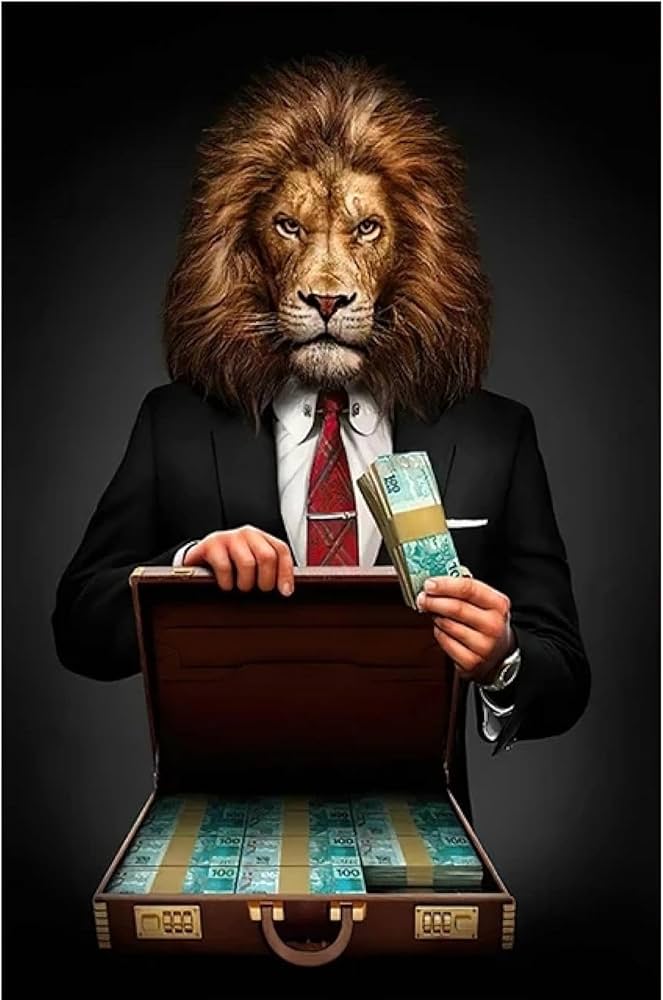
A lion hunts because it is hungry today. It doesn’t receive a salary every month in exchange for future hunting rights. A bee gathers nectar because it immediately creates value for the hive. A wolf shares food because the survival of the pack improves the survival of the individual.
Nature works through direct exchange, immediate cooperation and biological trust. Animals don’t need money because they don’t build civilisations.
Humans faced a different challenge. As societies grew beyond small tribes, relationships alone stopped being enough. You could no longer know everyone personally or remember every obligation. Communities increasingly needed ways to record value, settle debts and coordinate activity across much larger groups. Money emerged as one solution to that challenge.
One of the best illustrations of this comes from the tiny Yap Islands in Micronesia.
For centuries, the islanders used enormous limestone discs, known as Rai stones, as money.
Some were several metres across and weighed tonnes, making them almost impossible to move, yet ownership changed regularly without the stones ever leaving their resting place. Everyone in the community simply knew who owned which stone.
In one famous story, a Rai stone sank to the bottom of the sea during transport. It was never recovered, but it continued to be accepted as money because everyone agreed it still existed and knew who owned it. The value was never in the stone itself. The value lay in the shared belief about the stone.
The story has become popular amongst bitcoin advocates because it demonstrates that money has never depended upon the physical object. It depends upon shared agreement about ownership and, long before bank accounts, blockchain or digital ledgers, the people of Yap had already demonstrated one of the most profound truths about money: it is not an object. It is trusted information.
When kingdoms emerge and cities grow or when rulers need to pay soldiers, collect taxes, organise trade and govern people they will never meet. Money wasn’t simply an economic innovation. It became a technology for scaling society.
A coin stamped with the ruler’s image carried a simple message. This has value because the state says it does. For the first time, authority could travel independently of the individual exercising it.
Money transformed power from something physical into something informational.
That may be money’s greatest achievement.
A king no longer had to stand in front of his army to exercise authority. His coinage carried that authority for him. Taxes could be collected across an entire kingdom. Soldiers could be paid hundreds of miles away. Roads, ports and cities could be financed long before the ruler ever visited them.
Money allowed power to travel.
Animals organise themselves through physical relationships. Humans organise themselves through shared beliefs. Money is one of the most powerful shared beliefs ever created.
Money is shared information. More importantly, it is trusted information. It is a record that society agrees to believe.
The fascinating thing is that humans have spent thousands of years making this shared information easier to move. Coins became banknotes. Banknotes became bank accounts. Bank accounts became payment cards. Cards became smartphones. Smartphones are now becoming AI agents.
The technology changes but the information remains.
Every step has been about improving the movement of trusted information.
Today we are living through another transformation just as profound. Instead of kingdoms connected by roads, we are building digital societies connected by networks and AI. Unsurprisingly, this has reopened fundamental questions about who creates money, who controls it and who should be trusted to manage it.
Animals never needed any of this because evolution solved their coordination problem biologically. A wolf doesn’t need a written contract to trust another member of the pack. Ant colonies don’t require payment systems. Bees don’t need digital identities. Trust is built into the system, but human societies became too large for biological trust.
Once you’re trading with millions of complete strangers, you need institutions that can establish trust at scale and that’s why banks exist.
People often think banks exist to store money. They don’t. Banks exist because trust doesn’t scale naturally.
The larger society becomes, the less we know one another personally. Banks, payment systems, legal contracts and governments all emerged to solve that problem. How do I trust someone I’ve never met, and money became the language that answers that question.
Now AI is forcing us to ask it all over again.
If autonomous agents begin buying products, negotiating prices, arranging insurance and making payments without human intervention, then trust can no longer depend upon recognising another person. It has to depend upon trusted digital identities, verifiable credentials, policies, permissions and continuously assessed risk.
In other words, money becomes even more dependent upon trusted information than ever before.
Perhaps that’s the biggest difference between humans and every other species.
Animals trust individuals and humans invented institutions to trust strangers. AI is forcing us to invent systems that can trust machines.
The birds in my garden don’t need banks because they already know the rules of their world. We built banks because our world became too complicated to survive without them.
Perhaps the next generation of financial systems will have to solve the same problem once more, only this time for intelligence rather than people.
Tomorrow morning the birds in my garden will wake up and carry on exactly as they have for millions of years. They won’t need banks, governments or digital identities because evolution already solved their trust problem. Humans weren’t so fortunate. We invented money because civilisation demanded it. We invented banks because money alone wasn’t enough. Now we’re inventing AI, and we’re discovering that the problem has never really changed.
Money has never really been about wealth. It has always been humanity's way of scaling trust. Every generation must reinvent how that trust is earned.
Chris M Skinner
Chris Skinner is best known as an independent commentator on the financial markets through his blog, TheFinanser.com, as author of the bestselling book Digital Bank, and Chair of the European networking forum the Financial Services Club. He has been voted one of the most influential people in banking by The Financial Brand (as well as one of the best blogs), a FinTech Titan (Next Bank), one of the Fintech Leaders you need to follow (City AM, Deluxe and Jax Finance), as well as one of the Top 40 most influential people in financial technology by the Wall Street Journal's Financial News. To learn more click here...