
I was at a presentation last week where a guy from Canada shared the Wealthsimple story. I was not familiar enough with it, although I had heard of them, but the guy showed their advert and it cracked me up.
#mustwatch
For decades, Canadian banking has been dominated by a handful of powerful institutions with enormous balance sheets, extensive branch networks and deeply entrenched customer relationships. The Big Five – RBC, TD, Scotiabank, BMO and CIBC – have enjoyed a market structure that many banking executives elsewhere can only dream about.
Then along comes Wealthsimple, a Toronto fintech, founded in 2014, with a simple proposition: investing should be easier, cheaper and accessible to everyone.
Twelve years later, it has become one of Canada's most interesting financial challengers, with millions of customers, more than C$150 billion in assets (just over $100bn USD) under administration and a multibillion-dollar valuation.
And the really interesting part is that Wealthsimple is no longer just attacking wealth management. It is attacking the entire relationship between Canadians and their money.
From a little investment app to a financial giant
Wealthsimple was founded by Michael Katchen and his co-founders with a mission to democratise wealth management. The original proposition was straightforward: use technology to deliver automated investment management without the expensive advisers, complicated products and high fees associated with traditional wealth management.
The early growth was impressive, but the acceleration over the past few years is extraordinary.
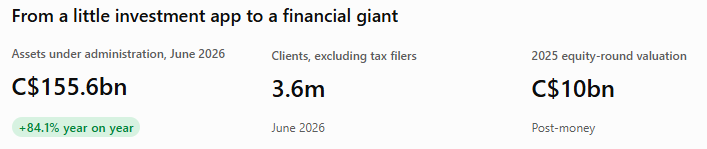
In 2015, Wealthsimple had around 10,000 users. By 2020, it had passed one million. By 2022, it had reached two million, and by June 2026, it reported 3.6 million clients excluding tax-only users.
Meanwhile, its assets under administration have grown from around C$400 million in December 2015 to C$155.6 billion by June 2026.
That is nearly 390 times the assets in just over a decade.
The growth curve that should terrify Canada's banks
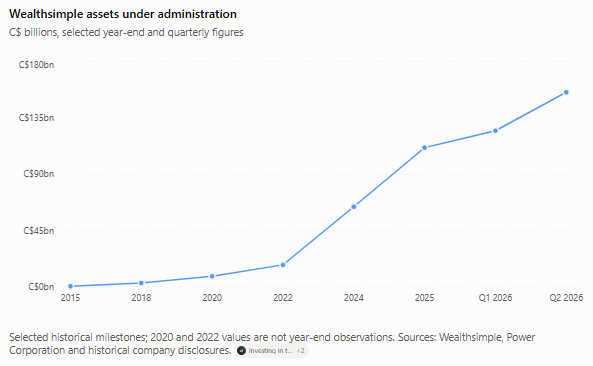
Look more closely at the recent numbers. Wealthsimple's assets under administration rose from C$64 billion at the end of 2024 to C$111.3 billion at the end of 2025, an increase of almost 74%.
By March 2026, assets had reached C$124.8 billion, rising another 24.7% in the following three months to C$155.6 billion at the end of June.
That means the company added C$44.3 billion in assets under administration in six months, although the increase reflects both net customer flows and movements in asset values. In the second quarter alone, net inflows reached approximately C$17 billion, equivalent to around C$187 million a day over the 91-day quarter.
These numbers are not the growth of a small fintech finding its feet. They are the numbers of a serious financial institution taking share from an established market.
And the customer demographics make the story even more compelling.
In 2025, Ipsos estimated that Wealthsimple served approximately 5% of Canadian adults, up from less than 3% in 2021. By 2026, Wealthsimple reported that 23% of Canadians aged 18 to 40 used its services, while its July announcement described penetration among this group as nearly one quarter.
This is an important distinction. Wealthsimple does not have a quarter of the Canadian banking market. It has reached almost a quarter of the younger adult population with at least one product, which gives it a potentially powerful position as those customers accumulate wealth.
For the incumbent banks, the threat is not just the money Wealthsimple manages today. It is the money those customers will earn, inherit, save and invest over the next thirty years.
From wealth management to wealth ownership
The genius of Wealthsimple's strategy is that it began with investing and gradually expanded into everything surrounding the customer's financial life.
The company moved from automated investing into commission-free stock trading, cryptocurrency, tax filing, savings, chequing, cards and credit. By 2025, it was adding sophisticated trading capabilities including margin accounts, expanded options strategies and extended-hours trading.
In May 2026, the company announced further expansion into family finances, children's accounts, business services, portfolio-backed lending and US-dollar chequing.
Some of these products were announced for later release rather than being immediately available, but the direction is unmistakable. Wealthsimple wants to become the customer's primary financial relationship, not just the place where they buy an ETF, and the evidence suggests that its strategy is working.
According to Ipsos, the proportion of Wealthsimple customers using both investment management and everyday banking services increased from 5% in 2021 to 13% in 2025, while in the second quarter of 2026, the company opened more new chequing accounts than investment accounts.
This marks a significant turning point in its evolution from an investment app into an everyday money platform, making it a far more dangerous competitor for traditional banks than a cheap brokerage.
Investors have noticed too, as demonstrated by the company's C$10 billion valuation. Wealthsimple reached a valuation of approximately C$1.4 billion in 2020, rising to C$5 billion in 2021. In October 2025, it announced a C$750 million equity financing at a C$10 billion post-money valuation, backed by investors including Dragoneer, GIC and CPP Investments.
That represented a doubling of its 2021 valuation and was accompanied by confirmation that the company had been profitable in 2024 and remained profitable in 2025.
It is worth emphasising that profitability matters. Plenty of fintechs have attracted millions of customers by subsidising products, burning venture capital and promising profitability at some distant point in the future.
Wealthsimple is showing that a broadening financial platform can achieve scale while generating profits, although it does not publish the full revenue, net-income and margin disclosures that would allow a detailed comparison with listed banks.
There is another fascinating element to this story: Wealthsimple is not entirely an outsider attacking the establishment.
Power Corporation and its affiliated businesses have been major backers. At June 2026, the Power group collectively held 52.3% of Wealthsimple's undiluted equity and 57.5% of its voting interest.
In other words, one of Canada's most powerful financial groups has a controlling stake in one of the country's most disruptive financial challengers.
Perhaps the smartest way to disrupt banking is to have the financial establishment funding the disruption.
The business model: make money by saving customers money
There is another reason Wealthsimple is interesting. It is turning the traditional banking revenue model upside down.
In its 2025 annual customer update, the company estimated that clients had saved C$1.3 billion in trading commissions and earned C$200 million in interest through its chequing accounts during the year. It also reported welcoming more than 650,000 new clients.
The strategy is simple: make the core financial experience cheaper and easier, then build deeper relationships that create additional revenue opportunities through managed investments, premium services, foreign exchange, credit and other financial products.
The customer acquisition model is also changing. Wealthsimple says referrals from friends and family are its leading source of new customers. That creates an advantage over traditional institutions that spend heavily acquiring customers through advertising, branches and promotional campaigns.
Meanwhile, its first 10,000 clients began with C$161 million in assets and had grown their combined holdings on the platform to more than C$1.3 billion by 2024.
This is the real prize. Acquire customers when they have little money, serve them well, and grow with them as they become wealthier.
There is also an increasingly aggressive competitive dimension.
In a 2026 submission to the Canadian government, Wealthsimple attacked the account-transfer fees imposed by financial institutions, noting that customers commonly face charges of around C$150 per account when moving investments.
Wealthsimple says the average processing cost of an automated account transfer is just C$2.20.
That is a remarkable difference between the cost of moving an account and the price some institutions charge customers to leave. The company also estimated that Canadians paid more than C$1 million a day in investment account transfer fees during the first quarter of 2026.
For Wealthsimple, removing those barriers is not merely a consumer protection issue. It is a powerful growth opportunity.
The real battle is for the next generation's money
There are, of course, important caveats. Wealthsimple's C$155.6 billion in assets under administration is not equivalent to C$155.6 billion in bank deposits or revenue-generating loans. The company also operates through a different regulatory and balance-sheet model from the large Canadian banks. Canada's established banks remain enormously larger in assets, capital, lending and profitability but, measuring Wealthsimple solely against today's bank balance sheets, misses the point as the company is capturing customers early, expanding the number of products they use and encouraging them to consolidate more of their financial lives on its platform.
It is also pursuing the wealthier customer. Wealthsimple reported in 2024 that million-dollar accounts were its fastest-growing segment, challenging the assumption that digital-first investment platforms are only attractive to younger customers with small balances.
This is how disruption moves upmarket. It begins with people the traditional institutions underestimate, builds trust through a superior experience and gradually takes over relationships that incumbents once considered secure.
The bottom line
Wealthsimple's story is not simply about a fintech growing from C$400 million to C$155.6 billion in assets under administration or reaching 3.6 million investing and banking clients in twelve years. It is about a fundamental change in how financial relationships are created.
Traditional banks built their businesses around accounts, products, branches and transactions. Wealthsimple is building its business around the customer's financial life, using investing as the entry point and expanding into spending, saving, borrowing and wealth creation.
The question for Canada's banks is no longer whether Wealthsimple can attract customers. It has already demonstrated that it can and the question is whether those customers will ever need to return to their old banks. Then the bigger question for banking executives everywhere is whether the next generation will choose their financial institution because it has the biggest balance sheet, the longest history and the most branches, or because it understands their money and helps them make more of it.
Wealthsimple started by making investing simple. Now it wants to make traditional banking unnecessary.
With C$155.6 billion in assets, 3.6 million clients and nearly a quarter of young Canadian adults using its products, the established banks should be paying very close attention because Wealthsimple isn't just taking market share. It is competing to own the next generation of customer relationships and that is worth far more than a trading commission.
Sources: Wealthsimple Newsroom, Ipsos Canadian Financial Monitor, and Power Corporation financial disclosures.
All financial figures are in Canadian dollars. 1CAD = 0.7USD or 0.53GBP
Latest published quarterly operating data: 30 June 2026. Wealthsimple's wider figure of more than four million Canadians served includes tax-only users, whereas the 3.6 million client figure excludes them. Asset growth includes market movements as well as net flows.

Chris M Skinner
Chris Skinner is best known as an independent commentator on the financial markets through his blog, TheFinanser.com, as author of the bestselling book Digital Bank, and Chair of the European networking forum the Financial Services Club. He has been voted one of the most influential people in banking by The Financial Brand (as well as one of the best blogs), a FinTech Titan (Next Bank), one of the Fintech Leaders you need to follow (City AM, Deluxe and Jax Finance), as well as one of the Top 40 most influential people in financial technology by the Wall Street Journal's Financial News. To learn more click here...