
Nubank wants to go global but not like Revolut.
Everyone assumes Nubank wants to be like the next Revolut. They’re wrong. Revolut wants to build one financial superapp for the world. Nubank is building something different: a global banking empire that does not require Nubank to be the bank.
That sounds like a subtle distinction, but it changes everything about how you read Nubank’s recent moves.
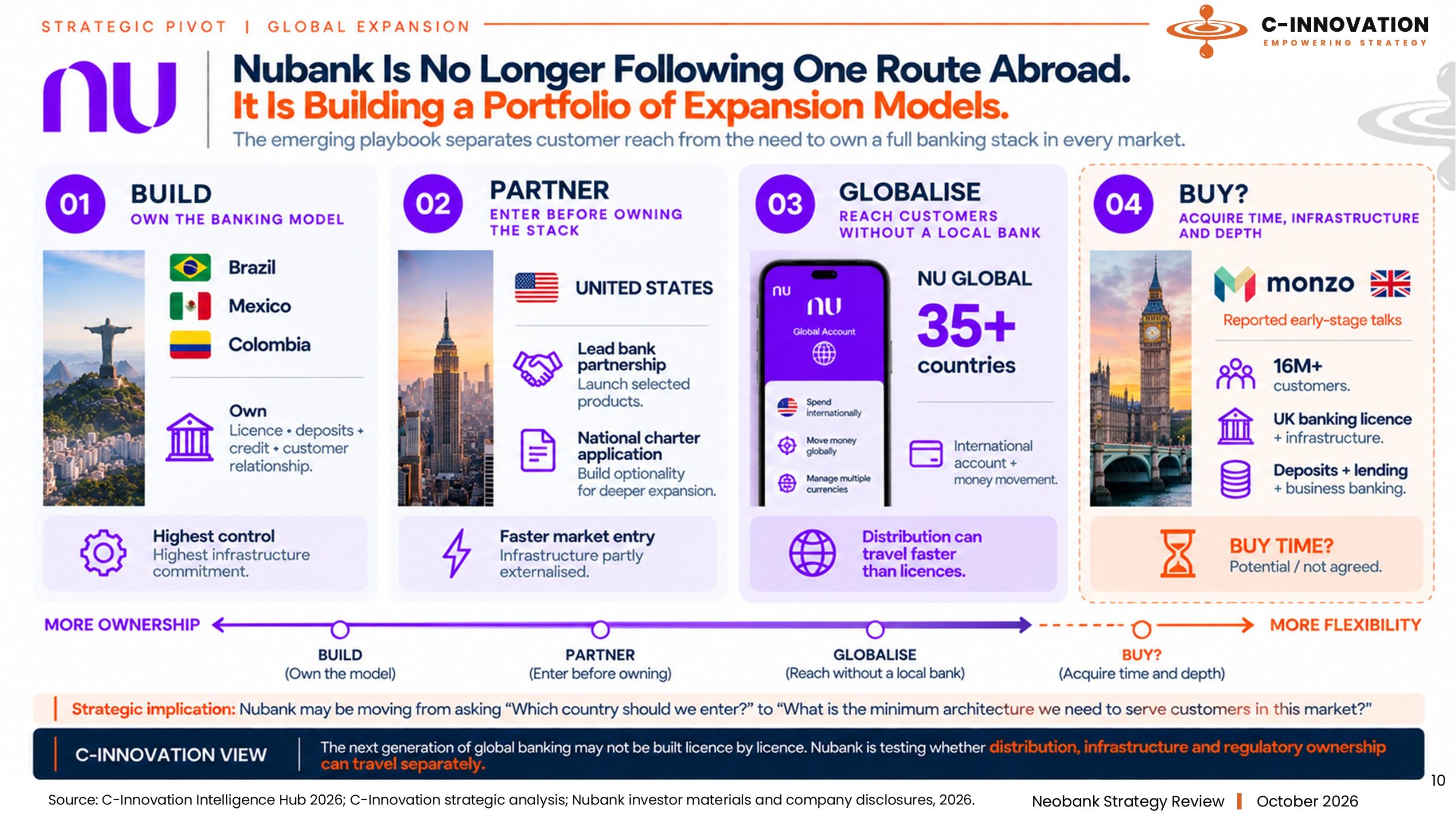
Brazil, Mexico and Colombia. A banking charter and partnership strategy in the United States. Nu Global reaching across more than 35 countries. A strategic investment in Tyme Group that gives Nubank exposure to Africa and Asia. And then, suddenly, reports that Nubank might spend around £8 to £10 billion buying Monzo.
This is not the normal international expansion strategy of a bank, and it is certainly not Revolut’s strategy.
Nubank appears to be separating being global from being everywhere.
It can build its own banks where the economics make sense, partner with local institutions where regulation makes that easier, invest in digital banks such as Tyme where local expertise already exists, use Nu Global to connect customers across borders and, potentially, acquire an established bank such as Monzo where buying years of infrastructure and regulatory experience makes more sense than building from scratch.
In other words, Nubank does not need a Nubank bank in every country to become a global banking business. It needs the Nubank advantage – its technology, capital, economics and operating model – to travel.
Which brings us to Monzo.
Reports suggested that Nubank was considering paying somewhere around £8-10 billion for the British digital bank, a deal that would instantly give the Brazilian group a substantial position in one of the world's most sophisticated banking markets. Monzo has around 16 million customers and £26 billion of deposits, which means Nubank would not merely be buying customers. It would be buying a British banking licence, deposits, technology, brand, management, regulatory relationships and, most importantly, time.
Then Nubank said no.
More precisely, Nubank stated that it is not pursuing a transaction with Monzo, while adding that it regularly evaluates partnerships, investments and acquisitions that fit its long-term strategy. Its shares, which had fallen sharply when the takeover reports emerged, promptly recovered.
So, nothing to see here?
I am not so sure, because whether Nubank buys Monzo is almost secondary to the fact that the idea makes strategic sense. The rumours have exposed a much bigger question about Nubank’s future, and it is no longer whether the Brazilian model works. We know it works. The question is whether Nubank needs to export the bank at all in order to export the advantage.
Nubank has built an extraordinary machine in Latin America. It now has well over 100 million customers and has expanded beyond Brazil into Mexico and Colombia. Mexico is particularly important because Nu now has more than 15 million customers there, representing roughly 15% of the adult population, and received authorisation this summer to operate as a bank.
That is not a Brazilian bank dabbling overseas. It is evidence that at least some of the Nubank formula travels.
But going from Brazil to Mexico and Colombia is one thing. Going from Latin America to the United States, Britain, Europe, Africa, Asia and eventually the rest of the world is another. The regulatory structures change, customer expectations change, economics change, competition changes and, critically, the reasons customers hate their incumbent banks change.
That is why the Nubank-Revolut comparison is becoming so fascinating. We are watching two very different experiments in how banking globalises in the digital age.
Revolut starts with global utility and moves towards deeper banking. Its ambition is to take Revolut everywhere: one increasingly universal financial platform, one customer relationship and an expanding range of services that progressively turns the app into the customer’s primary bank. A superapp bank.
Nubank starts from the opposite direction.
It has already built extraordinarily deep banking relationships in its home markets and is now working out which parts of that success need to travel. Sometimes that means building, as in Mexico and Colombia. Sometimes it means partnering, as in the United States. Sometimes it means investing, as with Tyme. Sometimes it means creating a cross-border layer through Nu Global. And perhaps, one day, it means acquiring, which is why the Monzo rumours remain interesting even after Nubank denied them.
The danger is complexity.
The more routes Nubank uses to expand, the more difficult it becomes to preserve the simplicity, economics and customer obsession that made Nubank successful. There is a wonderful irony in that. Digital banks set out to destroy the complexity of global banking, only to discover, as they become global themselves, why so much of that complexity exists.
But Nubank may have spotted something the old global banks missed. A bank does not have to own everything, operate everywhere or put its name above every door to become global. What matters is whether the things that made it successful – its technology, economics, capital, customer experience and operating philosophy – can create value wherever they go.
Revolut wants to put Revolut in every market.
Nubank doesn’t need to.
Revolut is going everywhere. Nubank is making everywhere come to Nubank.


Chris M Skinner
Chris Skinner is best known as an independent commentator on the financial markets through his blog, TheFinanser.com, as author of the bestselling book Digital Bank, and Chair of the European networking forum the Financial Services Club. He has been voted one of the most influential people in banking by The Financial Brand (as well as one of the best blogs), a FinTech Titan (Next Bank), one of the Fintech Leaders you need to follow (City AM, Deluxe and Jax Finance), as well as one of the Top 40 most influential people in financial technology by the Wall Street Journal's Financial News. To learn more click here...