You have to laugh. The police spend their lives chasing criminals and now the criminals are stealing their identities to sell cryptocurrency. You really couldn’t make it up.
The latest example comes from Ireland, where the Gardaí, the Irish police, have apparently discovered that their social media accounts are rather less secure than the criminals they are supposed to be chasing.
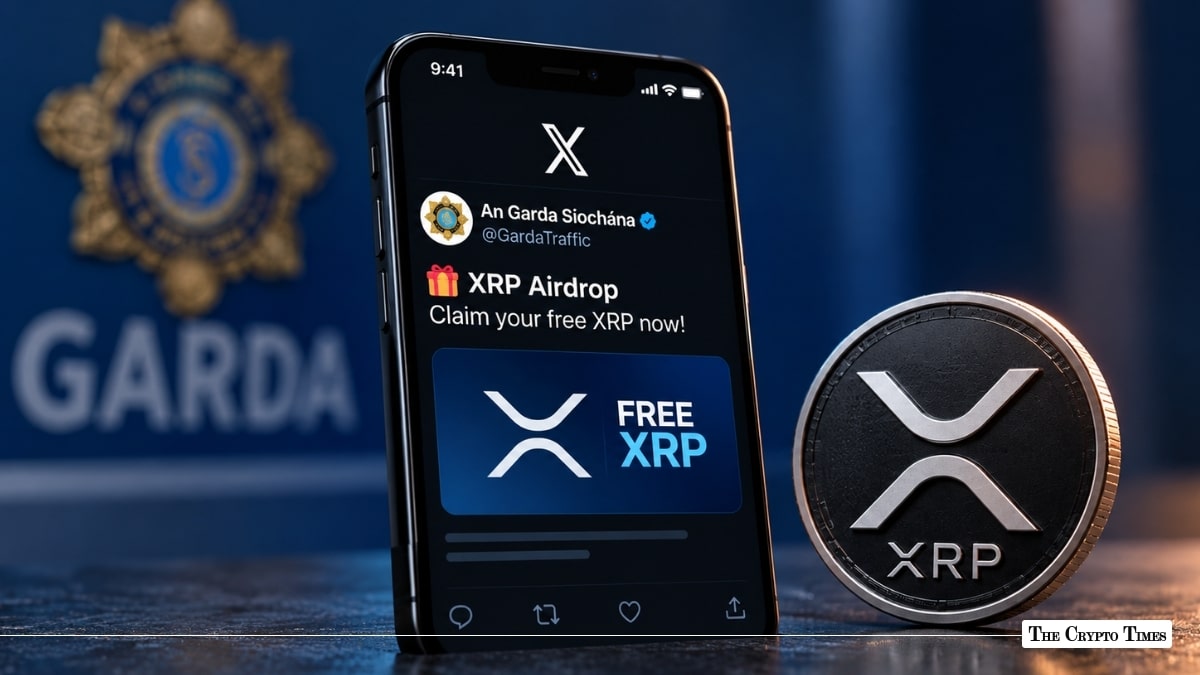
According to the BBC, two official Garda accounts on X, formerly Twitter, were compromised and used to promote cryptocurrency. @GardaTraffic account, with around 600,000 followers, and @GardaInfo, with almost 300,000, suddenly lost their official branding and started promoting crypto instead.
Even more amusingly, the accounts appeared to have relocated to Amsterdam which made me wonder if the Gardaí had opened a European cryptocurrency trading desk. Perhaps the officers have decided that issuing speeding tickets is less profitable than launching a meme coin. Or perhaps somebody forgot that the password shouldn’t be Garda123.
Whatever happened, the irony is delicious.
The people responsible for protecting us from criminals have had their own digital identities hijacked by criminals. And those criminals have decided that the most profitable use of an official police account is to promote cryptocurrency.
That’s almost poetic.
Except it isn’t funny. Well, it is, but only until you start looking at how often this happens.
The police are becoming victims of the crimes they investigate.
Take Britain.
In September 2026, Dyfed-Powys Police disclosed a cyberattack potentially compromising staff information. Weeks earlier, hackers published stolen details from the Police National Legal Database on the dark web.
Imagine the conversation.
“Hello, police? I’d like to report a cybercrime.”
“Certainly, sir. What happened?”
“My personal details have been stolen.”
“Ah. Yes. Ours too.”
In 2023, the Police Service of Northern Ireland accidentally exposed the identities of 9,483 officers and staff, earning a £750,000 fine. The culprit wasn’t a sophisticated Russian hacking operation. It was a spreadsheet released under a Freedom of Information request.
Forget cyberwarfare. Microsoft Excel is dangerous enough.
Meanwhile, Greater Manchester Police and the Metropolitan Police suffered potential data exposure when hackers targeted a supplier of police identity cards. The criminals didn’t even need to attack the police directly.
And Britain isn’t alone.
In 2023, ransomware crippled Dallas city systems, including police services, with hackers reportedly stealing more than a terabyte of data. Indonesian police faced claims of 28,000 compromised personnel records in 2021. More recently, the ShinyHunters group claimed to have stolen information relating to 38,000 FBI personnel, although that claim remains unverified.
The FBI. Think about that.
If the organisations responsible for catching cybercriminals cannot protect their own information, what hope is there for everyone else?
And banking has exactly the same problem, multiplied by money.
Banks spend billions protecting their systems. They employ cybersecurity specialists, fraud investigators, penetration testers, risk managers and armies of compliance officers. They have biometric authentication, behavioural analytics, artificial intelligence and sophisticated monitoring systems designed to detect unusual transactions.
Yet the fundamental weakness is often not the technology. It is the human being using it, the organisation supplying it or the trusted identity being impersonated.
The Irish police story is particularly revealing because the hackers were not simply stealing information. They were exploiting credibility.
An account with hundreds of thousands of followers and an official police identity carries authority. People trust it because they believe it belongs to the police. Once criminals gain control, they can borrow that authority to promote something entirely unrelated.
In this case, cryptocurrency.
In banking, the equivalent is a criminal impersonating your bank, your relationship manager, your chief executive or even your family.
For years, I have personally promoted the future of banking is digital. Now, I am promoting the concept of smart.
Everything moves to the cloud, everything connects through APIs, everything becomes embedded and everything eventually runs on artificial intelligence but, with every connection, we create another dependency and every dependency introduces another potential weakness and the more seamlessly we connect everything, the more attractive those connections become to criminals.
A bank might have outstanding cybersecurity, but what about its cloud provider, payments processor, customer communications platform, outsourced support centre or identity verification partner?
A criminal doesn’t need to break through the strongest door when somebody has left the window open which brings me back to the Irish police. I can just imagine the next financial crime awareness campaign.
“Beware of cryptocurrency scams. Never trust unsolicited investment opportunities. Always check that the person contacting you is genuine.”
Issued by the Gardaí.
On X.
Assuming they’ve got their account back.
Sources:
BBC – Irish police social media accounts breached
Dallas ransomware investigation
Image from The Crypto Times

Chris M Skinner
Chris Skinner is best known as an independent commentator on the financial markets through his blog, TheFinanser.com, as author of the bestselling book Digital Bank, and Chair of the European networking forum the Financial Services Club. He has been voted one of the most influential people in banking by The Financial Brand (as well as one of the best blogs), a FinTech Titan (Next Bank), one of the Fintech Leaders you need to follow (City AM, Deluxe and Jax Finance), as well as one of the Top 40 most influential people in financial technology by the Wall Street Journal's Financial News. To learn more click here...