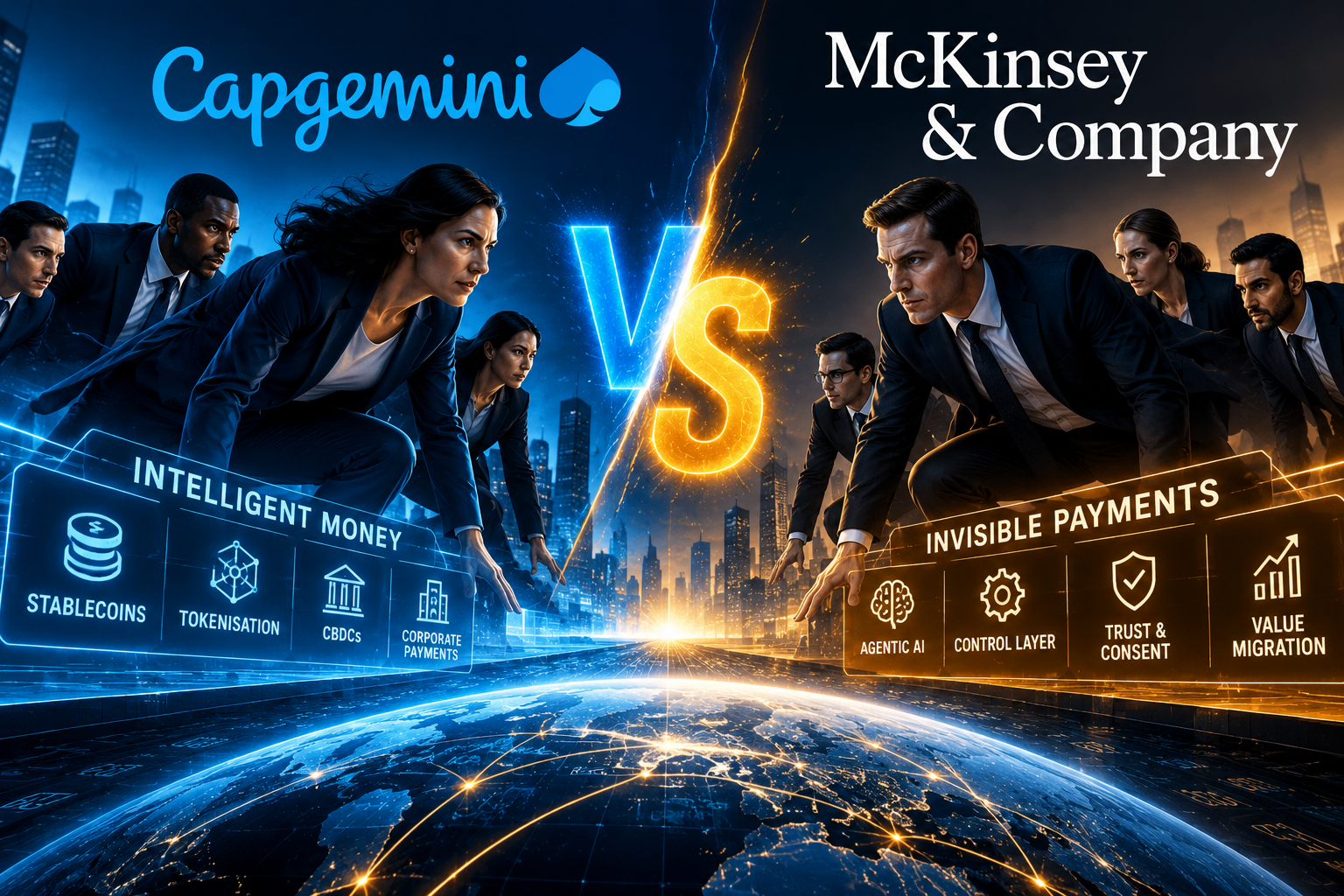
It’s SIBOS week and so lots of research and news announcements. Two caught my attention though, as I always look forward to what McKinsey and Cap Gemini are saying in their payments reports.
The both tell the same story from different angles, namely that the payment is disappearing.
Not disappearing in the sense that we will stop paying.
Quite the opposite.
There will be more payments, more transactions, more rails and more ways of moving value than ever before. What is disappearing is the payment as an event. That matters because payments remain an extraordinary business.
This is where the two reports become interesting because they describe two sides of the same revolution. McKinsey calls it the rise of invisible and agentic payments. As payments disappear into software, the value moves away from the checkout and towards what McKinsey calls the invisible control layer: machine identity, consent, trust and dynamic routing. Meanwhile, payment infrastructure itself fragments across real-time account-to-account systems, cards and stablecoin rails.
Capgemini comes at it from the corporate side and calls the change accelerated intelligent money. Stablecoins, tokenised deposits and CBDCs increasingly combine the movement of money with settlement and business rules. Money stops being something that simply moves from A to B and starts carrying instructions about what should happen when it gets there.
Put those two ideas together and something fundamental has changed. Money is becoming software and payments are becoming invisible.
That should make every bank CEO sit up because much of the economics of banking has historically depended upon friction. Money sits in the wrong account and banks earn the float. Currencies need converting and banks earn the FX spread. Money crosses borders through correspondent banks and banks charge for the journey. Transactions move through payment networks and somebody charges for processing them. Customers cannot continuously optimise every financial decision, so banks also benefit from inertia.
AI attacks the inertia while intelligent money attacks the friction.
McKinsey estimates that global payments generate around $2.6 trillion of revenues, representing roughly 41% of total banking revenues, but the easy growth is ending. Payments revenues grew around 9% annually between 2020 and 2025, but McKinsey expects that to slow to around 4% a year through 2030.
They then predict that agentic AI could put around $75 billion of payments revenues at risk by 2030 in its base case, rising to $160 billion in an aggressive scenario. Agents could automatically sweep deposits towards better yields, choose cheaper payment rails, optimise credit-card repayments, avoid fees and route foreign exchange in real time.
In card-heavy markets the effect becomes even more interesting, with McKinsey estimating that agentic commerce could affect around 30% of net card interchange revenue in its base case, 50% in an aggressive scenario and 75% in a rewards-war scenario. the-2026-global-payments-report…
Now add Capgemini.
Its report identifies around $230 billion of existing payments revenues exposed to disruption across FX spreads, correspondent banking fees, float income and transaction processing and settlement fees. It also finds that only 21% of banks are actively scaling at least one intelligent-money instrument. WPR_2027
In other words, the industry can see the iceberg, but most banks are still discussing the architecture of the deckchairs. It’s like that old quote of rearranging chairs on the deck of the Titanic.
There is an even more uncomfortable number.
Capgemini finds that 60% of banks have prioritised B2B payments innovation over the past three years, yet only 32% of corporate customers are satisfied with their primary banking partner. Even worse for banks, nearly 60% of corporates say they would be willing to source stablecoin services from non-banks if their banks cannot provide them.
Read that again.
Banks are investing in payments innovation and their customers are saying: fine, but if you don't move quickly enough, we'll get it somewhere else and they already are.
Capgemini reports that 36% of B2B payment volume is flowing through non-bank providers. Meanwhile, around $4 trillion remains trapped globally in nostro and vostro accounts supporting the old cross-border settlement architecture. WPR_2027
This is why I think we need to stop talking about faster payments. Faster payments are yesterday's argument. The future is intelligent money, something I wrote about in a book two years ago (order it here: https://www.amazon.co.uk/dp/B0CW942DG1/).
Money that knows where to go, can choose which rail to use, carries rules, settles automatically, optimises liquidity and moves between currencies and jurisdictions, all controlled by software agents acting for people and corporations. When money can do all of that, the question is no longer how do I make a payment? The question becomes why am I involved in making the payment at all?
My AI agent knows what I want and your AI agent knows what you want. The machines negotiate the transaction, establish permissions, choose the currency, select the cheapest or most appropriate rail, perform the compliance checks, execute the payment, reconcile the accounts and record the transaction. I may never see a payment screen.
McKinsey calls this an invisible world. Capgemini and I call it intelligent money, which creates a much bigger question: if the payment disappears, where does the value go?
Both reports give essentially the same answer.
It moves upwards, away from simply processing transactions and towards orchestration, intelligence, liquidity, software, identity, compliance and control. McKinsey notes that value is already migrating into the software and workflow layers around payments and argues that durable advantage increasingly comes from proprietary data, embedded distribution, trusted customer relationships and deep workflow integration. the-2026-global-payments-report… the-2026-global-payments-report…
Capgemini reaches a remarkably similar conclusion from another direction. Leading banks are moving away from relying purely on transaction economics and towards monetising settlement certainty, liquidity optimisation, real-time visibility and workflow coordination. WPR_2027
That is the real payments war. It isn't Visa versus Mastercard versus instant payments versus stablecoins versus CBDCs. Those are rails. The battle is over who controls the intelligence that decides which rail gets used.
That could be the bank, the payment company, the fintech, the stablecoin issuer, the enterprise software platform or the AI agent, and increasingly the customer may neither know nor care.
This is why I think the biggest mistake banks can make is treating AI, stablecoins, tokenised deposits, instant payments and CBDCs as separate innovation programmes. They aren't. They are converging. AI provides the intelligence, tokenisation makes money programmable, new rails provide the movement, APIs provide connectivity, identity and consent provide authority and real-time infrastructure provides execution.
Put those things together and we aren't modernising payments. We are programming money.
That changes the strategic question for banks completely. The old question was: how do we process more payments? The new question is far more uncomfortable.
When money can think, choose and move by itself, what exactly is the bank for?

Chris M Skinner
Chris Skinner is best known as an independent commentator on the financial markets through his blog, TheFinanser.com, as author of the bestselling book Digital Bank, and Chair of the European networking forum the Financial Services Club. He has been voted one of the most influential people in banking by The Financial Brand (as well as one of the best blogs), a FinTech Titan (Next Bank), one of the Fintech Leaders you need to follow (City AM, Deluxe and Jax Finance), as well as one of the Top 40 most influential people in financial technology by the Wall Street Journal's Financial News. To learn more click here...