
It is Halloween week and, by coincidence, the same week as the Chancellor's Budget which is announced tomorrow. I say by coincidence as it seems likely that the Chancellor wants to drink the banker's blood by restoring higher taxes upon them.
There has been a huge debate over increasing taxes on British banks.
The contest is between two economic arguments: should highly profitable banks contribute more to the public finances, or will taxing them further undermine the growth Britain desperately needs?
The immediate proposal is to reverse the 2023 reduction in the banking corporation tax surcharge. In simple terms, banks pay corporation tax on their profits, just like other businesses, but they also pay an extra tax specifically because they are banks. This additional tax is called the banking corporation tax surcharge.
In 2023, the government reduced that extra tax from 8% to 3%. To illustrate, a bank with £100 million of profits subject to the surcharge would previously have paid £8 million in additional tax, but under the new rate would pay just £3 million.
Reversing the reduction and restoring the 8% surcharge has been estimated to raise around £2 billion a year, although the actual amount would depend on bank profitability and behaviour.
However, there is a catch.
Although the banking surcharge fell from 8% to 3% in 2023, ordinary corporation tax increased from 19% to 25% at the same time. This means the combined headline tax rate for large banks actually rose from 27% to 28%. Restoring the surcharge to 8% would therefore take the combined rate to 33%, considerably higher than it was before 2023.
Supporters see this as restoring a fair contribution from a profitable industry, while opponents argue that it will discourage investment, weaken lending and damage employment across the country.
The arguments for and against higher bank taxes
The case for higher taxes
Banks are enjoying substantial profits because higher interest rates have boosted lending margins. The TUC, Trades Union Congress, argues that some of these gains should support public services and households facing higher living costs. An additional £2 billion annually would also help the Treasury defend its fiscal position without imposing an equivalent tax increase on the wider population.
The case against higher taxes
Banks do not operate in isolation from the economy. Higher taxation reduces shareholder returns and may eventually be passed to customers through higher borrowing costs or lower savings rates. International investment banking is also mobile, and institutions such as JPMorgan have warned that further increases could discourage UK investment and employment. Those risks are credible, although their magnitude remains uncertain.
Are British banks already overtaxed?
This is where the independent analysis is particularly revealing. UK Finance's PwC research suggests Britain is among the most expensive financial centres for banks. However, Tax Policy Associates challenges the methodology, including its treatment of employer National Insurance, business rates and VAT, claiming that the UK tax structure is broadly competitive with major European countries, although significantly more expensive than New York, Ireland and Singapore.
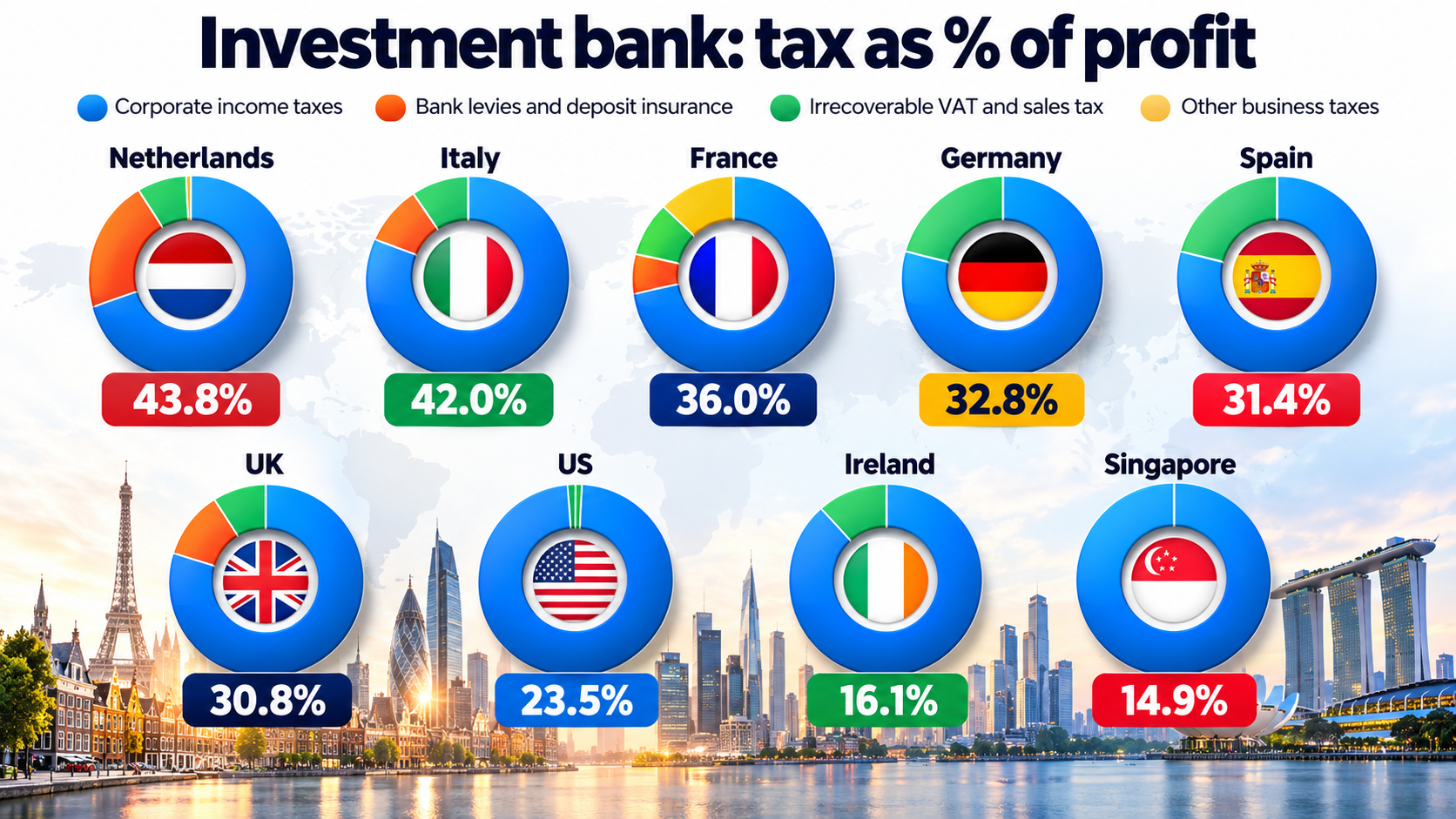
Source: Tax Policy Associates comparative study*
The important point is that both sides have exaggerated elements of their case. Campaigners overstate the growth in underlying UK bank profits by including overseas earnings and ignoring inflation, while industry comparisons can exaggerate the relative UK tax burden through different definitions of which taxes banks actually bear.
Will Healey's Budget work?
It depends on what success means:
- Raise around £2 billion a year: Plausible in the short term
- Reduce fiscal pressure: Helps, but is modest relative to wider pressures
- Improve public services: Depends on how the revenue is spent
- Protect bank lending: Limited near-term risk from a modest increase, but not zero
- Encourage investment and jobs: Risk of adverse effects, especially over time
- Deliver stronger UK growth: No convincing evidence that the tax increase itself would achieve this
The independent Tax Policy Associates assessment is especially useful here. It concludes that a relatively small surcharge increase is unlikely to cause serious immediate economic damage, partly because the Bank of England does not currently regard bank capital shortages as the main constraint on lending. However, it recommends that any increase be temporary, with a credible end date, to reduce the risk of investment and employment shifting abroad.
The bigger question: should banks pay more tax permanently, or just when they make exceptional profits?
The real question is whether the government wants banks to pay higher taxes forever or simply contribute more when they are making exceptional profits. There is a big difference. Banks have benefited from higher interest rates, which have boosted their profits without necessarily requiring them to work harder, innovate or take greater risks.
That makes the argument for a temporary windfall tax understandable, particularly when the government desperately needs money. Increasing the general banking surcharge is different, because it applies whether profits come from higher interest rates, greater efficiency or successful investment. Permanently increasing this surcharge therefore risks discouraging future investment, innovation and growth. The danger is that the Chancellor raises a few billion pounds today but discourages the investment and employment that would generate far greater tax revenues tomorrow.
There is also a distinction between domestic retail banking and international investment banking. A British mortgage book cannot simply relocate to Singapore, but trading activities, capital allocation and some highly paid financial jobs can. A uniform increase therefore creates different incentives across the industry.
My overall assessment: A modest, temporary increase in bank taxation is economically defensible and likely to raise useful revenue. However, restoring the full 8% surcharge permanently would be a much more consequential decision, potentially undermining Britain's competitiveness and the very tax base the Chancellor wants to exploit. The question is whether the government wants a short-term revenue boost or is prepared to accept the longer-term economic risks of a permanent tax increase.
The Chancellor may succeed in raising another £2 billion from Britain's banks, but if the result is less investment, fewer jobs and weaker economic growth, he will have won the tax battle and lost the economic war.
Finally, be careful if you go out tonight. You might meet Healula, the vampire who doesn't suck your blood. He sucks your bank profits dry.
* The figures use a consistent hypothetical investment bank and should not be interpreted as actual sector-wide effective tax rates.
For full sources, click on these:
https://www.cityam.com/john-healey-poised-to-target-banks-with-budget-tax-raid/
https://www.cityam.com/city-chiefs-warn-healey-higher-bank-taxes-hurt-jobs-outside-london/
https://www.bbc.co.uk/news/articles/c32l4k2xdvrzo
https://www.theguardian.com/uk-news/2026/oct/15/john-healey-raise-taxes-banks-budget
https://www.investorschronicle.co.uk/content/97788f55-d5c0-476f-b8ca-af1321bc58bf
https://taxpolicy.org.uk/2026/10/22/should-bank-tax-go-up/

Chris M Skinner
Chris Skinner is best known as an independent commentator on the financial markets through his blog, TheFinanser.com, as author of the bestselling book Digital Bank, and Chair of the European networking forum the Financial Services Club. He has been voted one of the most influential people in banking by The Financial Brand (as well as one of the best blogs), a FinTech Titan (Next Bank), one of the Fintech Leaders you need to follow (City AM, Deluxe and Jax Finance), as well as one of the Top 40 most influential people in financial technology by the Wall Street Journal's Financial News. To learn more click here...