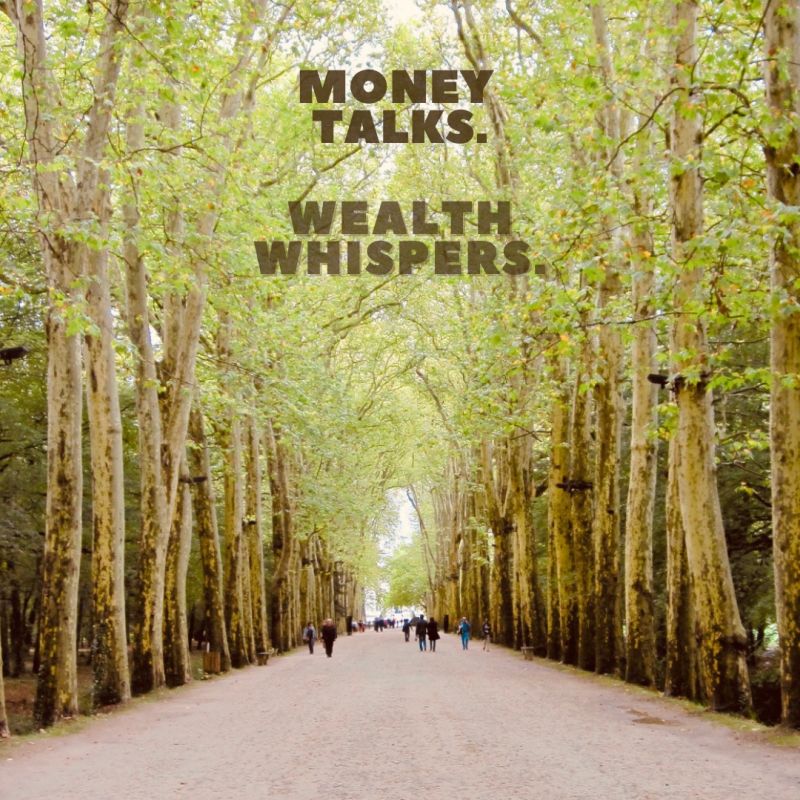
Building on the commentary about Taylor Swift’s big wedding, we’ve all heard the saying that money talks but wealth whispers. It’s a lovely phrase because it conjures up images of old aristocratic families quietly living behind the gates of country estates whilst the newly rich roar past in Ferraris. The implication is that once you’ve accumulated enough wealth, you no longer feel the need to prove anything.
I’m no longer convinced that’s true.
Money certainly talks. It always has. It buys the sports car, the penthouse apartment, the designer wardrobe and the Instagram lifestyle designed to persuade strangers that you’ve somehow won at life. Every generation invents its own symbols of success, and every generation spends extraordinary amounts of money making sure everyone notices them.
What has changed is that social media has industrialised the process.
We have built entire economies around broadcasting prosperity, where likes have become another currency and visibility is often mistaken for value and yet this obsession with displaying money distracts us from asking a far more interesting question.
Who actually owns the world?
That is where wealth becomes something altogether different.
The person driving the Ferrari may be rich. The person who owns the company financing the Ferrari is wealthy. The influencer posing in a private jet may be making money. The investment fund that owns the aircraft leasing company is accumulating wealth. One spends whilst the other collects a percentage every time someone spends. That distinction matters because wealth has never really been about possessions. It is always about ownership.
For centuries that meant land. Then it meant factories, railways, oil fields and banks. Today it means cloud infrastructure, semiconductor manufacturing, payment networks, artificial intelligence, intellectual property, satellite systems and the data generated by billions of people going about their everyday lives. The assets have changed but the principle hasn’t. Wealth belongs to those who own the system, not to those who consume what the system produces.
This is why so much of modern capitalism feels different.
We have become mesmerised by visible luxury at precisely the moment that the most valuable assets have become almost invisible. You cannot photograph an AI model worth hundreds of billions of dollars. There is nothing glamorous about a hyperscale data centre, a portfolio of patents or the software quietly routing trillions of dollars through payment networks every day. Yet these are the assets that are defining twenty-first century wealth far more than yachts anchored off Monaco.
The consequence is that the gap between appearing wealthy and actually being wealthy has never been greater.
It has become remarkably easy to rent the image of success.
Luxury cars can be leased; designer watches can be financed; private jets can be chartered for an afternoon. Even social status can be purchased through followers, verification badges and carefully curated online identities. The performance of wealth has become a business model, and an astonishing number of people have become experts at looking rich whilst owning very little.
Meanwhile, the genuinely wealthy have moved on to a different game altogether. They are buying companies instead of products, platforms instead of brands and algorithms instead of advertising. Increasingly they are investing in the intelligence that decides what billions of people read, watch, buy and believe.
That isn’t simply wealth. It is influence on an entirely different scale.
Perhaps this is where the old saying starts to break down.
Wealth no longer whispers because it is modest. It whispers because it has become embedded in the infrastructure of modern life. It doesn’t need to shout when it owns the social network carrying the conversation, the payment rails settling the transaction, the cloud storing the information, the AI generating the answers and the energy infrastructure keeping the whole machine running. It doesn’t seek attention because attention is already flowing through assets it controls.
The real divide in society is no longer between people who have money and people who don’t. It is between those who earn income and those who own systems. One group exchanges time for money. The other owns the machinery that converts everyone else’s time into capital.
Perhaps that’s the uncomfortable truth hidden inside the old saying.
Money talks because it wants to be noticed. Wealth whispers because it owns the microphone.
Chris M Skinner
Chris Skinner is best known as an independent commentator on the financial markets through his blog, TheFinanser.com, as author of the bestselling book Digital Bank, and Chair of the European networking forum the Financial Services Club. He has been voted one of the most influential people in banking by The Financial Brand (as well as one of the best blogs), a FinTech Titan (Next Bank), one of the Fintech Leaders you need to follow (City AM, Deluxe and Jax Finance), as well as one of the Top 40 most influential people in financial technology by the Wall Street Journal's Financial News. To learn more click here...