
For decades, the architecture of money was reasonably easy to understand. Banks held the money, central banks sat at the heart of national monetary systems, card networks connected merchants and consumers, and SWIFT connected banks across borders. It was complicated behind the scenes, but the basic structure had been remarkably stable for years.
Then the internet arrived and we digitised the front end.
PayPal changed the way we paid online. Stripe turned payments into software. Shopify embedded commerce into a platform. Revolut and Nubank showed that a financial relationship could live almost entirely inside a smartphone. Visa and Mastercard evolved from card networks into huge digital payment platforms.
We transformed the customer experience. What we did not fundamentally transform was the plumbing underneath. That is changing now.
We are watching the emergence of a very different architecture for money in which banks, SWIFT, payment companies, fintech platforms, stablecoin issuers and blockchains are beginning to converge. Add artificial intelligence and autonomous agents into that mixture and something much bigger starts to appear.
It looks less like a payments industry and more like a global operating system for money.
That is what this picture is trying to capture.
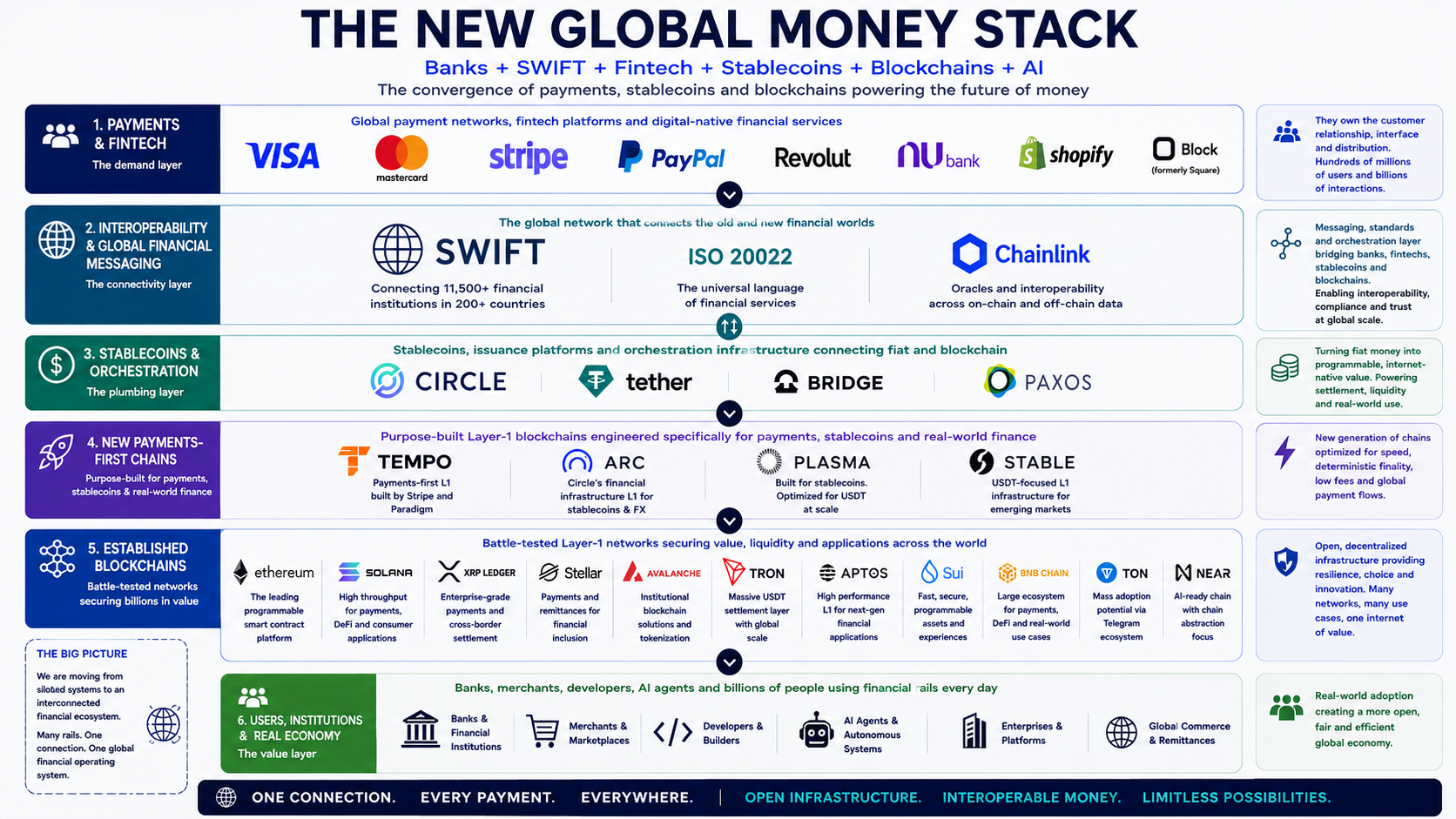
It is not really a blockchain map. It is not really a payments map either. It is a map of how I think value will move through the internet in the 2030s.
The first layer: whoever has a customer relationship wins
At the top of the stack are the companies we interact with every day: Visa, Mastercard, Stripe, PayPal, Revolut, Nubank, Shopify, Block and many others.
They own something incredibly important: distribution.
They have hundreds of millions of customers, millions of merchants and billions of interactions. They understand identity, fraud, checkout, commerce and customer experience. More importantly, customers trust them enough to press the button marked pay.
This is why I have never believed that blockchain would simply sweep the existing payments industry away.
Why would it?
Customers don't wake up in the morning wanting to use a blockchain. They want to buy something, send money to someone, get paid, save, invest or move their money somewhere else. The technology underneath should be largely invisible.
The interesting question therefore isn't whether blockchain replaces Visa, Mastercard, Stripe or PayPal. It is what happens when these companies begin using blockchain infrastructure themselves … and they are.
But between the customer-facing world and the emerging world of stablecoins and blockchains sits something incredibly important.
SWIFT.
SWIFT: the bridge between two financial worlds
For years, the blockchain industry liked to present SWIFT as the old world.
SWIFT was slow. Blockchain was fast. SWIFT represented correspondent banking. Blockchain represented peer-to-peer value. SWIFT belonged to yesterday and crypto belonged to tomorrow.
It was always a rather simplistic argument.
SWIFT is not a bank and does not actually move the underlying money itself. It provides the secure messaging, standards and connectivity that allow thousands of financial institutions around the world to communicate and coordinate financial transactions. That makes SWIFT one of the most important pieces of financial infrastructure ever created, and now SWIFT is changing. Rather than standing outside the tokenised world, it is increasingly positioning itself as a way of connecting it.
That matters enormously because the future financial system is unlikely to consist of one blockchain, one stablecoin or one settlement network. We are going to have many of them.
There will be bank deposits, tokenised deposits, central bank money, stablecoins, tokenised securities, public blockchains, private blockchains, specialised payment chains, existing domestic payment systems, card networks, and whatever comes next.
The danger is obvious. We could replace today's fragmented financial system with tomorrow's fragmented digital financial system. A hundred shiny new digital islands are still a hundred islands. This is where SWIFT becomes interesting. Its future role could be less about being the network and more about being the network of networks. In other words, the connective tissue between traditional banks, tokenised assets, stablecoins, central bank infrastructure and blockchain networks.
That is why I put SWIFT, ISO 20022 and interoperability infrastructure such as Chainlink into their own layer in the picture.
This is the connectivity layer.
If the future of money is multi-network, interoperability becomes one of the most valuable pieces of the whole architecture.
ISO 20022 matters more than most people realise
There is another piece of this layer that rarely gets much attention outside banking technology circles: ISO 20022.
It sounds wonderfully boring. It is also extremely important.
Money doesn't just need to move. Information needs to move with it. Who paid? Who received it? What was the payment for? Which invoice does it relate to? What compliance information accompanies it? What happens if it fails? Who is authorised to make it?
The richer and more standardised that information becomes, the easier it is for banks, payment systems and eventually intelligent machines to understand and automate financial activity. This becomes particularly important when the financial world begins connecting conventional accounts with tokenised money.
Interoperability isn't simply about moving a token from Blockchain A to Blockchain B. It is about making different financial systems understand each other.
That is a much bigger challenge.
Stablecoins become the new plumbing
Then we arrive at Circle, Tether, Bridge, Paxos and the rapidly expanding stablecoin infrastructure industry.
For years, people described stablecoins as crypto products.
That description is missing the mark as Stablecoins are becoming internet-native representations of money.
A dollar in a traditional bank account exists inside a particular banking system, operating environment and jurisdiction. Moving it internationally can involve correspondent banks, payment messages, cut-off times, reconciliation and several intermediaries. A digital dollar represented by a stablecoin can potentially move across an internet-connected network twenty-four hours a day, seven days a week. That changes the economics of money movement.
It also explains why stablecoins have moved from the crypto department to the boardroom. They are no longer simply something people use to trade Bitcoin. They are becoming infrastructure for treasury, settlement, remittances, merchant payments and machine-to-machine commerce.
Circle and Tether provide the money. Companies such as Bridge help businesses connect conventional finance with stablecoin infrastructure. Paxos provides regulated infrastructure behind a range of digital money initiatives.
Together, they are creating another layer in the financial stack: the layer that makes traditional fiat money programmable … but programmable money needs somewhere to move.
Which brings us to perhaps the most interesting part of the whole picture.
The blockchain is being redesigned around money
The first generation of blockchains were designed around a broad idea: create decentralised computing networks and see what people build on them. Bitcoin created decentralised money. Ethereum created programmable money. Solana pushed performance. XRP Ledger and Stellar focused heavily on payments and cross-border value.
Now something else is happening as we are seeing blockchains being created specifically around the requirements of financial services and payments.
Tempo is perhaps the clearest example. Developed by Stripe and Paradigm, its proposition is not simply that the world needs another blockchain. The proposition is that payments have specific requirements around throughput, predictable fees, settlement, compliance and reliability, and therefore deserve infrastructure designed around those requirements.
Circle's Arc reflects a similar direction. Plasma and Stable attack the opportunity from the stablecoin side, particularly around dollar and USDT settlement.
This is an important shift.
The conversation is moving from:
What financial products can we build on a blockchain?
to:
What blockchain would we build if its primary purpose were moving money?
Those are very different questions.
It reminds me of the early internet. At first, companies took their existing businesses and put websites on top of them. Eventually, entirely new companies appeared that were designed around the internet from birth.
We may now be seeing the same thing happening with financial infrastructure.
Then there are the battle-tested networks
None of this means Ethereum, Solana, XRP Ledger, Stellar, Avalanche, TRON, Aptos, Sui, BNB Chain, TON, NEAR and the rest suddenly disappear. Quite the opposite. They provide the enormous experimental laboratory upon which much of this new financial architecture has developed.
Ethereum remains at the centre of much programmable finance and tokenisation. Solana has become increasingly important for high-speed payments, stablecoins and consumer applications. XRP Ledger and Stellar have spent years attacking cross-border payments. TRON has become a major rail for stablecoin transfers. Avalanche has concentrated heavily on institutional and tokenised finance.
Different networks optimise for different things. That is why I don't think there will be one blockchain to rule them all. Money has never worked that way.
There will be public chains, private infrastructure, bank networks, stablecoin networks, tokenised deposit networks and specialised payment chains and, sitting across them, organisations and technologies trying to make them interoperable.
This is why the interesting competition isn't really SWIFT versus blockchain. That framing belongs to the last decade. The interesting question is whether SWIFT can become the trusted interoperability layer for a world of blockchains. If it can, SWIFT doesn't get disrupted by tokenisation. It becomes one of the mechanisms through which tokenisation reaches the banking system.
That's a far more interesting proposition.
And then AI turns up
Just when you thought this architecture was complicated enough, artificial intelligence arrives. Most payment infrastructure has been designed around humans. A human opens an account. A human chooses a product. A human enters a card number. A human approves a payment. But what happens when the customer is software?
An AI agent booking a business trip may negotiate with dozens of airlines, hotels, transport providers and insurers. Another agent might manage a company's cloud infrastructure and purchase computing capacity dynamically. Another could manage a supply chain, buying components and paying suppliers without waiting for someone in accounts payable to approve every transaction.
These systems will need identity, authority, limits, compliance, liability and auditability. They will also need money that behaves like software. That is where programmable payments, stablecoins and blockchain settlement start to look less like a crypto experiment and more like infrastructure for the agentic economy.
An autonomous machine doesn’t care whether the underlying transaction uses SWIFT, a stablecoin, a tokenised deposit, Tempo, Ethereum or Solana. It will simply choose the route that satisfies its instructions around price, speed, liquidity, risk and compliance.
Think about that for a moment.
We may be moving from humans choosing payment methods to machines choosing payment rails.
That could profoundly alter the economics of payments.
The bottom of the stack is actually the point
There is one thing I particularly like about this diagram.
At the bottom are not blockchains. There are people, businesses and institutions. Banks, merchants, developers, enterprises, consumers and, increasingly, AI agents.
That matters because technology industries have a terrible habit of becoming fascinated with their own plumbing. Nobody cares which database their bank uses. Nobody chooses an airline because of its API architecture. Nobody buys coffee because the merchant has a particularly impressive cloud deployment.
Blockchain will become genuinely successful when we stop talking about blockchain. The same applies to SWIFT, stablecoins, tokenisation, and blockchains.
You'll just make a payment.
You won't consciously use ISO 20022. You won't think about whether you hold a tokenised dollar, deposit token or conventional bank balance.
You'll just make a payment.
And somewhere underneath that simple action, Stripe might orchestrate the transaction, Circle might provide the digital dollar, SWIFT might provide connectivity into the banking system, Chainlink might connect different networks, Tempo or Solana might process the transaction and a bank might provide the liquidity.
Whether or not an AI agent has initiated the whole thing, the customer neither knows nor cares. That is success.
From networks to a network of networks
This is why I have changed the title of the picture.
Originally, I called it The New Global Payments Stack. I now think that is too narrow. It is The New Global Money Stack.
Payments are only one part of it.
What we are seeing is the gradual convergence of bank money, stablecoins, tokenised assets, blockchains, payment networks, financial messaging and artificial intelligence.
The crucial word is not blockchain. It isn't stablecoin. It isn't even AI. It is interoperability.
The future financial system cannot work if every bank, fintech, blockchain and stablecoin becomes another walled garden. The winners will therefore be the companies and networks that connect those worlds.
SWIFT, Visa and Mastercard, Stripe and Circle understand this. The blockchain industry increasingly understands it and most banks are beginning to understand it.
We spent the last thirty years putting finance onto the internet. We may spend the next decade connecting all forms of money through it. And it won’t be one blockchain, one stablecoin, one bank or one network. It will be many rails creating one interconnected financial ecosystem.
Will that be the real architecture of money in the 2030s?

Chris M Skinner
Chris Skinner is best known as an independent commentator on the financial markets through his blog, TheFinanser.com, as author of the bestselling book Digital Bank, and Chair of the European networking forum the Financial Services Club. He has been voted one of the most influential people in banking by The Financial Brand (as well as one of the best blogs), a FinTech Titan (Next Bank), one of the Fintech Leaders you need to follow (City AM, Deluxe and Jax Finance), as well as one of the Top 40 most influential people in financial technology by the Wall Street Journal's Financial News. To learn more click here...