
We gave them our data, our money, our businesses and now our intelligence. In return, they gave us convenience. Nobody asked who would end up controlling the world.
I have been thinking a lot about the Google Cloud outage this week and the fact that a power failure in a London data centre disrupted banking services across Britain. Revolut, Lloyds, Halifax and HSBC were among those affected, leaving customers struggling to access their money and make payments.
I have written extensively about this issue, particularly in my recent series about the dangers of concentration risk, beginning with Too Cloud to Fail* and, more recently, releasing a book all about it called Who owns the Oxygen? My argument was that we had spent decades reducing the systemic risks of banking while creating an entirely new form of systemic risk through our dependence on a handful of technology companies.
Then Google went down and we discovered what that meant.
But the more I think about it, the more I realise that the outage is merely a symptom of something far bigger, something that has been happening for decades and that we have barely noticed.
We have sleepwalked into stupidity.
Think about what we have done.
Over the past thirty years, we have voluntarily handed over an extraordinary amount of information about ourselves, our businesses, our finances and our lives to a remarkably small number of corporations.
Our personal information goes to Google, Meta, Apple and the social media platforms. Our shopping habits go to Amazon and the digital marketplaces. Our corporate information goes to Microsoft and Amazon Web Services. Our financial information flows through banks, payment networks, fintech platforms and the technology providers supporting them.
We have become dependent upon a few companies who now control our lives.
Our photographs, conversations, friendships, movements, interests, purchases, investments, business plans, intellectual property and commercial relationships are increasingly stored, processed or analysed through systems operated by companies we do not control.
And now we are doing the same thing with artificial intelligence.
We are giving AI systems our questions, ideas, strategies, documents, decisions and problems. We are asking them to interpret our world, advise us on our futures and increasingly make decisions on our behalf.
We are not just outsourcing the storage and processing of information anymore. We are beginning to outsource intelligence itself.
How the hell did we get here? It is easy to see if you look to the past and how we got here today as I have been developing an argument about the history of civilisation, wealth and power around a deceptively simple question: Who owns the oxygen?
Imagine that somebody could own the air we breathe. Every breath would have a price, every human being would become a customer and whoever controlled the oxygen would possess unlimited power.
It sounds absurd, but throughout history the greatest fortunes have been built around this principle. Find something people cannot live without, establish control over it and turn that dependency into wealth.
In the agricultural age, that resource was land and water. Whoever controlled the land controlled food production, employment and the livelihoods of entire communities. The pyramids of ancient Egypt were monuments to a civilisation in which power was concentrated around rulers who commanded land, labour, resources and the agricultural surplus of the Nile.
The Industrial Revolution created a new pyramid of power. The owners of factories, machinery, railways, coal and steel accumulated enormous fortunes because the modern economy depended upon their infrastructure. Oil subsequently became one of the world's most strategically important resources, shaping international relationships, wars and the fortunes of nations.
Then came the financial age, when access to capital, credit and payments became essential to economic participation. Banks controlled the infrastructure of money, and those who controlled banking exercised extraordinary influence over businesses, governments and individuals.
Each revolution changed the resource, but the underlying process remained remarkably consistent.
Scarcity creates value. Value attracts ownership. Ownership concentrates wealth. Wealth becomes power.
And power allows its owners to shape the rules governing everyone else's access to the resources they need.
I call this the pyramid of power.
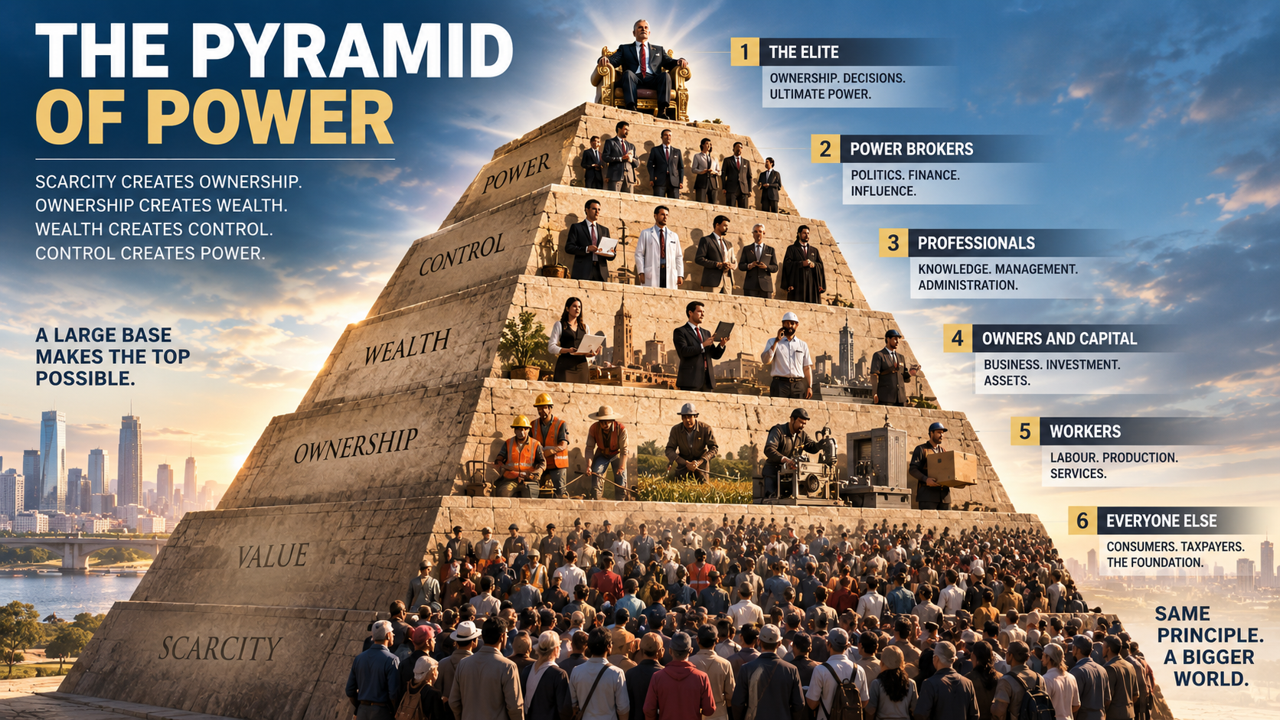
Now we are building another pyramid, and this time the essential resource is digital.
Data, computing infrastructure, communications networks and artificial intelligence are becoming as fundamental to economic life as land, energy and capital were in earlier centuries.
The difference is that we are creating this new pyramid with astonishing speed, and we are doing it voluntarily.
Nobody forced us to surrender control of so much of our digital lives. There was no invasion, no revolution and no dramatic announcement that the infrastructure of modern civilisation would be concentrated among a handful of private corporations. Instead, it happened through millions of perfectly rational decisions.
We thought we were democratising access to information but, instead, we have been centralising control of our lives, our businesses, our economies, our world through the platforms where all of our data and information flows. We thought we were creating greater competition, but what we are actually building is a world that depends upon the infrastructure controlled by just a few companies whose scale makes them extraordinarily difficult to challenge. We thought we were becoming more independent, but we are creating brand new forms of dependency and we barely noticed because the process was gradual, convenient and extraordinarily successful.
We knew what we were buying, but we never understood what we were giving away.
Amazon, Microsoft and Alphabet dominate cloud infrastructure. NVIDIA supplies much of the advanced computing hardware driving the AI revolution. Apple and Google control the two dominant smartphone operating systems. Meta and X influence how information circulates, while OpenAI, Anthropic and other AI developers are shaping the systems through which we increasingly analyse information and make decisions.
These are different businesses operating at different layers of the digital economy, but their combined influence demonstrates how concentrated the foundations of modern digital life have become.
And the same broad pattern is emerging in Asia.
Alibaba and Ant Group have built extensive ecosystems spanning commerce, payments, financial services and technology. Tencent has created an extraordinary digital environment through WeChat and WeChat Pay, integrating communications, shopping, payments and everyday services into a single platform.
China's political and regulatory environment differs significantly from that of America and Europe, particularly in the relationship between the state and major technology companies, but the underlying economic dynamic is the same.
As platforms become more integrated and essential to everyday life, the organisations controlling them acquire greater influence over the people and businesses that depend upon them.
This is how the pyramids of power work.
At the bottom are billions of people and millions of businesses who depend on digital services to participate in the economy. Above them are the platforms through which they communicate, trade, transact and access information. Above those are the companies controlling critical infrastructure, computing capacity, software ecosystems and increasingly artificial intelligence.
The higher you climb the pyramid, the fewer organisations you find, and the more dependent the world becomes on those organisations, the greater their economic power.
There is an important distinction here. These corporations do not own all the data stored or processed through their systems, and contractual rights, privacy laws and technical safeguards restrict what providers are permitted to do with customer information, but owning the data is not the same as controlling the infrastructure required to use it.
You do not need to own the oxygen to exercise power over people who depend on your systems to breathe.
Control the supply, control the distribution or control the price of access, and you acquire influence over everyone who depends upon that resource.
That is the lesson of the pyramids of power, and it is playing out again in the digital economy.
The financial system has become part of somebody else's pyramid
This brings me back to banking and the Google Cloud outage.
For centuries, banks occupied an exceptionally powerful position because they controlled access to money. They operated the ledgers, managed payments, provided credit and maintained the infrastructure connecting businesses and consumers to the financial system.
They also controlled all of their systems and processes. Then there was outsourcing and offshoring and cloud. The world changed.
Today, banks increasingly rely on technology infrastructure operated by other companies.
They still manage deposits, provide credit, hold capital and maintain customer relationships, but many of the systems required to deliver their services are supplied by cloud providers, software companies, payments processors and other technology specialists.
The banks have not surrendered their regulatory responsibilities, but they have become dependent on infrastructure they do not fully control and that has changed the balance of power.
When Google Cloud suffered its outage, the affected banks had not run out of money. Their balance sheets had not collapsed, and there was no traditional financial crisis, and yet customers experienced disruption because the technology connecting them to financial services was unavailable.
The incident has exposed a fundamental distinction between financial resilience and operational resilience. A bank may have sufficient capital to withstand a recession, enough liquidity to survive a market panic and sophisticated systems for managing credit risk, but none of those protections guarantees that customers can access their money when critical technology fails. This is the new concentration risk I have been warning about.
In 2008, the financial system nearly collapsed because banks were dangerously interconnected through financial exposures. Today, banks are increasingly interconnected through technological dependencies.
A thousand banks can each have excellent risk management systems and still depend on the same underlying infrastructure. Everyone may have diversified their individual risk while nobody has diversified the system. The Google outage demonstrated the vulnerability, but it has also exposed something more profound.
The institutions that once controlled access to money increasingly depend on corporations that control access to the technology required to move it.
* the blog series:
Too Intelligent to Fail (Part Two)
Too Digital to Fail (Part Four)
Chris M Skinner
Chris Skinner is best known as an independent commentator on the financial markets through his blog, TheFinanser.com, as author of the bestselling book Digital Bank, and Chair of the European networking forum the Financial Services Club. He has been voted one of the most influential people in banking by The Financial Brand (as well as one of the best blogs), a FinTech Titan (Next Bank), one of the Fintech Leaders you need to follow (City AM, Deluxe and Jax Finance), as well as one of the Top 40 most influential people in financial technology by the Wall Street Journal's Financial News. To learn more click here...