Is your bank a world-class orchestra, or just a collection of musicians making a lot of noise?
I’ve often compared a bank to an orchestra. In fact, back in 2016, I wrote an article called The future CIO is not a CIO, arguing that the Chief Information Officer was evolving from being the person responsible for maintaining technology into the conductor of an increasingly complex financial ecosystem. The argument was that banks were moving away from being monolithic, internally controlled organisations towards open platforms, marketplaces and networks. The CIO’s role was no longer to own every instrument, employ every musician or write every note. It was to make sure that all the different players could perform together, creating something far greater than the sum of their individual contributions.
Ten years later, I’ve been revisiting that idea and realised something fundamental has changed. The conductor is no longer the CIO. The conductor is the CEO.
Why?
Because technology is no longer a department within a bank. Technology is the bank.
Payments, lending, investments, insurance, customer relationships, risk management and regulatory compliance are all increasingly dependent upon digital platforms, data and artificial intelligence. In my book Digital Bank, I argued that banks needed to become digital at the core. Today, even that is no longer enough. Now I argue that banks need to be AI-native, with intelligence embedded throughout their operations, decisions and customer relationships. The CEO therefore needs to understand not just the business of banking, but how all the instruments of modern finance work together.
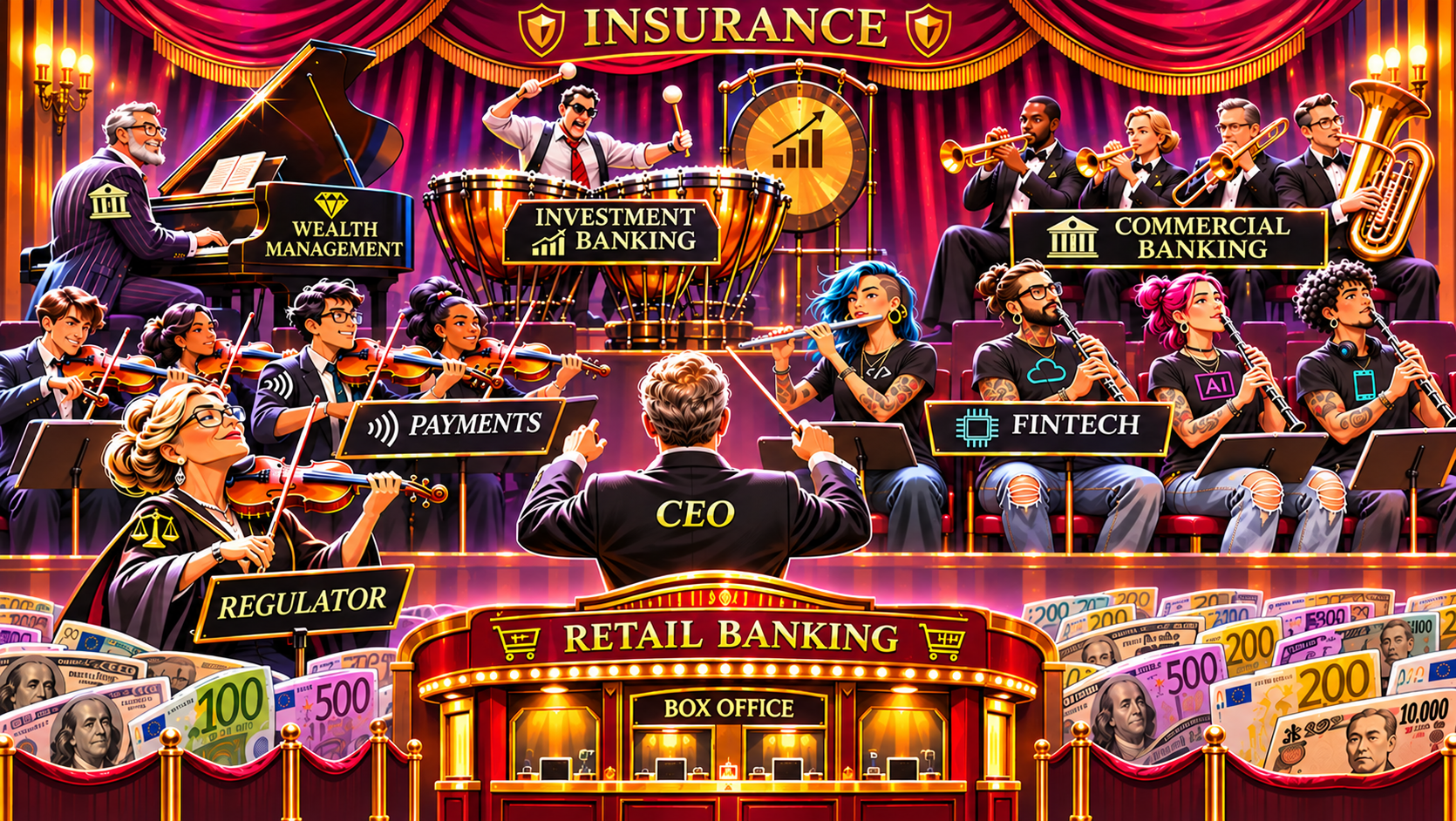
This got me thinking about what the modern financial orchestra would look like, and I came up with the illustration above. It is a slightly irreverent view of banking, with different financial functions represented by the various sections of a symphony orchestra. Each has its own personality, traditions, strengths and weaknesses, and each believes its contribution is the most important. The challenge for the conductor is to bring them together into a coherent performance.
Welcome to the Symphony of Finance.
Let’s start with the string section. The violins, cellos and double basses.
In an orchestra, the strings provide continuity, movement and much of the melody. They are constantly working, providing the foundation upon which everything else is built. In banking, that’s payments. Every second of every day, billions of transactions are being initiated, processed, cleared and settled across an extraordinary network of banks, payment providers, merchants and customers.
Most of the time, nobody notices because everything works. The money moves, the transaction completes and life continues. Yet when the payments section stops playing, everyone notices immediately. Customers cannot buy their groceries, businesses cannot receive their revenues, and the financial system begins to seize up. Payments are the melody of the modern economy, and the orchestra cannot function without them.
Behind the strings sits the brass section, representing commercial banking.
The brass instruments are powerful, confident and authoritative, providing weight and presence to the performance. They are the heavyweights of finance, supporting businesses through lending, working capital, trade finance and treasury services. These are the institutions that provide finance factories, infrastructure, international trade and economic growth.
In my illustration, they are appropriately dressed in dinner jackets, reflecting the established traditions of commercial banking – you only need to go to SIBOS to see what this means – but their challenge is that the music is changing. Businesses increasingly expect instant payments, embedded financial services, automated lending and real-time information. The brass section cannot continue playing the same old tune when the rest of the orchestra has moved on. It needs to modernise without losing the strength, stability and reliability that make it so important.
Then there is the percussion section, which I’ve assigned to investment banking.
This seemed appropriate because investment bankers have a remarkable ability to create excitement, drama and occasionally an almighty crash.
When capital markets are booming, the drums are rolling, the cymbals are crashing and everyone is enjoying the performance. Investment banking provides the capital, liquidity and financial engineering that support corporate expansion, mergers, acquisitions and investment activity.
Having said that, it can also introduce volatility, complexity and risk.
We have all seen what happens when the percussion section becomes a bit too enthusiastic, most notably during the 2008 financial crisis but, nevertheless, the CEO needs the energy and ambition of investment banking. On the other hand, the CEO must make sure that the percussion section doesn’t drown out all of the other instruments. A symphony is not improved by having the drummer play louder than the rest of the orchestra.
Then we come to my favourite section, the woodwinds representing fintech.
The musicians look as though they’ve wandered into the wrong concert, and that’s rather the point. Fintech has always challenged the conventions of traditional banking. Its players don’t respect established rules, dress codes or hierarchies. They want to experiment, improvise and introduce new sounds. They are bringing artificial intelligence, blockchain, digital wallets, embedded finance, tokenisation and autonomous financial services into the orchestra. Some of their ideas are brilliant, others are dreadful, and a few will transform the entire performance. Either way, it all adds to the music.
The challenge for the CEO is to integrate these innovators without destroying the creativity that makes them valuable. Force them all into dinner jackets, make them follow every traditional process and insist they play exactly the same music as everyone else, and you’ve defeated the purpose of inviting them into the orchestra.
Equally, let them improvise without any coordination, and the result is chaos. This is the tension between established banks and fintech innovators. One side values stability, control and predictability, while the other values speed, experimentation and disruption. Both have something to contribute, and neither can deliver the future of finance alone. The best conductors understand that innovation needs freedom, but freedom also needs coordination.
Then we have the Grand Piano and, sitting at the Grand Piano, is wealth management.
The specialist performer capable of extraordinary sophistication, precision and individual flair.
Wealth management has traditionally been built around personal relationships, expert judgement and an understanding of customers’ ambitions, investments, families and financial futures. Unlike the mass-market payments business, the strings, wealth management is highly personalised, and its clients expect a performance tailored to their individual circumstances.
Yet even this exclusive part of banking is being transformed.
Artificial intelligence can analyse portfolios, assess risk, identify investment opportunities and provide increasingly sophisticated financial guidance. Robo-advisers and digital wealth platforms are making investment services accessible to customers who would never have qualified for traditional private banking.
The question is whether technology replaces the pianist or makes the pianist better.
I would argue the latter because a great pianist brings interpretation, sensitivity and emotion to the music. In wealth management, the equivalent is understanding the human being behind the financial portfolio. Money is never just about numbers. It is about people’s lives.
Then we come to the one person who sets the rules for the symphony.
That is the concertmaster.
Every orchestra has a concertmaster, the lead first violinist who coordinates the musicians, sets standards and provides a critical link between the conductor and the orchestra.
In my financial orchestra, I’ve given this role to the regulator.
Regulators don’t run banks and they shouldn’t be writing the business strategy. Their responsibility is to establish the rules within which the financial system operates, protect customers and maintain confidence in the system. They set standards, monitor performance and intervene when institutions take excessive risks or threaten the stability of the wider financial system.
Bankers often complain that regulators restrict innovation and make life unnecessarily difficult yet imagine an orchestra in which every musician ignored the score, played at whatever volume they wanted and followed their own interpretation of the music. It wouldn’t be an orchestra for very long.
The relationship between the CEO and the regulator is therefore critical. They have different responsibilities, but both have an interest in ensuring the performance succeeds. The regulator doesn’t conduct the orchestra, but the conductor would be foolish to ignore the concertmaster.
Equally, the regulator needs to recognise that the orchestra must evolve, introducing new instruments, new techniques and new compositions rather than performing the same music forever.
Behind the orchestra are the great red curtains marked Insurance.
This is deliberate because insurance provides the protection that allows individuals, businesses and institutions to take risks with greater confidence. It is the financial safety net supporting economic activity from protecting homes and businesses to underwriting international trade and major infrastructure projects.
Insurance rarely takes centre stage in discussions about the future of finance but, without it, many of the activities that banks finance would become prohibitively risky. Insurance provides the backdrop that makes much of the performance possible, and it too is undergoing a technological revolution as artificial intelligence transforms underwriting, claims processing, fraud detection and risk assessment. Even the curtains are becoming intelligent.
At the front of the concert hall is the box office, representing retail banking.
This is where the customer enters the financial system, opening accounts, depositing money, applying for mortgages, obtaining loans and accessing the services needed in everyday life.
For generations, that box office was a physical bank branch. Today, it is an app.
Customers expect banking to be available whenever and wherever they need it. It reminds me of the old advertising slogan that inspired my idea of Martini Banking: anytime, anyplace, anywhere.
Customers don’t care whether their payment is processed through one network or another, whether their mortgage involves artificial intelligence or whether their bank uses cloud infrastructure. They want the experience to work, and they want it to be easy, reliable and secure. A magnificent orchestra is worthless if nobody can buy a ticket or get through the door.
Finally, look at the audience. Instead of people, I’ve filled the concert hall with dollars, euros, yen and other currencies.
The audience represents the money flowing through the global financial system, but the important point is that money itself is not the customer because, behind every banknote, is a person, a business, a government or an institution with a reason for using financial services.
The orchestra exists to serve them, and this is something banks sometimes forget.
They become so obsessed with their internal structures, products, systems and performance targets that they lose sight of why they exist. The audience doesn’t care how technically accomplished the second violinist is or how much the percussion section has invested in new equipment. It cares about the performance. Customers are exactly the same. They judge a bank by the experience it delivers, the confidence it inspires and the value it creates. If the music is terrible, the audience leaves.
Which brings me back to the question I first raised ten years ago. Who is conducting this extraordinary orchestra, and who is responsible when the music goes wrong?
In 2016, I argued that the CIO would become the Chief Conductor because banking was becoming a platform business, integrating internal systems, external partners and distributed services. That argument remains valid, but the responsibility has moved to a higher level as, today, the CEO must be the conductor because the entire institution is becoming a technology-enabled, data-driven, AI-native ecosystem.
The CEO doesn’t need to be the best violinist, trumpeter, drummer or pianist. In fact, trying to play every instrument would be disastrous. The CEO needs to understand what each section of the orchestra contributes, how to optimise their contribution, and how the entire performance fits together.
This is particularly important as artificial intelligence begins to transform the nature of banking itself.
Imagine an orchestra in which some musicians are human, others are AI agents, and many of the instruments can play themselves.
Payments can be initiated by autonomous software, lending decisions can be made by algorithms, investment portfolios can be managed by intelligent agents and customer interactions can be handled by conversational systems. The conductor is no longer coordinating people alone, but people, machines, algorithms, platforms and partners.
Who decides what music they should play? Who determines whether the performance is successful? Who takes responsibility when an autonomous instrument plays the wrong note? The answer cannot be the technology department.
It must be the CEO.
This is why I believe the modern banking CEO must also become the ultimate Chief Information Officer, not in the traditional sense of managing technology infrastructure but in understanding how information, intelligence and technology shape every part of the business.
It doesn’t mean that the CIO disappears or becomes less important. Quite the opposite. The CIO remains responsible for ensuring that the technological instruments can perform together, but the CEO must understand the capabilities, limitations and opportunities those instruments create. The distinction is that the CIO conducts the technology, while the CEO conducts the institution. The CEO owns the music.
There is another important difference between the orchestra of 2016 and the orchestra of today. Back then, the challenge was largely about connectivity and integration, bringing together systems, platforms and partners to create a seamless digital bank. Today, the challenge is about intelligence and autonomy. Artificial intelligence is beginning to make decisions, initiate actions and coordinate activities across organisational boundaries. This changes the nature of management itself, because the CEO is no longer just directing departments and people, but overseeing systems that can increasingly operate without direct human intervention.
Consider what happens when every department deploys its own artificial intelligence.
Payments develops autonomous transaction systems, commercial banking introduces AI-driven lending, investment banking deploys trading algorithms, wealth management creates intelligent advisers, and fintech partners introduce their own autonomous agents. Each department could become extraordinarily efficient, optimising its own operations and improving its individual performance. Yet if those systems cannot communicate, coordinate or understand the wider objectives of the organisation, the result could be an extraordinarily efficient collection of disconnected systems.
Every section might perform brilliantly, while the orchestra sounds dreadful.
This is the difference between implementing AI and becoming AI-native.
An AI-native bank is not one in which every department has artificial intelligence. It is one in which intelligence connects the entire organisation, allowing information, decisions and actions to flow across traditional boundaries. It requires common standards, shared data, coordinated governance and clear accountability, alongside the freedom for individual business functions to innovate and improve. The CEO’s job is to create that harmony, ensuring that the technology serves the strategy rather than allowing the strategy to become a collection of technology projects.
And this brings us to the biggest challenge facing banking leadership today.
Most banks are still organised around individual business lines, each with its own management team, budget, technology priorities and performance measures.
Each section of the orchestra has its own conductor.
Payments wants to improve transaction volumes and revenues; commercial banking wants to increase lending; investment banking wants to generate returns; wealth management wants to grow assets under management; technology wants to modernise infrastructure; and compliance wants to reduce risk. Each has its own objectives and incentives, and each believes its contribution is critical to the institution’s success.
The problem is that an orchestra cannot succeed if every section is playing a different composition.
A great conductor doesn’t make every musician play the same instrument or insist that every section performs at the same volume. The conductor understands the composition, recognises the strengths of the musicians and brings them together at the right moment to create something extraordinary.
Sometimes the violins lead, sometimes the brass dominates, sometimes the percussion creates the drama and sometimes the entire orchestra comes together in a magnificent crescendo. The conductor knows when to encourage, when to restrain, when to listen and when to intervene.
That is the role of the modern banking CEO.
ng businesses through lending, working capital, trade finance and treasury services. These are the institutions that provide trade finance for factories, infrastructure, international trade and economic growth.
In my illustration, they are appropriately dressed in dinner jackets, reflecting the established traditions of commercial banking – you only need to go to SIBOS to see what this means – but their challenge is that the music is changing. Businesses increasingly expect instant payments, embedded financial services, automated lending and real-time information. The brass section cannot continue playing the same old tune when the rest of the orchestra has moved on. It needs to modernise without losing the strength, stability and reliability that make it so important.
Then there is the percussion section, which I’ve assigned to investment banking.
This seemed appropriate because investment bankers have a remarkable ability to create excitement, drama and occasionally an almighty crash.
When capital markets are booming, the drums are rolling, the cymbals are crashing and everyone is enjoying the performance. Investment banking provides the capital, liquidity and financial engineering that support corporate expansion, mergers, acquisitions and investment activity.
Having said that, it can also introduce volatility, complexity and risk.
We have all seen what happens when the percussion section becomes a bit too enthusiastic, most notably during the 2008 financial crisis but, nevertheless, the CEO needs the energy and ambition of investment banking. On the other hand, the CEO must make sure that the percussion section doesn’t drown out all of the other instruments. A symphony is not improved by having the drummer play louder than the rest of the orchestra.
Then we come to my favourite section, the woodwinds representing fintech.
The musicians look as though they’ve wandered into the wrong concert, and that’s rather the point. Fintech has always challenged the conventions of traditional banking. Its players don’t respect established rules, dress codes or hierarchies. They want to experiment, improvise and introduce new sounds. They are bringing artificial intelligence, blockchain, digital wallets, embedded finance, tokenisation and autonomous financial services into the orchestra. Some of their ideas are brilliant, others are dreadful, and a few will transform the entire performance. Either way, it all adds to the music.
The challenge for the CEO is to integrate these innovators without destroying the creativity that makes them valuable. Force them all into dinner jackets, make them follow every traditional process and insist they play exactly the same music as everyone else, and you’ve defeated the purpose of inviting them into the orchestra.
Equally, let them improvise without any coordination, and the result is chaos. This is the tension between established banks and fintech innovators. One side values stability, control and predictability, while the other values speed, experimentation and disruption whilst both have something to contribute, but neither can deliver the future of finance alone. The best conductors understand that innovation needs freedom, but freedom also needs coordination.
Then we have the Grand Piano and, sitting at the Grand Piano, is wealth management.
The specialist performer capable of extraordinary sophistication, precision and individual flair.
Wealth management has traditionally been built around personal relationships, expert judgement and an understanding of customers’ ambitions, investments, families and financial futures. Unlike the mass-market payments business, the strings, wealth management is highly personalised, and its clients expect a performance tailored to their individual circumstances.
Yet even this exclusive part of banking is being transformed.
Artificial intelligence can analyse portfolios, assess risk, identify investment opportunities and provide increasingly sophisticated financial guidance. Robo-advisers and digital wealth platforms are making investment services accessible to customers who would never have qualified for traditional private banking.
The question is whether technology replaces the pianist or makes the pianist better.
I would argue the latter because a great pianist brings interpretation, sensitivity and emotion to the music. In wealth management, the equivalent is understanding the human being behind the financial portfolio. Money is never just about numbers. It is about people’s lives.
Then we come to the one person who sets the rules for the symphony.
That is the concertmaster.
Every orchestra has a concertmaster, the lead first violinist who coordinates the musicians, sets standards and provides a critical link between the conductor and the orchestra.
In my financial orchestra, I’ve given this role to the regulator.
Regulators don’t run banks and they shouldn’t be writing the business strategy. Their responsibility is to establish the rules within which the financial system operates, protect customers and maintain confidence in the system. They set standards, monitor performance and intervene when institutions take excessive risks or threaten the stability of the wider financial system.
Bankers often complain that regulators restrict innovation and make life unnecessarily difficult yet imagine an orchestra in which every musician ignored the score, played at whatever volume they wanted and followed their own interpretation of the music. It wouldn’t be an orchestra for very long.
The relationship between the CEO and the regulator is therefore critical. They have different responsibilities, but both have an interest in ensuring the performance succeeds. The regulator doesn’t conduct the orchestra, but the conductor would be foolish to ignore the concertmaster.
Equally, the regulator needs to recognise that the orchestra must evolve, introducing new instruments, new techniques and new compositions rather than performing the same music forever.
Behind the orchestra are the great red curtains marked Insurance.
This is deliberate because insurance provides the protection that allows individuals, businesses and institutions to take risks with greater confidence. It is the financial safety net supporting economic activity from protecting homes and businesses to underwriting international trade and major infrastructure projects.
Insurance rarely takes centre stage in discussions about the future of finance but, without it, many of the activities that banks finance would become prohibitively risky. Insurance provides the backdrop that makes much of the performance possible, and it too is undergoing a technological revolution as artificial intelligence transforms underwriting, claims processing, fraud detection and risk assessment. Even the curtains are becoming intelligent.
At the front of the concert hall is the box office, representing retail banking.
This is where the customer enters the financial system, opening accounts, depositing money, applying for mortgages, obtaining loans and accessing the services needed in everyday life.
For generations, that box office was a physical bank branch. Today, it is an app.
Customers expect banking to be available whenever they need it, wherever they happen to be, all of the time and anytime. It reminds me of an old idea we had of Martini Banking, anytime, anyplace, anywhere.
Customers don’t care whether their payment is processed through one network or another, whether their mortgage involves artificial intelligence or whether their bank uses cloud infrastructure. They want the experience to work, and they want it to be easy, reliable and secure. A magnificent orchestra is worthless if nobody can buy a ticket or get through the door.
Finally, look at the audience. Instead of people, I’ve filled the concert hall with dollars, euros, yen and other currencies.
The audience represents the money flowing through the global financial system, but the important point is that money itself is not the customer because, behind every banknote, is a person, a business, a government or an institution with a reason for using financial services.
The orchestra exists to serve them, and this is something banks sometimes forget.
They become so obsessed with their internal structures, products, systems and performance targets that they lose sight of why they exist. The audience doesn’t care how technically accomplished the second violinist is or how much the percussion section has invested in new equipment. It cares about the performance. Customers are exactly the same. They judge a bank by the experience it delivers, the confidence it inspires and the value it creates. If the music is terrible, the audience leaves.
And who is conducting, which is the challenge I asked ten years ago.
In 2016, I argued that the CIO would become the Chief Conductor because banking was becoming a platform business, integrating internal systems, external partners and distributed services. That argument remains valid, but the responsibility has moved to a higher level as, today, the CEO must be the conductor because the entire institution is becoming a technology-enabled, data-driven, AI-native ecosystem.
The CEO doesn’t need to be the best violinist, trumpeter, drummer or pianist. In fact, trying to play every instrument would be disastrous. The CEO needs to understand what each section of the orchestra contributes, how to optimise their contribution, and how the entire performance fits together.
This is particularly important as artificial intelligence begins to transform the nature of banking itself.
Imagine an orchestra in which some musicians are human, others are AI agents, and many of the instruments can play themselves.
Payments can be initiated by autonomous software, lending decisions can be made by algorithms, investment portfolios can be managed by intelligent agents and customer interactions can be handled by conversational systems. The conductor is no longer coordinating people alone, but people, machines, algorithms, platforms and partners.
Who decides what music they should play? Who determines whether the performance is successful? Who takes responsibility when an autonomous instrument plays the wrong note? The answer cannot be the technology department.
It must be the CEO.
This is why I believe the modern banking CEO must also become the ultimate Chief Information Officer, not in the traditional sense of managing technology infrastructure but in understanding how information, intelligence and technology shape every part of the business.
It doesn’t mean that the CIO disappears or becomes less important. Quite the opposite. The CIO remains responsible for ensuring that the technological instruments can perform together, but the CEO must understand the capabilities, limitations and opportunities those instruments create. The distinction is that the CIO conducts the technology, while the CEO conducts the institution. The CEO owns the music.
There is another important difference between the orchestra of 2016 and the orchestra of today. Back then, the challenge was largely about connectivity and integration, bringing together systems, platforms and partners to create a seamless digital bank. Today, the challenge is about intelligence and autonomy. Artificial intelligence is beginning to make decisions, initiate actions and coordinate activities across organisational boundaries. This changes the nature of management itself, because the CEO is no longer just directing departments and people, but overseeing systems that can increasingly operate without direct human intervention.
Consider what happens when every department deploys its own artificial intelligence.
Payments develops autonomous transaction systems, commercial banking introduces AI-driven lending, investment banking deploys trading algorithms, wealth management creates intelligent advisers, and fintech partners introduce their own autonomous agents. Each department could become extraordinarily efficient, optimising its own operations and improving its individual performance. Yet if those systems cannot communicate, coordinate or understand the wider objectives of the organisation, the result could be an extraordinarily efficient collection of disconnected systems.
Every section might perform brilliantly, while the orchestra sounds dreadful.
This is the difference between implementing AI and becoming AI-native.
An AI-native bank is not one in which every department has artificial intelligence. It is one in which intelligence connects the entire organisation, allowing information, decisions and actions to flow across traditional boundaries. It requires common standards, shared data, coordinated governance and clear accountability, alongside the freedom for individual business functions to innovate and improve. The CEO’s job is to create that harmony, ensuring that the technology serves the strategy rather than allowing the strategy to become a collection of technology projects.
And this brings us to the biggest challenge facing banking leadership today.
Most banks are still organised around individual business lines, each with its own management team, budget, technology priorities and performance measures.
Each section of the orchestra has its own conductor.
Payments wants to improve transaction volumes and revenues; commercial banking wants to increase lending; investment banking wants to generate returns; wealth management wants to grow assets under management; technology wants to modernise infrastructure; and compliance wants to reduce risk. Each has its own objectives and incentives, and each believes its contribution is critical to the institution’s success.
The problem is that an orchestra cannot succeed if every section is playing a different composition.
A great conductor doesn’t make every musician play the same instrument or insist that every section performs at the same volume. The conductor understands the composition, recognises the strengths of the musicians and brings them together at the right moment to create something extraordinary.
Sometimes the violins lead, sometimes the brass dominates, sometimes the percussion creates the drama and sometimes the entire orchestra comes together in a magnificent crescendo. The conductor knows when to encourage, when to restrain, when to listen and when to intervene.
That is the role of the modern banking CEO.
Postscript: if you don't like the orchestra analogy, try the football one ...
Chris M Skinner
Chris Skinner is best known as an independent commentator on the financial markets through his blog, TheFinanser.com, as author of the bestselling book Digital Bank, and Chair of the European networking forum the Financial Services Club. He has been voted one of the most influential people in banking by The Financial Brand (as well as one of the best blogs), a FinTech Titan (Next Bank), one of the Fintech Leaders you need to follow (City AM, Deluxe and Jax Finance), as well as one of the Top 40 most influential people in financial technology by the Wall Street Journal's Financial News. To learn more click here...