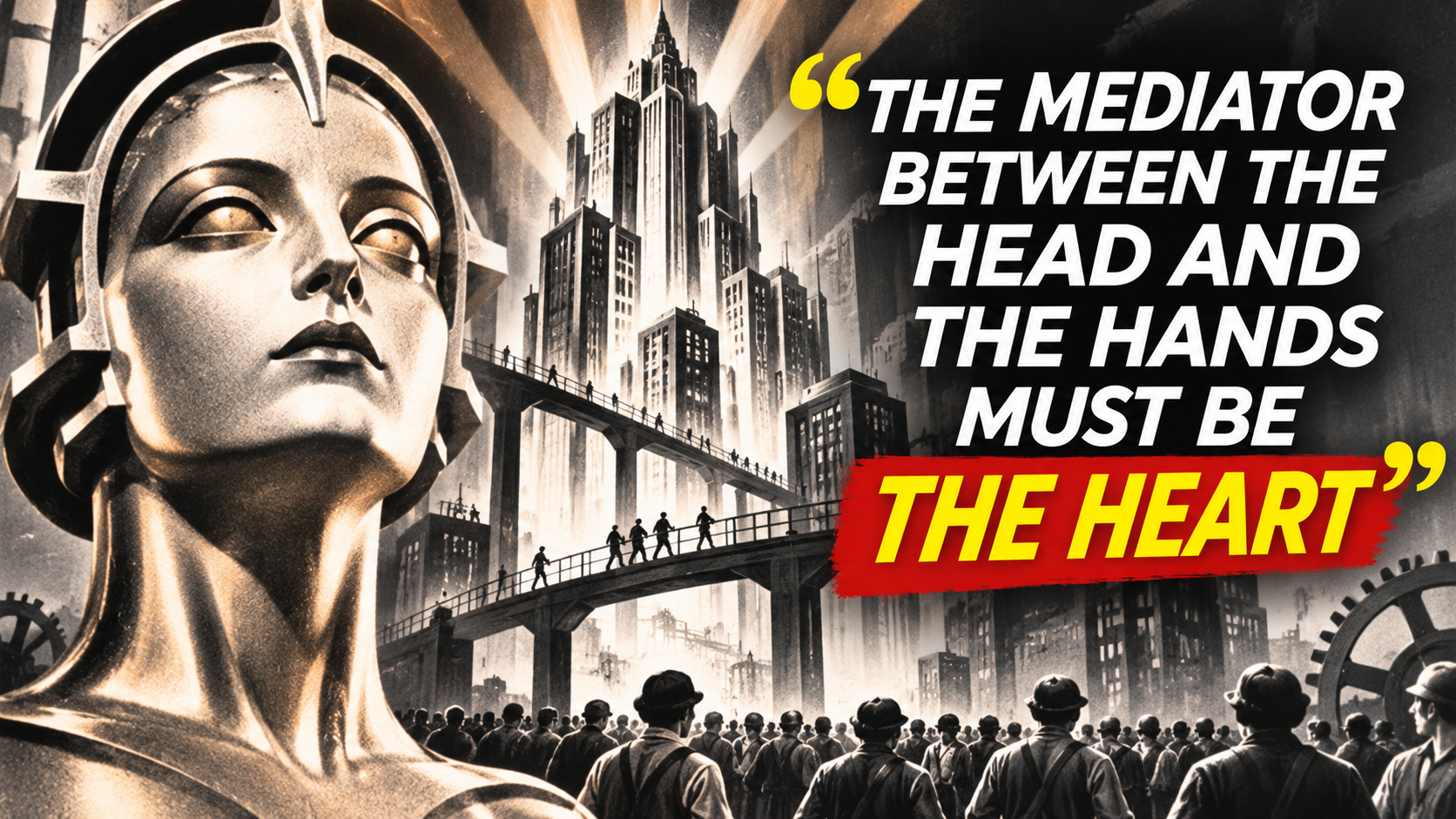
“The Mediator Between the Head and the Hands Must Be the Heart.” — Metropolis, 1927
I have been affected by the film Metropolis for as long as I can remember. Made in 1927 by Fritz Lang, it is almost a century old and yet, whenever I watch it, I wonder whether we have learned anything since.
The film imagines a future in which the wealthy live in extraordinary towers of luxury whilst workers labour underground, operating the machines that keep the city alive. The privileged enjoy the benefits of technological civilisation whilst those who sustain it are treated like dirt, interchangeable parts of an enormous industrial machine. The remarkable thing is that Metropolis was made before computers, artificial intelligence and the internet, yet its central message is as relevant today as it was in 1927.
“The mediator between the head and the hands must be the heart.”
The head represents those who control the system, the hands those who do the work, and the heart the humanity that should connect them. In Lang’s vision, the head has forgotten the hands, creating a society divided between those who have everything and those who have almost nothing. Today, we call them the 1% and the 99%.
The reality is more complicated, but the metaphor captures something fundamental. Wealth creates power, power determines who controls technology, and control of technology increasingly determines who accumulates wealth. It is a great arrangement if you own the machines, but less wonderful if you are among those being replaced. What makes me angry is that we celebrate technologies capable of generating extraordinary wealth without confronting who will receive that wealth. Executives collect bonuses for reducing headcount, shareholders celebrate improved margins and workers receive reassuring presentations about reskilling. Try paying the mortgage with a PowerPoint presentation.
Another reason I love Metropolis is its connection with David Bowie, whose music and imagination have accompanied much of my life. Bowie was fascinated by technology, identity, alienation and humanity’s uncertain relationship with the future. He understood something technology executives often forget. The future is not just about what we create. It is about what those creations do to us.
I wonder what Bowie would make of our world today. Artificial intelligence writes our words, algorithms choose our entertainment and digital platforms shape our relationships. We can communicate with anyone on the planet in seconds yet struggle to talk to the person next to us. We have created machines that imitate human conversation whilst building institutions determined to eliminate human conversation altogether. Bowie would probably have written an album about it, and I would buy it.
Perhaps that is why I keep returning to science fiction. From In Time and The Hunger Games to Snowpiercer, storytellers repeatedly return to the fear that a privileged minority will control the resources upon which everyone else depends. Even the contrast between Star Wars and Star Trek reflects the same question. Will extraordinary technology become an instrument of domination or a means of liberating humanity from scarcity and economic survival? These stories are not predictions. They are warnings about the choices societies make when technological power becomes concentrated.
Which brings us to artificial intelligence.
We are creating technologies capable of performing an increasing proportion of human work whilst concentrating extraordinary computational power, data and infrastructure among relatively few organisations. For centuries, the wealthy depended upon others to create their wealth. Landowners needed agricultural workers, industrialists needed factory workers and bankers needed clerks, analysts and administrators. In Lang’s world, the workers were exploited because the wealthy needed them. Their labour kept the machines running and the city alive. In our world, the danger is far greater. What happens when the wealthy no longer need the workers at all? When machines can manufacture, algorithms can decide and artificial intelligence can perform the intellectual labour upon which millions depend for their livelihoods, what bargaining power remains for the 99%? The industrial revolution created a struggle over who owned the means of production. The AI revolution threatens to create a struggle over who has the right to participate in the economy at all.
I have spent my career celebrating technological innovation and have no intention of becoming a Luddite. AI can transform healthcare, education and financial inclusion whilst eliminating repetitive work. It can enhance and augment human life and our thought processes. History also shows that technological revolutions create new occupations, but what history does not guarantee is that the resulting wealth will be shared fairly. Imagine creating a civilisation capable of extraordinary abundance and then telling millions of people they cannot participate because they no longer have jobs. That would not be a failure of artificial intelligence. It would be a spectacular failure of humanity.
This brings me to a question I have explored in my latest business book, Who Owns the Oxygen?.
Imagine a world in which a handful of corporations controlled the atmosphere, determining how much oxygen everyone could consume, what they paid and whether they qualified to breathe. Is that absurd? Consider how dependent we have become upon digital infrastructure to work, communicate, trade and participate in society. Who owns the cloud, the data, the algorithms and the platforms through which we increasingly conduct our lives? Much of this infrastructure belongs to a relatively small number of extraordinarily powerful corporations. They have created remarkable innovations, but indispensable infrastructure brings responsibilities beyond shareholder returns.
In the industrial age, the wealthy owned the factories and means of production. In the digital age, they increasingly own the platforms, networks and means of participation. In the age of artificial intelligence, they could own the means of thought.
The technology industry loves talking about democratising access and empowering humanity, but these ambitions become hollow when the social consequences of innovation are dismissed as somebody else’s problem. You cannot claim to be transforming humanity whilst refusing to consider what happens to the humans.
This is where banking becomes central.
I recently gave a speech about how banking is being hacked, automated, reinvented and disrupted, all at once. The mainframe automated processing, the internet connected people and artificial intelligence is beginning to automate judgement, decisions and action. Banks determine who receives credit, builds businesses, buys homes and participates in the economy. Money is not oxygen but try living without access to it.
I believe in AI-native banking architectures capable of understanding customers and delivering extraordinary services. What worries me is the motivation behind their deployment. Imagine a bank replacing thousands of employees and celebrating its improved cost-income ratio. The chief executive receives a substantial bonus, shareholders enjoy higher dividends and the stock market applauds another successful transformation programme. Meanwhile, the people whose jobs have disappeared are told to retrain for an economy in which the next generation of machines is already learning to perform the jobs they are being encouraged to pursue. At what point do we stop calling this progress and start asking who progress is supposed to benefit?
I am tired of technology being discussed entirely in terms of efficiency and shareholder value, as though people were an accounting inconvenience. We have even reached the point where a bank boss can describe workers as “lower value human capital”, before having to apologise. What a wonderful expression. Human capital. Not people with mortgages, children, ambitions and lives, but assets whose value can be assessed, depreciated and written off.
We are talking about livelihoods, families and communities. Executives describe redundancy programmes as strategic transformations. Those losing their jobs experience something rather different, and when someone who has lost their job calls the bank because they cannot meet their mortgage payments, they may discover that the only thing available to discuss their circumstances with is another AI system. What an extraordinary achievement. We have automated the process of making people redundant and then automated the process of telling them they cannot afford to live.
That is not my vision of intelligent banking.
A customer is not a data point. A struggling family is not a risk score. Behind every transaction is a person, a relationship, an ambition or a fear. Technology should help us understand people better, not provide an excuse to stop caring about them.
What irritates me the most is the complacency and the assumption that because we can build these systems, we should deploy them immediately and worry about the consequences afterwards. Those who stand to gain the most from automation confidently reassure everyone else that everything will work out. Meanwhile, the people who stand to lose the most are expected to trust those reassurances, even when they have no say in the decisions being made.
We should demand answers about ownership, accountability and how the benefits of artificial intelligence will be distributed. Who will own the productivity gains? Who will share in the prosperity? Who will be responsible when automated decisions destroy livelihoods? These are not questions for engineers alone, or for chief executives and shareholders meeting behind closed doors. They are questions for governments, regulators, businesses and every citizen whose future is being shaped by systems they neither own nor control. Human dignity cannot be reduced to economic productivity.
Almost a century ago, Fritz Lang warned us about a civilisation in which the wealthy depended upon workers whilst remaining indifferent to their suffering. We are approaching something even more disturbing. We are approaching a future in which that dependency could diminish dramatically, leaving millions wondering where they belong in an economy that places declining value on their labour.
The question is no longer whether the head can replace the hands. The question is whether the head still has a heart.
Chris M Skinner
Chris Skinner is best known as an independent commentator on the financial markets through his blog, TheFinanser.com, as author of the bestselling book Digital Bank, and Chair of the European networking forum the Financial Services Club. He has been voted one of the most influential people in banking by The Financial Brand (as well as one of the best blogs), a FinTech Titan (Next Bank), one of the Fintech Leaders you need to follow (City AM, Deluxe and Jax Finance), as well as one of the Top 40 most influential people in financial technology by the Wall Street Journal's Financial News. To learn more click here...