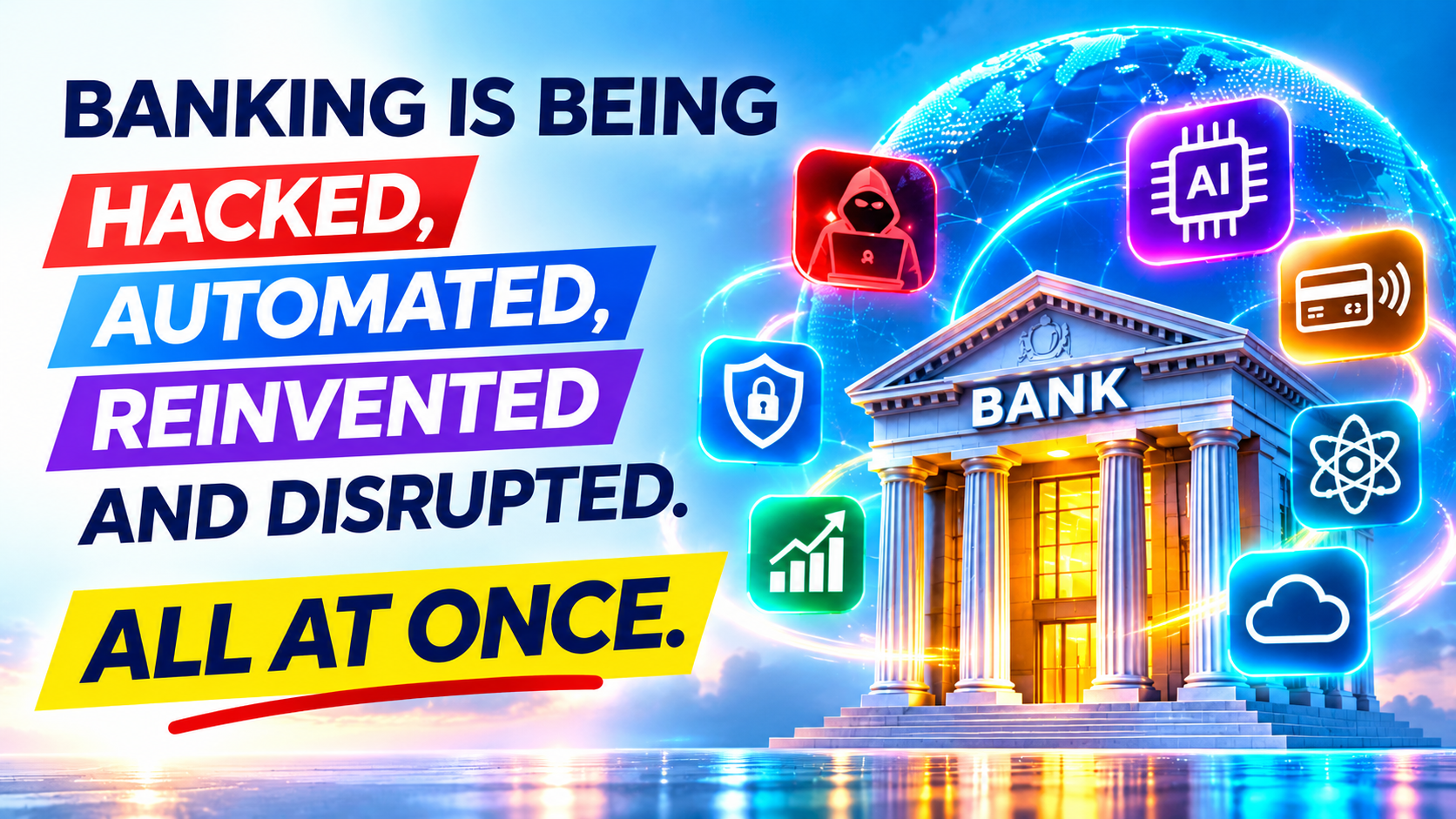
I recently delivered a keynote at Visa Next in Poland exploring the future of money, payments and banking. From the technological revolutions that created today’s financial system to the arrival of AI-native banking, the industry faces a fundamental question: are we using technology to make banking better for customers, or just cheaper for banks?
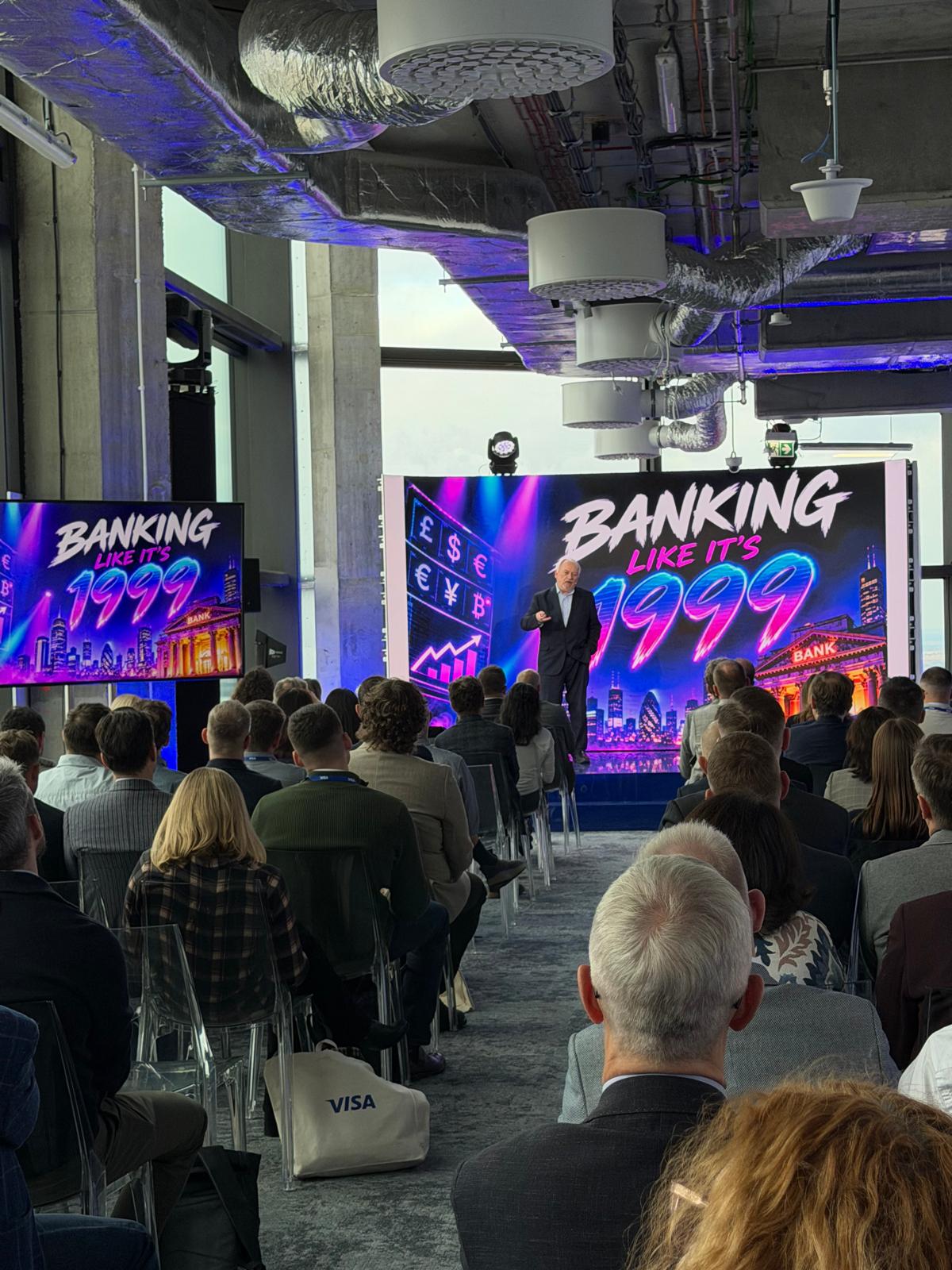
Here’s an expanded version of my speech.
To AI or not to AI. That is the question.
I should probably begin with an apology. I am going to speak English, which is rather embarrassing for someone who has lived in Poland for eight years. During COVID, I decided to learn Polish properly. I spent six months on Duolingo – not the planet, but the website – and dedicated thirty minutes every day to learning Polish.
I discovered two things. First, I cannot learn Polish through a machine and, second, the Polish language appears to have been designed by someone who had been given all the Zs left over from a game of Scrabble and told to use every one of them.
In English, a Z is worth ten points because we hardly use it, except in words like zither and zebra. In Polish, you can barely order a coffee without encountering three Zs.
Still, I have learned something more important than the language, which is that Poland is an extraordinary country. I am married to a Polish woman, so I have a vested interest in saying that, but I also mean it. The transformation I have watched here is remarkable. Look out of the window and compare what you see with the Poland of ten or twenty years ago. This is a country that has embraced change rather than treated it as a threat.
And there is something else I admire here, which is all about relationships.
A good example came at a Halloween party over the weekend. We had a problem making a payment to a catering firm. Their response was, “Don’t worry. Pay us on Monday.” That little exchange tells you a great deal about Poland. In England, I the response would have been rather different. No payment, no catering.
What strikes me in talking about this is the link between transactions and relationships. The two should be mutually inclusive, not exclusive. Today, payments and transactions are increasingly about technology, but business and banking should also be about people. You can build the most sophisticated payments network on Earth and still miss the point if you forget the relationship on either side of the transaction.
That is what I want to explore today, because we are entering a period in which technology could transform finance more profoundly than anything we have seen before. The question is whether we will use that technology to strengthen relationships or eliminate them.
As some of you know, I spend an unreasonable amount of my life thinking, speaking and writing about the future of money. I have written about digital banking, financial technology and the future of commerce for decades, and have maintained my blog, The Finanser, for twenty years.
More recently, I began writing fiction as well. I call it Pulp Finction: fun, fact, finance and fiction.
My first pulp novel, Diary of a Ponzi Scheme, began with an uncomfortable thought when talking to a wealthy friend about property investment in Dubai. I mentioned that I had invested there and, before long, my friend had bought three apartments. That made me wonder how easy it would be to persuade people to hand over money if I wrapped a proposition in enough fashionable financial terminology.
Tokenisation. Real-world assets. Digital currencies. Stablecoins. A token fund.
It sounds impressive, doesn’t it? It could also be complete nonsense which, in the book, it is but, for the avoidance of doubt, I did not steal anybody’s money. I wrote a novel instead. It seemed the safer career choice.
The serious point is that new technology does not eradicate old human weaknesses. Greed, fear, ambition, misplaced confidence and the desire to believe a convincing story are as old as commerce itself. We can digitise an asset, automate a transaction and settle a payment in seconds. None of that guarantees that the proposition behind it is honest, and there is a wonderful irony in all of this. We live in an increasingly unstable world, yet one of the great innovations of finance is something called a stablecoin. We are trying to create stability in an unstable world. Meanwhile, cybercriminals, including state-sponsored hackers, are attacking the infrastructure we are building.
Just look at the most recent example of the Binance hack. Over $6.3 billion stolen in twenty minutes. That’s the real-time world we live in and, what intrigues me is that, like most other hacks, it is human errors that allowed this to happen.
It is not faults with technology but faults with the way we use them. We have new currencies, new networks and new ways of moving money, but the oldest problems of finance remain the same, namely, fraud, deception, security and confidence.
The technology changes. Human nature does not.
This is why I spend so much time studying history. As Confucius is quoted as saying, “Study the past to define the future.” If you want to understand the future of financial structures, it helps to understand where they came from and why.
At school I learned Latin, which has proved surprisingly useful in a career devoted to technology. Two principles have stayed with me: caveat emptor, buyer beware, and uberrima fides, utmost good faith. One tells us to be careful about what we buy and who we are buying from whilst the second, a core to insurance, demands a high standard of disclosure and honesty.
Alongside those principles sit three foundations of commerce around transactions and relationships and, most importantly, trust.
Trust allows commerce to happen. Transactions make commerce work. Relationships make commerce sustainable. Buyer beware reminds us that not everyone deserves our confidence, while utmost good faith reminds us that honesty must work both ways.
For centuries, we have built institutions, rules, reputations and networks around these principles. Banks, insurers, card networks, payment systems and regulators all exist, in different ways, to enable strangers to do business with one another.
If I make a payment to a merchant with Visa, the merchant has confidence that the payment will be honoured. I’m good for the money. That is the fundamental promise behind payments, isn’t it yet, behind all the sophisticated technology, sits a very human question that asks who is on the other side, what are they promising, and can I rely on them?
Now imagine that the person making the payment is not a person at all.
Imagine it is an artificial intelligence agent, acting on your behalf, selecting a product, negotiating a price and authorising a transaction. Who carries the responsibility when something goes wrong? You, the bank, the technology company or the machine?
We have spent centuries developing rules for human accountability. We are now entering a world where machines make decisions, but humans still have to answer for them.
This brings me to the extraordinary changes taking place around us.
Banking and finance are being hacked, automated, reinvented and disrupted all at once. Cyberattacks test the resilience of our systems. Artificial intelligence automates decisions that once required teams of people. Fintech firms challenge the assumptions of established banks. New payment architectures are changing who controls the relationship with the customer.
I look at these developments through political, economic, social and technological lenses, although I confess a bias towards technology. I avoid politicians where possible. As the old joke goes, politics comes from poly, meaning many, and tics, meaning blood-sucking parasites.
No, I prefer to look at the world through technology and, across my career, I have seen three great technological revolutions in financial services.
The first was the mainframe revolution or, as I call it, to automate the mundane with a mainframe.
In the 1960s and 1970s, institutions such as Visa and SWIFT helped create the infrastructure for processing transactions at scale and connecting financial organisations across borders. The objective was straightforward which was to automate the mundane, reduce errors, increase efficiency and move money reliably.
Most of it was back office focused and targeted for the efficiencies of getting transactions from the front office to the back as fast and cheaply as possible, and it worked. It also left behind enormous, complicated systems that were massively capital-intensive and difficult to change.
The second revolution was the network revolution that made us all connected. Everyone. Peer-to-peer, person-to-person, one-to-one. The internet, cloud computing, smartphones, APIs and open banking changed society, relationships and the whole architecture of finance, business and competition. Banking no longer had to mean visiting a branch or using a service designed around the limitations of a mainframe. It moved it to an app and an API.
In my book Digital Bank, I argued that banks needed to rethink their businesses around a connected customer, rather than put a digital screen in front of an old process, and most banks took note.
Poland is a particularly revealing example because much of its modern banking development took place after the political and economic changes of 1989 and 1990, and after the internet appeared. That created opportunities to build a financial world with newer technologies and fewer inherited assumptions. mBank became one of the examples I discussed in Digital Bank because it was the first bank I found in the whole world who threw away the shackles of the past, BRE bank, to reinvent themselves for mobile banking in the 21st century.
It is not that Polish banks have no legacy problems, as every institution eventually acquires them. Even new fintech firms like Stripe claim that a third of their engineers are dedicated to resolving technical debt issues which, when translated, means legacy. The thing is that fintechs and banks like mBank have a starting point that is different to when you compare these firms with traditional banks in Britain, France, Germany or America that still carry layers of technology, products and processes designed decades before the smartphone existed.
That distinction helps explain the success of digital challengers such as Revolut and Monzo, and of innovative financial platforms elsewhere in the world. They did not begin by asking how to make a branch-based model look attractive on a mobile screen. They began by asking what financial services should look like when the network is the starting point.
Yet digital transformation is now yesterday’s argument. In fact, if your strategy in 2026 is still to become digital, where were you during the last decade? The question today is what comes after digital and the answer is the AI-native bank.
An AI-native bank is not a traditional bank with a chatbot attached, nor is it a bank that has purchased a collection of artificial intelligence tools and announced that it is innovative. It is an institution designed so that intelligence informs its processes, decisions, products and relationships at every stage, in real time.
That requires layers from reliable data, modern cloud architecture, accessible services and APIs, models, orchestration, governance and, above them all, processes that solve real problems for real customers. You cannot bolt intelligence onto a fragmented architecture and expect the whole organisation to become intelligent.
And this is where the handcuffs of legacy become obvious.
The mainframe revolution gave us processing. The digital revolution gave us connectivity. The AI revolution requires adaptive architecture.
This is the core tenet of my latest book Intelligent Bank, the third fintech revolution.
Systems that can sense what is happening, understand the context, make decisions and act intelligently, and not just process an instruction but recognise what the instruction means and whether it should happen at all.
A bank cannot become AI-native by putting a clever interface on top of fifty years of disconnected databases, batch-processing systems and product silos. It needs an architecture where cloud, data, APIs and multiple layers of artificial intelligence work together.
That does not mean throwing everything away that already works. It means creating an intelligent, adaptive environment in which old systems can be progressively replaced, connected or abstracted without holding the future as a hostage to the past.
I see banks investing heavily in AI for fraud detection, compliance, risk management and cost reduction. Those are sensible applications. Nobody wants more fraud or more expensive administration, but the mistake is to stop there. If AI is used only to make the bank more efficient, we have just built a faster version of yesterday’s institution or, as Henry Ford would put it, a faster horse.
AI is great for cost reductions and efficiency, but why can’t we use it to make the customer’s life better?
Imagine a financial service that understands the customer’s circumstances, anticipates a cash-flow problem before it becomes a crisis, identifies an unsuitable product before it is sold, or helps a small business manage international payments without needing to become an expert in foreign exchange. That is a very different ambition from replacing a call-centre worker with a bot. One improves an internal cost ratio whilst the other changes the value of the relationship, and here we reach the most uncomfortable question of all. Who owns the intelligence?
Banks are enthusiastic about AI agents working on their behalf but are far more cautious about agents working on behalf of customers.
Why?
Because a genuinely empowered customer agent could compare rates, fees, service quality and products across the market, negotiate with providers and move business to whoever offers the best outcome. In other words, AI can cannibalise the bank itself. It can automatically shift the customer to alternative providers without the customer even knowing that those providers exist and without the bank being able to do anything about it.
The bank’s AI agent is programmed to maximise the bank’s interests. The customer’s AI agent is programmed to maximise the customer’s interests. So, what happens when those two agents start negotiating with each other? For decades, banks have held the advantage because they know more than their customers. They understand the products, the pricing, the margins, the risks and the alternatives. The customer often knows very little by comparison. Now, artificial intelligence turns this on its head.
Imagine your personal AI agent knows every interest rate, every fee, every foreign exchange spread and every alternative provider. It does not get bored comparing products. It does not forget to switch accounts. It does not accept a poor deal because the paperwork is too complicated.
It can negotiate with the bank’s AI agent in milliseconds.
Suddenly, the advantages banks have enjoyed from customer inertia disappear. In fact, for decades, financial institutions have benefited from the friction of complexity, opaque comparisons and the inconvenience of switching. Agentic commerce threatens to remove that friction and that is a much bigger threat to the traditional banking model than another fintech launching another app.
Most banks are understandably enthusiastic about using AI to reduce their own risks and costs. When it comes to customers using AI independently, however, the conversation often turns to fraud, security and consumer protection.
Those are legitimate concerns. AI creates new opportunities for criminals as well as customers, and nobody should underestimate the risks.
Yet there is another uncomfortable truth. Empowered customers could expose pricing, margins and product differences that banks have traditionally kept opaque. AI could make the market more transparent and competitive, reducing the advantages institutions have enjoyed from information asymmetry. In other words, AI is not just a technology revolution. It is a power revolution. For the first time, the customer has automated and delegated access to intelligence that is more powerful than the intelligence of the institution serving them.
So here is my challenge to every bank in the room: are you prepared for a future where your customers are more intelligent about money than you are and, if you are not, what are you going to do about it?
You could try to restrict the customer’s access to intelligence, although I suspect that would be a losing battle, or you could embrace the change and build a business that competes on genuine value rather than customer ignorance.
That is the choice, and this is where payments become the battleground.
Consider a world where your AI agent does not just find the best product but negotiates the best price, checks the merchants, selects the optimal payment method, arranges any required financing and completes the transaction. The payment is no longer an isolated event at the end of the shopping journey. It becomes part of an intelligent commercial process.
For decades, we have treated payments as the plumbing of commerce: move money from A to B, make sure it arrives, and do it securely and efficiently. That remains important, but payments are becoming something much bigger. They are evolving into an operating system for commerce connecting identity, intelligence, data, risk, financing and settlement in ways that change how businesses and consumers interact. More than this, payments are becoming embedded and invisible.
This raises fundamental questions for banks, card networks, merchants and regulators. Who authorises the transaction? Who carries the risk? Who is accountable when something goes wrong? And who controls the intelligence that decides how money moves?
The customer wants the payment to work but does not want to think about the machinery behind it. Merchants want certainty, speed and choice. Networks want security and interoperability. Regulators want resilience and accountability.
Meanwhile, tokenised assets, digital currencies, instant payments and new forms of programmable commerce add more layers to what is already a complex world.
The winning architecture will not be the one with the largest collection of fashionable technologies. It will be the one that makes complexity disappear for the people using it, and that creates another challenge.
Are we making customers switch off?
For years, banks have encouraged customers to go digital. Use the app. Stop visiting the branch. Don’t telephone us. Serve yourself. It has been a tremendous success in terms of efficiency, but I wonder whether we are approaching a point where digital makes people switch off.
If every interaction is automated, every question answered by a machine and every decision made invisibly, what happens to the relationship? There is no relationship.
We are creating a financial world in which customers are more connected technologically and less engaged emotionally. They may have access to everything yet feel connected to nothing. We are creating a financial world where banks are invisible utilities, processing transactions efficiently while losing any meaningful place in the customer’s life and, if the relationship disappears, why should the customer be loyal? Why not allow an AI agent to do everything and choose whichever provider offers the best deal today?
This is the paradox of today’s banking. We have spent decades making it easier for customers to interact with banks, yet we may have made it easier for customers to stop caring about why they bank with them.
There is a temptation to see this as a contest between humans and machines. I think that misses the point. The real challenge is how we integrate humans with machines. For example, I use AI extensively in my own work. It helps me challenge ideas, sharpen arguments, organise research and improve drafts. It does not replace my experience, judgement or voice. If it did, you would be listening to an algorithm give this speech, and it would probably be much more polite about politicians.
The same principle applies to banking.
AI should augment human capability, not become an excuse to abandon human responsibility. There are moments when a customer wants an instant answer and moments when they want another person to understand the fear, frustration or complexity behind the question. A financial institution that cannot tell the difference has confused automation with service. They have confused cost reduction and efficiency with connection and capability. They have lost sight of relationships and focused purely upon transactions.
This brings me back to the Halloween party and the promise to pay on Monday.
The technology failed, but the relationship worked.
We should not romanticise that as a substitute for robust payments infrastructure. We should recognise it as a reminder of why the infrastructure exists. Transactions move money. Relationships make commerce meaningful.
In conclusion, there is a wonderful discussion with the late Dolly Parton where she said: “It’s hard to be a diamond in a rhinestone world.”
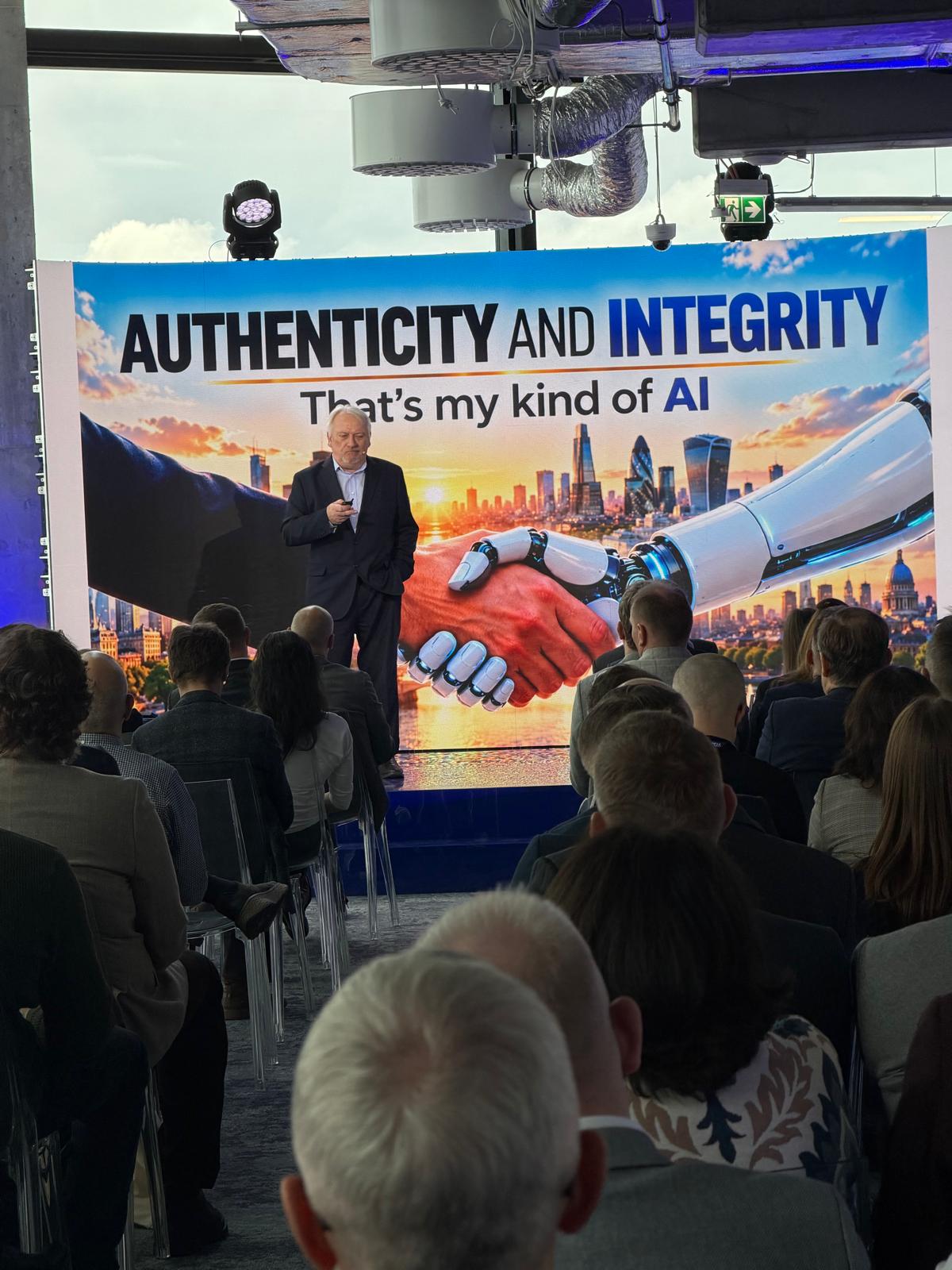
Dolly made a career out of playing with her image that was not her reality. The wigs, the rhinestones, the exaggerated glamour. All of it is deliberately artificial, yet the personality behind it is unmistakably real. She had authenticity and integrity as well as pomp and circumstance.
I love that contradiction because it captures something important about artificial intelligence.
There is nothing wrong with artificiality when we know it is false. The problem begins when we cannot distinguish the artificial from the authentic, or when something that looks convincing is mistaken for something that deserves our confidence.
We can make the intelligence artificial but we need to keep the human real, and that is where I want to finish.
We are entering a world in which artificial intelligence can produce convincing words, voices, images, decisions and advice at enormous scale. We are creating systems that can act for banks, merchants and customers, moving money and making decisions faster than any human could follow.
In that world, authenticity and integrity become more important, not less. Customers need to know what is real, who is accountable and whose interests are being served.
There is something else we must recognise.
Artificial intelligence is changing the balance of power in finance. It is challenging the information advantage of institutions, exposing the economics of banking and giving customers the ability to negotiate, compare and transact in ways they never could before.
That is an extraordinary opportunity but with great power comes great responsibility.
If AI gives customers more power, we must ensure that power is exercised responsibly. If AI gives banks greater intelligence, we must ensure they use it to serve customers rather than exploit them. If AI makes transactions invisible, we must ensure accountability does not disappear with them.
AI changes who holds the power in banking. Authenticity and integrity determine how that power is used.
So my challenge to Visa, to banks, to fintech firms and to everyone in this room is to stop thinking about artificial intelligence as a way to make yesterday’s banking cheaper. Start thinking about it as a way to make tomorrow’s banking better for customers, for businesses and for society.
We have spent sixty years making transactions faster, cheaper and more efficient. We are now entering an era where machines think, negotiate and transact on our behalf. The next revolution should not be measured by how much money banks save, how many jobs they automate or how quickly they process transactions. It should be measured by how much better we make our financial lives.
Technology can deliver efficiency. It can deliver speed. It can even deliver intelligence. What it cannot deliver is authenticity and integrity, and that’s my kind of AI.
Thank you.

Chris M Skinner
Chris Skinner is best known as an independent commentator on the financial markets through his blog, TheFinanser.com, as author of the bestselling book Digital Bank, and Chair of the European networking forum the Financial Services Club. He has been voted one of the most influential people in banking by The Financial Brand (as well as one of the best blogs), a FinTech Titan (Next Bank), one of the Fintech Leaders you need to follow (City AM, Deluxe and Jax Finance), as well as one of the Top 40 most influential people in financial technology by the Wall Street Journal's Financial News. To learn more click here...