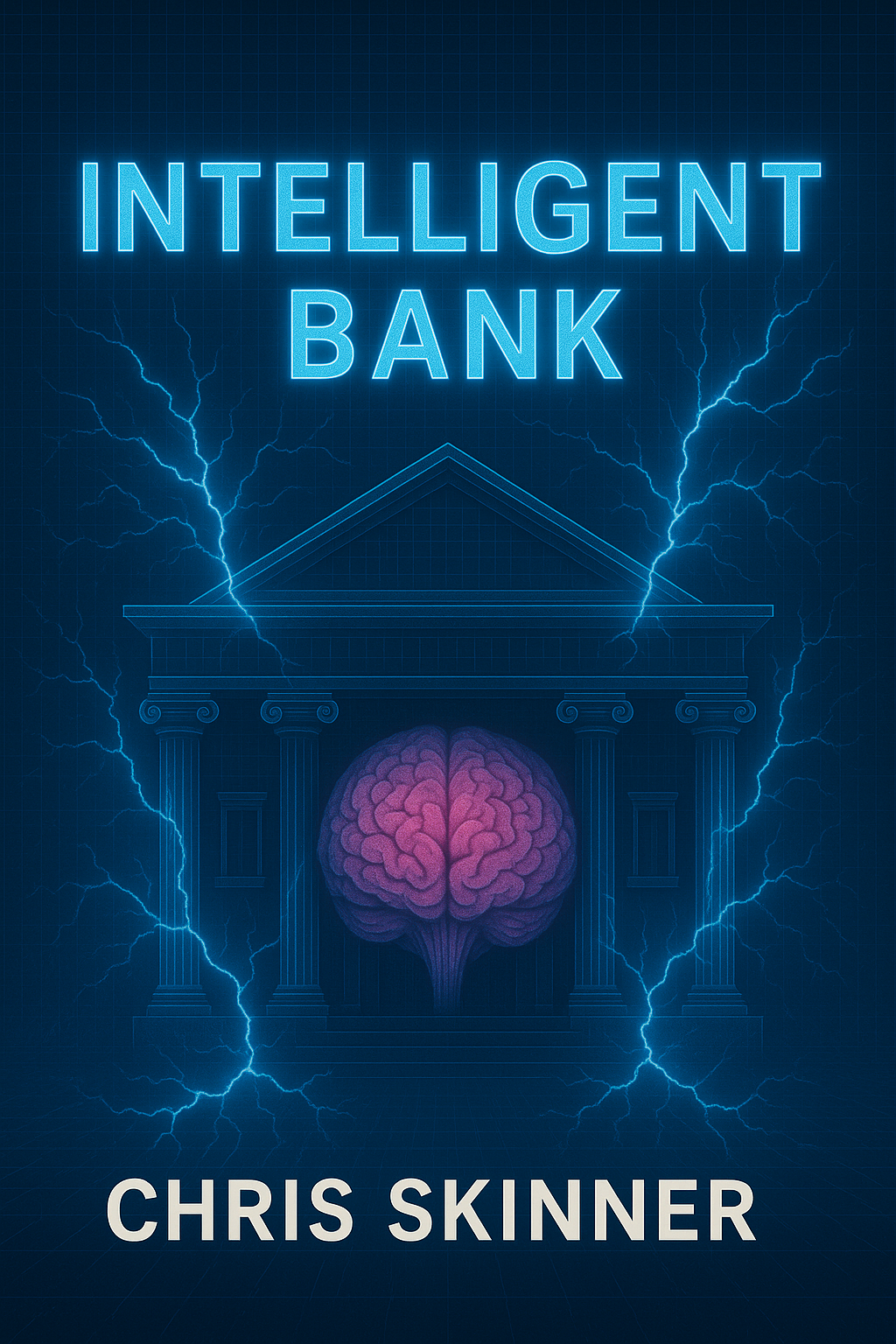
I just got a summary of my new book from the publishers. It comes out in the summer but, for those interested, here are the key messages:
Core Thesis
The book argues that banking is entering its third great technological revolution:
- Mainframe era → automation and scale
- Digital era → connectivity, mobile, fintech, experience
- Intelligence era → AI-driven insight, prediction, and delegated decision-making
Skinner’s central claim is that “doing digital” is no longer enough. Banks must now become intelligent at the core, meaning they must transform data into knowledge, knowledge into insight, and insight into real-time action—across every interaction and channel.
______________
From Digital Bank to Intelligent Bank
What “digital” achieved
- Removed physical banking from the centre (branches, paper, people)
- Introduced apps, APIs, cloud, real-time analytics, and fintech partnerships
- Enabled mobile-first banking and open ecosystems
Why digital is incomplete
Despite huge investment, most banks:
- Still operate with fragmented data
- Lack a true, real-time customer view
- Remain product-centric, not customer-centric
- Struggle with GDPR, legacy systems, and organisational silos
Skinner argues that digital banking solved distribution, but failed to solve understanding.
______________
Defining the Intelligent Bank
An intelligent bank is one that:
- Has fully consolidated data and systems
- Uses AI and analytics to understand customers, not just serve products
- Anticipates needs rather than reacting to requests
- Delivers insight consistently across all touchpoints (apps, voice, wearables, cars, bots)
- Delegates decisions to intelligent systems while keeping humans “in the loop”
The shift is from automating processes to digitalising experiences to delegating financial decisions.
______________
The Intelligence Revolution (AI at the Core)
While GenAI and Agentic AI dominate headlines, Skinner stresses the deeper shift:
- Intelligence is about insight, not content generation
- AI’s real value lies in pattern recognition, prediction, and orchestration
Banks already sit on vast data assets—but most of that data is:
- Duplicated
- Siloed
- Underused
Without connected, high-quality data, intelligence cannot emerge.
______________
Humans and Machines: Augmentation, Not Replacement
A recurring theme is human–AI collaboration:
- AI will not replace humans, but it will replace how humans work
- One person plus AI can operate like a team
- New roles will emerge even as old ones disappear
Key implications:
- Routine tasks vanish
- Interpretation, judgement, ethics, and emotional intelligence rise in importance
- Organisations that fail to reskill people will fall behind
______________
Customer Experience Reimagined
Future competitiveness will be driven by precision, not size:
- Hyper-personalisation (“a segment of one”)
- Micro-level balance sheet optimisation
- Targeted M&A for capability, not bulk
Rethinking “customer journeys”
Customers don’t want:
- Loans
- Mortgages
- Insurance
They want:
- Homes
- Security
- Freedom
- A life without financial anxiety
Skinner reframes finance as life enablement, not transactions—reviving his long-held concept of “Copernicus commerce”, where the customer (not the bank) is the centre of the universe.
______________
The Unsolved Problem: Identity and Trust
Despite technological progress, trust remains broken.
The core issue
- The internet was built for information, not identity or value
- Passwords and usernames still underpin global finance
- AI-generated voices, faces, and documents are accelerating fraud
Key questions:
- Can I trust that you are who you say you are?
- Can I prove that I am me—without exposing my data?
Skinner estimates that 2–5% of global GDP is linked to illicit activity, driven by identity failure.
______________
Crime, Fraud, and Systemic Fragility
The book explores:
- Deepfakes and AI-driven fraud
- Crypto, stablecoins, and illicit finance
- IT failures as a systemic risk (banks as “digital Jenga towers”)
- Regulatory overreach that reacts too late and stifles innovation
These risks expose how fragile modern digital finance really is.
______________
The Solution: Trust Architecture
Skinner argues that rebuilding trust requires:
- Zero Trust architectures (never assume, always verify)
- Zero-Knowledge Proofs (prove legitimacy without revealing data)
- Token-based identity models
- Stronger alignment between ethics, regulation, and technology
Trust must be designed into the system, not layered on afterward.
______________
The Future Bank
The “Future Bank” is:
- Invisible but omnipresent
- Embedded in daily life, not accessed via products
- Intelligent but accountable
- Automated yet ethical
It will:
- Orchestrate life, value, and risk in real time
- Move beyond owning infrastructure
- Compete primarily on trust
______________
Long-Term Outlook (2035–2100)
Looking ahead, the book explores:
- Quantum computing as the next major disruption
- Tokenised assets and programmable money
- The decline of wallets, cards, and even phones
- AI reshaping work, talent, and economic structures
- The implications of Big Tech, crypto, and global power shifts
Skinner concludes that the future will reward:
- Adaptability over strength
- Intelligence balanced with ethics
- Innovation anchored in trust
______________
Overall Takeaway
Intelligent Bank is not a book about technology alone. It is a warning and a roadmap. Banks that fail to move from digital to intelligent will not survive—not because they lack apps or AI, but because they fail to earn trust in an autonomous, AI-driven world.
Chris M Skinner
Chris Skinner is best known as an independent commentator on the financial markets through his blog, TheFinanser.com, as author of the bestselling book Digital Bank, and Chair of the European networking forum the Financial Services Club. He has been voted one of the most influential people in banking by The Financial Brand (as well as one of the best blogs), a FinTech Titan (Next Bank), one of the Fintech Leaders you need to follow (City AM, Deluxe and Jax Finance), as well as one of the Top 40 most influential people in financial technology by the Wall Street Journal's Financial News. To learn more click here...