
Two headlines really struck me this morning. The first is that Stripe is now valued at over $150 billion – I’ve been following Stripe’s valuations for over a decade (it was just over $9 billion in 2016) …

… and the second is that they are thinking about buying PayPal, which would be immense imho.
Let’s start with the first headline, which is applauded in the Irish media because the founders of Stripe are two Irish brothers, Patrick and John Collison, from the small village of Dromineer in County Tipperary, Ireland.
Founded in 2010 under Y Combinator in Silicon Valley, the company has grown from strength to strength, mainly due to its ability to code beautifully. The original product was a simple merchant checkout system based upon seven lines of code and, because the code was so simple, everyone loved it and used it. Today, the company is now covering a whole lot more.
There is an extensive payments infrastructure for companies that covers functions such as billing and subscription management, tax compliance, fraud prevention, embedded finance and global treasury management.
The result is that its Stripe Link payments platform is used by more than 200 million people and more than five million businesses including the industry’s top artificial intelligence (AI) companies, some of the largest blue-chip companies, big tech firms and startups.
In a regular update letter, the company said revenue rose more than a third in 2025, reaching $1.9 trillion. That is equivalent to roughly 1.6 per cent of global gross domestic product (GDP).
“All in all, 2025 was a strong year for the internet economy, and we’re delighted to see so many of Stripe’s customers do so well,” the company said. “Since our last update, we acquired Privy*, which powers more than 110 million programmable wallets, and Metronome**, which powers the complex usage-based billing models used by companies like OpenAI, Anthropic, Confluent, and Nvidia”.
Another notable change is that the company is now focused upon stablecoins – a type of cryptocurrency that is pegged to the value of a currency such as the US dollar – and agentic AI in commerce.
Agenitc AI is an autonomous system that can think, plan, and take real-world actions.
It also acquired Bridge, its stablecoin subsidiary, in 2025 and expanded the integration of stablecoins into Stripe’s platform. The important news about Bridge is that they secured approval for a U.S. national bank trust charter. A U.S. national bank charter is a federal license issued by the Office of the Comptroller of the Currency (OCC) allowing a financial institution to operate as a bank nationwide.
So Stripe is now a fully-fledge challenger bank, not just a payments company … if they want to be.
The company has also been developing lots around blockchain, with the launch of a blockchain purpose-built for payments called Tempo in September 2025.
That announcement made clear that Tempo is a Layer-1 blockchain (core, not Layer-2 where it is built upon a blockchain) for payments using by Stripe and Paradigm. This means that it offers a specific payments alternative to bitcoin and Ethereum designed for the payments industry. The aim is to facilitate high-throughput, low-cost global transactions using stablecoins. More than this, it is engineered for real-world applications, delivering sub-second finality.
“We will likely need blockchains that support more than one million – or even one billion – transactions per second,” the company said, and that’s what they aim to deliver: a billion transactions per second.
The final breakout headline is that the firm is now thinking of buying PayPal (market cap of just over $43 billion, although it was worth $356 billion just five years ago).
John Collison, Stripe’s president, said in an interview this week, that “PayPal has had, obviously, a tough time over the past few years and the landscape has changed quite a bit with Apple Pay and Google Pay and everything like that ... I can’t talk about any, you know, M&A hypotheticals but they’ve definitely had a tough time.”
So, it is early days, but Stripe are likely to acquire some or all of PayPal’s business. I must admit it amused me how CoinGape reported this:
Stripe, a traditional payments giant, is reportedly considering a deal to acquire PayPal Holdings, which may potentially result in one of the biggest fintech mergers in recent years.
A traditional payments giant?
There’s nothing traditional here folks.
In fact, the big thing that Linas Beliunas notes is that “the real story is that payments have undergone a permanent structural inversion: infrastructure has won over brand, and consumer-facing payment products are becoming commodities. Most importantly, PayPal’s collapse is not a management failure [as] two CEOs in three years couldn’t fix it. The problem is clearly architectural. And Stripe’s interest in buying PayPal isn’t a vote of confidence in PayPal’s future. It’s a recognition that 434 million consumer accounts are worth more as raw material for an infrastructure company than as a standalone business”.

The thing is that if Stripe succeeds in acquiring PayPal it could start to challenge mobile wallets like Apple Pay and Google Pay and, knowing Stripe, they would be a serious challenge.
All in all, between Tempo, Bridge, Metronome, Privy and more, Stripe is now a serious gorilla in the payments world, not just a fintech and not just a traditional payments system.
* Stripe acquired Privy in June 2025 to accelerate its crypto infrastructure and enhance user onboarding for digital assets.
** Stripe acquired Metronome because they believe usage-based models will be a defining feature of the next decade and that metering and billing are a very direct interface between product and business.
Postscript:
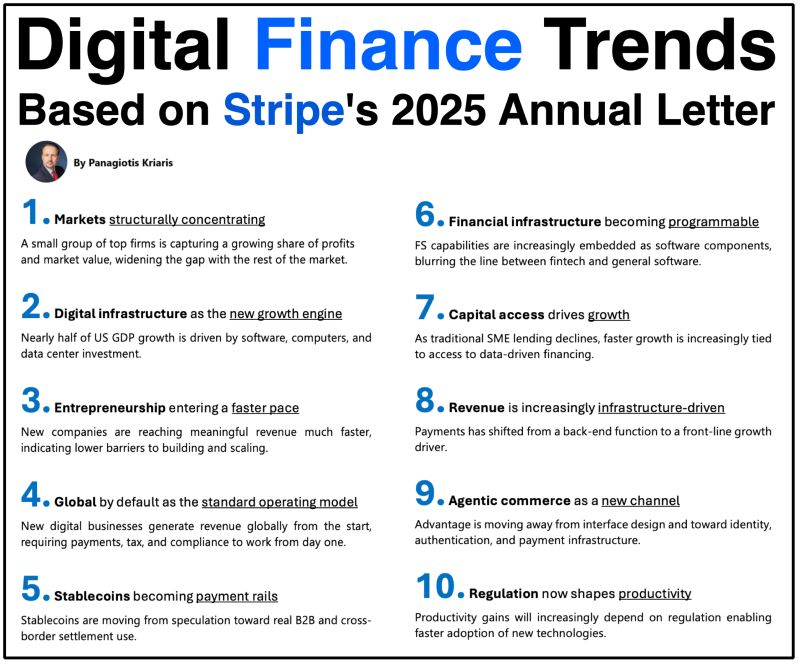
My friend Panagiotis Kriaris also gives a good analysis of the Stripe news.

Chris M Skinner
Chris Skinner is best known as an independent commentator on the financial markets through his blog, TheFinanser.com, as author of the bestselling book Digital Bank, and Chair of the European networking forum the Financial Services Club. He has been voted one of the most influential people in banking by The Financial Brand (as well as one of the best blogs), a FinTech Titan (Next Bank), one of the Fintech Leaders you need to follow (City AM, Deluxe and Jax Finance), as well as one of the Top 40 most influential people in financial technology by the Wall Street Journal's Financial News. To learn more click here...