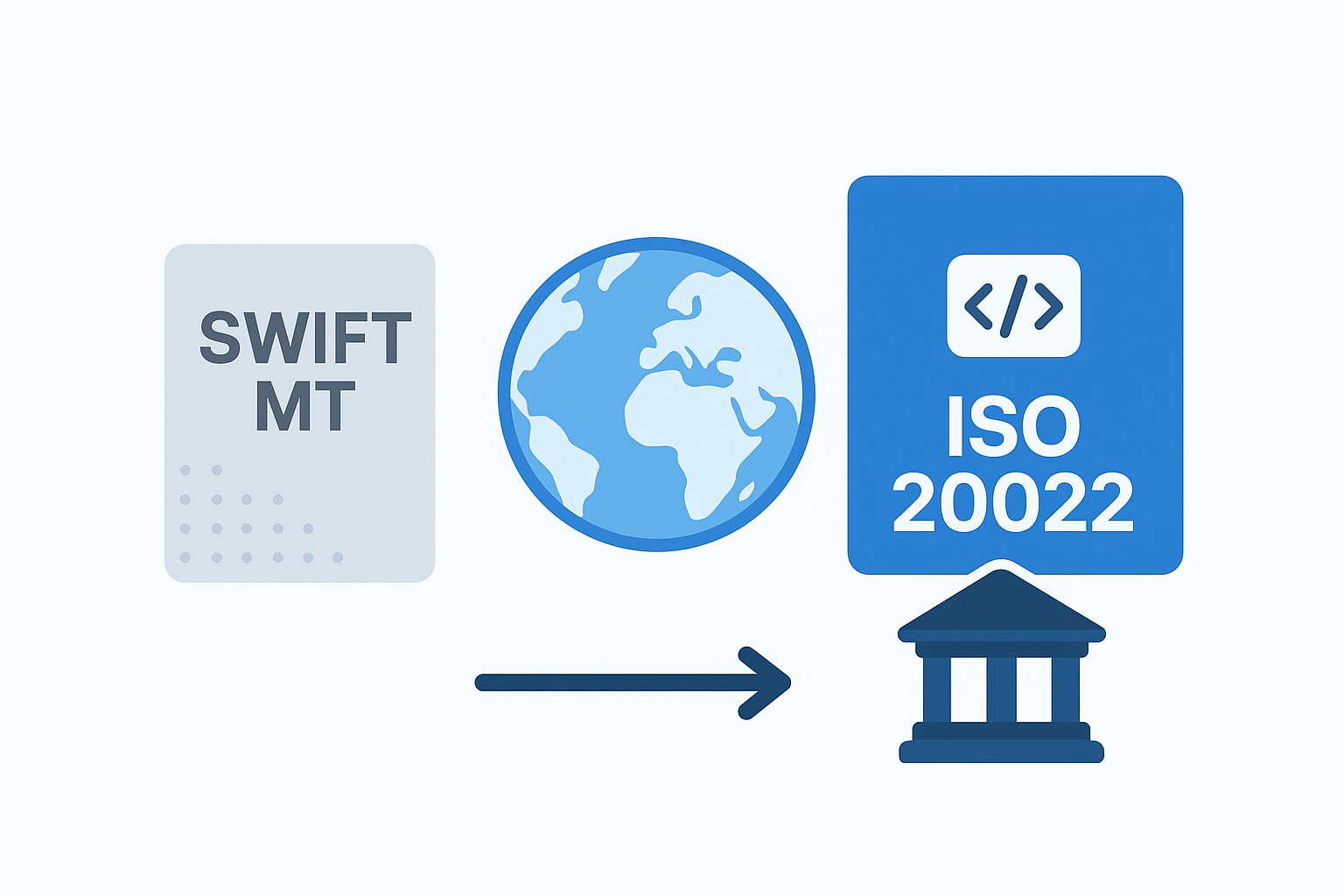
Just got some interesting research from RedCompass Labs that states 44% of banks aren’t on track to meet ISO 20022’s structured address migration deadline in November 2026.
It’s an important deadline as it marks a hard stop to the old SWIFT messaging standards.
You could see this as ‘glass half full’, and calculate that it means more than half (56%) are confident of meeting the deadline. But 44% is a significant chunk of global banks.
The data from the research found that – of those not on track – 40% see their projects as “recoverable”, which sounds promising. However that depends on what needs “recovering” at this stage. There may be multiple workstreams that need to be reconciled in the time before the deadline which is easier said than done.
There’s more concern for larger banks too with one in five major banks (assets of $250 billion or greater) saying the deadline is “unrealistic”. These are the organisations with more customers, higher numbers of transactions and more complex systems. They also have more at stake if payments start to get rejected.
With the November 2026 deadline looming, there’s plenty of work still to be done.
What surprises me is that we were talking about ISO20022 in 2003, so these banks have had twenty-three years to get their house in order. Having said that, most of the SWIFT community thought that ISO 20022 was just a technology upgrade. It’s not. It’s a data upgrade, and that’s why things got more painful.
To understand why this matters, you have to start with the plumbing of global finance. For decades, cross-border payments have run through SWIFT, the network that connects banks around the world. SWIFT doesn’t move money; it moves messages about money. And those messages have traditionally used formats known as MT, short for “Message Type”.
MT messages were designed in the 1970s. They’re compact, rigid, and heavily reliant on free text. That’s why you get messy address fields, inconsistent formats, and lots of ambiguity. Humans can read them. Machines struggle.
ISO 20022 changes that. It’s a global standard for financial messaging that replaces MT formats with MX messages that are richer, structured, and designed for machines first. Instead of cramming everything into a few text fields, MX messages break data into precise components: names, addresses, identifiers, references. It’s the difference between a paragraph and a database.
SWIFT has been migrating the world from MT to MX over the past few years, with a coexistence period where both formats run in parallel. That phase effectively ended in November 2025 but, as the RedCompass Labs article points out, that milestone isn’t the end of the journey ... it’s just the start of the real work because, once you move to MX, the quality of data matters more than anything.
The next big deadline is November 2026, when structured addresses become mandatory.
Up to now, banks have been able to get away with unstructured and free-text addresses - the financial equivalent of writing directions on the back of an envelope. During the transition, there’s some flexibility with hybrid formats but, after that, the system expects clean, structured data. If you can’t provide it then payments risk being delayed, flagged, or even rejected and this is where reality bites.
Most banks don’t have clean data, as I have blogged about often. They have decades of inconsistent, duplicated, poorly formatted address information spread across multiple systems. Moving to ISO 20022 isn’t just about changing message formats; it’s about fixing the underlying data across the entire organisation and that’s why this is hard. You’re not upgrading a pipe. You’re rebuilding the foundations of the bank.
The prize, however, is significant. Structured, standardised data enables better automation, faster processing, and more accurate compliance. Screening for fraud and sanctions becomes more precise. Payments flow more smoothly. The system becomes more intelligent.
But none of that happens if the data is wrong.
So, the real story here isn’t ISO 20022 or MX versus MT. It’s that we’re moving from a world of human-readable finance to machine-readable finance. And in that world, messy data is not just inefficient but it breaks the systems.
Postnote: as I wrote this I realised that I was often writing ISO2002 instead of ISO20022 ... you get the problem.

Chris M Skinner
Chris Skinner is best known as an independent commentator on the financial markets through his blog, TheFinanser.com, as author of the bestselling book Digital Bank, and Chair of the European networking forum the Financial Services Club. He has been voted one of the most influential people in banking by The Financial Brand (as well as one of the best blogs), a FinTech Titan (Next Bank), one of the Fintech Leaders you need to follow (City AM, Deluxe and Jax Finance), as well as one of the Top 40 most influential people in financial technology by the Wall Street Journal's Financial News. To learn more click here...