
What is a Sputnik moment?
A Sputnik moment is the moment the world suddenly wakes up and realises someone else may have leapt ahead technologically.
The phrase comes from 1957, when the Soviet Union launched Sputnik, the world’s first satellite, into space. Technically, it was just a metal sphere orbiting the Earth. Politically and psychologically, however, it was a shockwave. America suddenly realised that Russia was ahead in rocketry, engineering and advanced science. The result was the space race, which eventually led to the United States landing a man on the moon in 1969.
But Sputnik was never really about space. It was about technology, power and national competitiveness.
Today, the term “Sputnik moment” is used whenever a country, company or industry suddenly realises the competitive landscape has changed overnight. Right now, many believe we are living through several Sputnik moments simultaneously, particularly in artificial intelligence and quantum computing.
In AI, the shock has been the sheer speed of progress. For years, many organisations treated AI as an interesting side project: useful for automation, chatbots and analytics, but not fundamentally transformational. Then, almost overnight, systems appeared that could write software, analyse contracts, generate films, design drugs, tutor students and operate as autonomous agents.
Suddenly, AI stopped looking like a productivity tool and started looking like a new industrial infrastructure.
That is the Sputnik lesson all over again. Whoever masters the foundational technology first gains enormous economic, political and military advantage.
This explains why governments are now pouring billions into AI infrastructure, semiconductor manufacturing and sovereign data capabilities. AI is no longer viewed as simply a technology race. It has become a geopolitical race. The concern is not that another country builds a slightly better chatbot, but that they dominate the next generation of productivity, intelligence, cyber capability and economic growth.
In this context, breakthroughs from companies such as OpenAI, Google and DeepSeek are often treated like mini-Sputnik moments: proof that leadership can change very quickly.
Quantum computing creates an even deeper level of strategic anxiety because it threatens the foundations of today’s digital systems. Modern banking, defence networks, internet security and cryptocurrencies all rely on encryption that classical computers cannot realistically break. A sufficiently powerful quantum computer could eventually crack many of those protections.
That is why quantum is often described as the next nuclear race.
The first nation or company to achieve practical quantum advantage could gain extraordinary power: breaking encryption, accelerating pharmaceutical discovery, transforming materials science and solving optimisation problems that overwhelm today’s computers. Governments therefore increasingly see quantum leadership not merely as commercial advantage, but as critical national infrastructure.
The real significance emerges when AI and quantum are combined.
AI creates systems that can reason, decide and act at machine scale. Quantum computing could eventually provide computational power beyond anything we currently operate with today. Together, they represent a shift potentially as important as electricity, industrialisation or the internet itself.
And this is the real lesson of Sputnik: technological shocks change behaviour. They force governments, companies and societies to stop thinking incrementally and start thinking existentially.
Why am I writing about this today?
Because McKinsey’s new report, The State of Organizations 2026, argues that we are living through a Sputnik moment.
The report says companies are entering an entirely new era of management driven by three massive forces: AI, geopolitical fragmentation and workforce transformation.
The report argues that the traditional organisational model of hierarchies, silos, static job descriptions and slow decision-making, is broken. The organisations that survive will be those that become faster, flatter, more adaptive and deeply integrated with AI.
The problem I have with that argument is that I have heard it since I started working years ago. Companies do not change.
McKinsey argues that the conversation has changed dramatically since the pandemic years. Back then, executives worried about remote work, talent shortages and resilience. Today, the pressure is far more intense. Boards want productivity, growth and long-term value creation, with AI now sitting at the centre of organizational strategy.
Is that why JPMorgan and other banks are demanding staff return to the office?
The most striking contradiction in the report is this: almost every company is experimenting with AI, yet very few are seeing meaningful financial impact. McKinsey estimates that around 88% of organizations are deploying AI somewhere, but most are simply bolting AI onto old processes rather than redesigning the organization around it. McKinsey’s argument is blunt: AI is not just another software upgrade. It is a complete operating model rewrite.
That’s my whole point in presentations and books. Do not add AI to the old systems. Reimagine them.
That means moving beyond chatbots and copilots towards what McKinsey calls “agentic organisations”, where AI agents do not merely assist employees but actively participate in workflows, coordinate processes, make decisions and potentially manage entire operational activities.
The report repeatedly stresses that most organisations are nowhere near ready for this reality. In fact, 86% of leaders admit they are unprepared to adopt AI in day-to-day operations.
Importantly, McKinsey does not believe humans disappear from the workplace. Instead, work becomes hybrid. Humans and AI agents collaborate together. AI handles repetitive analysis, administration and pattern recognition, while humans increasingly focus on judgment, creativity, emotional intelligence, leadership and oversight.
In other words, the future employee is not competing against AI. The future employee works alongside it.
The problem is that most organisations are structurally incapable of making this transition. They are too fragmented, too siloed and too dependent on legacy systems. Two-thirds of leaders surveyed believe their organizations are already overly complex and inefficient. Traditional fixes such as restructuring, flattening hierarchies or cost-cutting are producing diminishing returns.
This is why McKinsey proposes a very different model that moves from “structure to flow”.
Instead of organising around departments and reporting lines, companies need to organise around workflows and value creation.
The question shifts from “who owns this?” to “how does value move from beginning to end?” The focus becomes simplifying processes, integrating data, removing duplication and automating wherever possible.
Perhaps the most important insight in the report is that technology itself will not be the differentiator anymore. Almost everyone will have access to AI models. The real competitive advantage will come from organisational capability: culture, workflows, leadership, adaptability and the ability to continuously reinvent the business.
That is why McKinsey repeatedly argues that transformation is no longer a one-off project. Continuous reinvention becomes the operating model, and that brings us back to Sputnik.
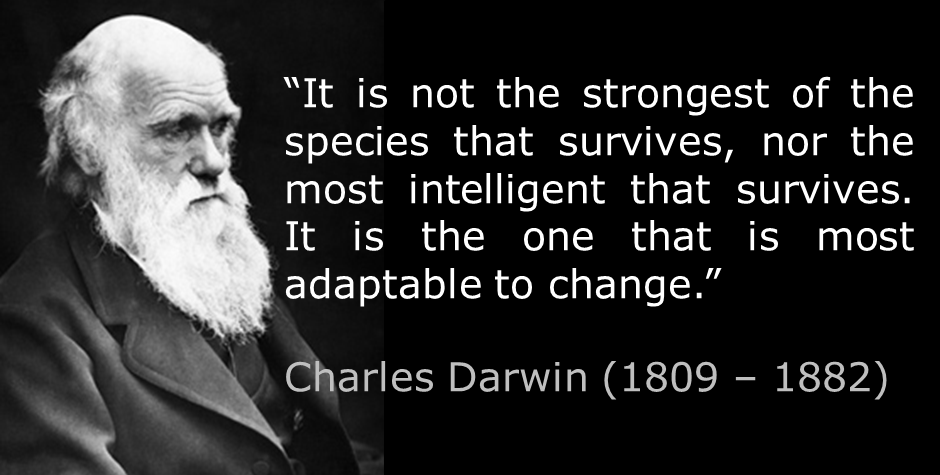
The companies that win over the next decade will not be those with the best technology. They will be the ones capable of redesigning themselves around intelligence. Sounds like a Darwin quote:
Chris M Skinner
Chris Skinner is best known as an independent commentator on the financial markets through his blog, TheFinanser.com, as author of the bestselling book Digital Bank, and Chair of the European networking forum the Financial Services Club. He has been voted one of the most influential people in banking by The Financial Brand (as well as one of the best blogs), a FinTech Titan (Next Bank), one of the Fintech Leaders you need to follow (City AM, Deluxe and Jax Finance), as well as one of the Top 40 most influential people in financial technology by the Wall Street Journal's Financial News. To learn more click here...