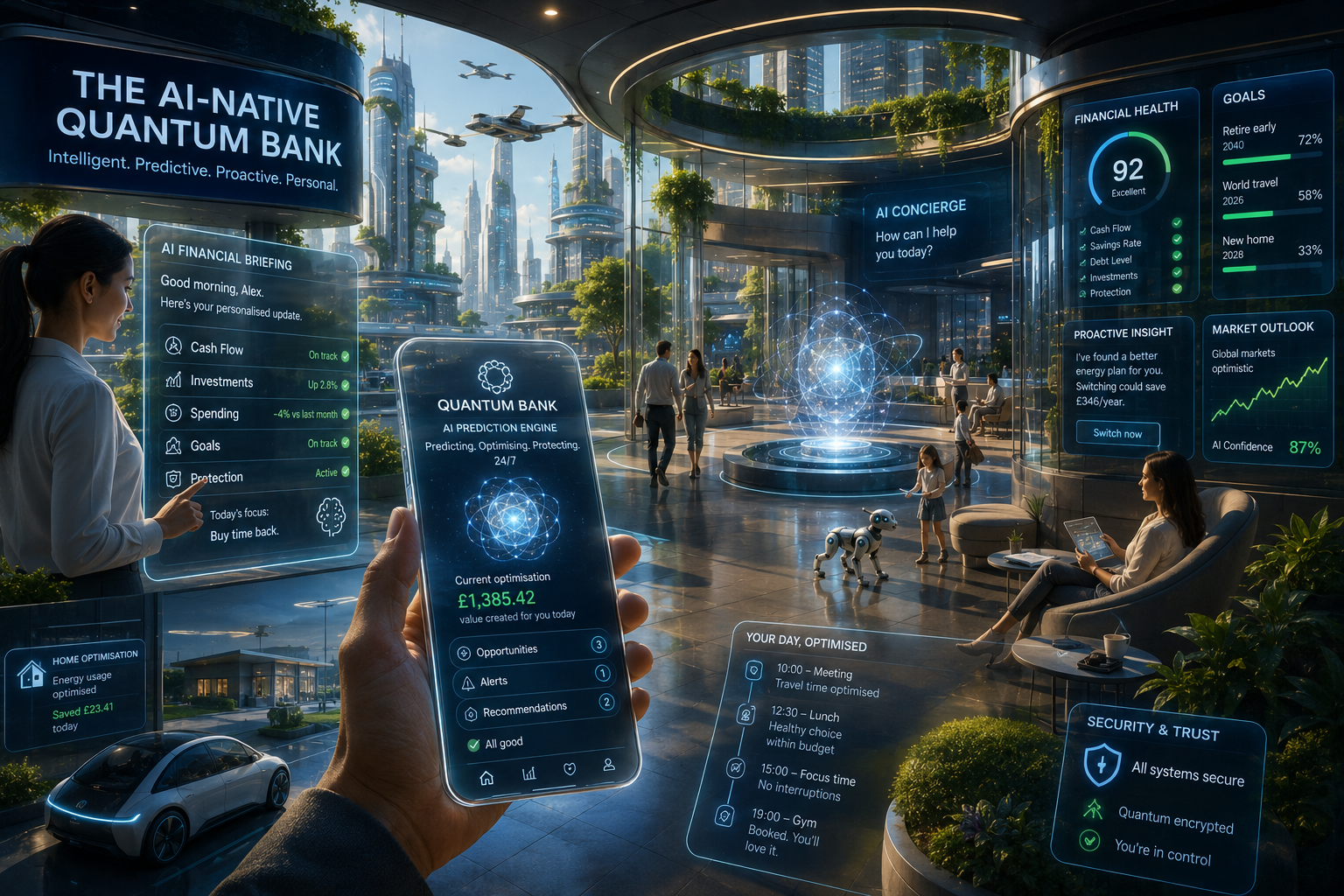
I’ve been meaning to write this for a while. I’ve finally got there, although my friend Dave Birch will probably roll his eyes at the density of buzzwords. Still, both ideas – AI-native banking and quantum computing – are no longer fringe. They sit squarely at the centre of fintech’s next wave of disruption.
The next question is simple: what would an AI-native quantum bank actually look like?
Start with AI-native. What does that really mean?
An AI-native bank isn’t just a traditional bank with machine learning bolted on. It’s a bank that has been fundamentally re-engineered. It operates as an open platform – built on APIs and apps – designed to collaborate across an ecosystem rather than control it. It doesn’t try to do everything itself. Instead, it orchestrates a network of partners.
The intelligence, which is the real value, sits in the data and the algorithms.
That’s the core of what I explore in Intelligent Bank: a bank built on clean, consolidated and harmonised data. Not a simplistic “360-degree view of the customer” as that’s an old idea. It’s a bank built upon dynamic, real-time understanding of every transaction, interaction and behavioural signal. A living, breathing data model of financial life. A bank that is genuinely customer-intimate through data and AI.
This is the direction of travel for the leading challengers. Revolut and Nubank are already setting the pace. The incumbents – the “good old banks” – face a stark choice: reinvent or retreat.
And retreat is not unthinkable. Increasingly, it feels as if traditional banks may end up focusing on corporate clients, capital markets, investment markets and infrastructure, while consumer relationships migrate elsewhere.
That’s a bold statement, but consider the evidence.
Branches have closed. Customers have been pushed to digital channels. Yet many legacy apps still feel clunky, slow and fragmented. Compare them with Monzo or Revolut, and the gap is obvious. In an AI-native world, experience is everything and switching is effortless.
That’s the real battleground.
Now layer in quantum.
What does quantum change?
If AI is about intelligence, quantum is about scale. It rewrites what is computationally possible. Problems that would take classical systems years to solve can now be processed in seconds. Optimisation, risk modelling, fraud detection, portfolio construction … everything accelerates.
Not incrementally but exponentially.
Now imagine combining the two.
A bank that doesn’t just react but anticipates. A bank that continuously models your financial life across every connected device from your car to your home, your wearables, your living world, and optimises all of the outcomes in real time. Not just faster payments, but smarter decisions. Not just transactions, but autonomous financial management.
A system that understands context and predicts intent and executes seamlessly, anywhere, anytime.
That’s the AI-native quantum bank.
So, here’s the scenario for 2035:
A Day in the Life of an AI-Native Quantum Bank Customer
You wake up at 06:17. Not because your alarm goes off. It doesn’t. Your bank wakes you.
“Good morning, Emma. Based on your sleep patterns, heart rate variability and today’s schedule, waking up now will improve your cognitive performance by 12% compared with sleeping another forty minutes.”
You open your eyes and put on your AI-glasses. You first see all the news headlines and things you like to access in the morning, in a 3D 360 ° view.
As you walk downstairs, your kitchen screen displays a message.
“I have reordered coffee beans. The current supplier increased prices by 7% last week. A better-quality supplier was identified and so we switched automatically saving you £8 a month.”
You didn’t ask. The bank already knew you would need coffee next Tuesday.
The AI-native quantum bank is connected to everything. Your health devices, your calendar, your home, your car, your subscriptions, your investments, your pension, your employer, your insurer, your tax authority and every financial relationship you have.
You don’t log into the bank. The bank lives with you.
While you drink your coffee, another message appears.
“I have moved £2,300 from your current account into your investment portfolio. Forecast cash flow indicates no liquidity requirement for the next 43 days. Expected annual return improvement: 4.7%.”
Again, no action required as the bank manages money continuously. You told it to. Your account balance no longer matters as the bank manages outcomes.
As you leave the house, your car informs you that traffic congestion on your usual route has increased. The bank immediately calculates the financial implications and suggests that taking an alternative route reduces fuel consumption, parking costs and travel time. The recommendation appears on your dashboard.
You follow it.
Not because the bank told you to but because the bank has become exceptionally good at being right.
At 10:23 your smartwatch vibrates.
“Your mortgage provider’s funding costs have fallen. I have identified a refinancing opportunity. Documentation has already been completed. Approval probability: 99.2%. Estimated lifetime savings: £38,742. Do you wish to proceed?”
You glance at the message.
“Yes.”
The entire process completes before your next meeting begins. No forms, calls or paperwork. Just a single confirmation.
At lunchtime, the system notices something else.
You have visited a restaurant three times in the past month, and the bank has identified that the owner has recently launched a small expansion project. The AI has analysed the business, local footfall, online reviews, supply-chain data and cash-flow forecasts.
A message appears.
“You have a 14% probability of becoming a repeat customer. Would you like to invest £500 in the business? Expected annual return: 11.3%.”
You smile but quickly decide not to invest this time, and the bank updates its understanding of your risk appetite.
By mid-afternoon, a more serious alert arrives.
“Potential issue detected.”
Your elderly father has begun spending significantly less than normal. The AI has observed reduced supermarket visits, fewer card transactions and a decline in travel activity over the last three weeks.
It’s nothing alarming, but it is unusual.
The system asks whether you would like to check on him.
You call you dad and it turns out he has been unwell. The bank wasn’t monitoring his health, but just monitoring patterns. Patterns humans often miss.
At 17:41 another notification arrives.
“I have delayed your planned electric vehicle purchase.”
“Why?”
The AI explains.
“Battery technology announcements expected within six weeks are projected to reduce prices by 8-12%. Waiting is financially optimal.”
You hadn’t even realised the system was monitoring your future car purchase but of course it was as you mentioned it during a conversation six months ago, so the bank remembered.
That evening you sit on the sofa watching a film.
Meanwhile, the AI-native quantum bank is working.
It is rebalancing investments, negotiating insurance, monitoring fraud, managing subscriptions, optimising tax liabilities, reducing energy costs, predicting future expenses, tracking macroeconomic changes, scanning millions of market scenarios, running quadrillions of simulations through quantum processors … all without asking you a single question because the bank understands something fundamental which is that people do not want banking. They want certainty.
People don’t want accounts, they want outcomes. They don’t want financial products. They want financial confidence.
Just before you go to sleep, the bank sends one final message.
“Today I saved you £147.32, reduced your future liabilities by £1,482, increased projected retirement income by £38 per month and prevented three unnecessary purchases. No action required. Sleep well.”
And that’s the moment you realise something extraordinary.
The AI-native quantum bank is no longer a place you go or an app you open or even a company. It’s an invisible financial operating system that optimises your life.

Chris M Skinner
Chris Skinner is best known as an independent commentator on the financial markets through his blog, TheFinanser.com, as author of the bestselling book Digital Bank, and Chair of the European networking forum the Financial Services Club. He has been voted one of the most influential people in banking by The Financial Brand (as well as one of the best blogs), a FinTech Titan (Next Bank), one of the Fintech Leaders you need to follow (City AM, Deluxe and Jax Finance), as well as one of the Top 40 most influential people in financial technology by the Wall Street Journal's Financial News. To learn more click here...