
One of the things I have always struggled with is that most books about finance are either informative or entertaining. Very few manage to be both.
That was the motivation behind writing Diary of a Ponzi Scheme. Rather than producing another business book explaining cryptocurrencies, tokenisation, digital currencies and central bank digital currencies, I wanted to tell a story. A story that people would enjoy reading whilst almost accidentally learning how modern finance actually works.
It’s a new genre I call Pulp Finction, where finance meets fiction.
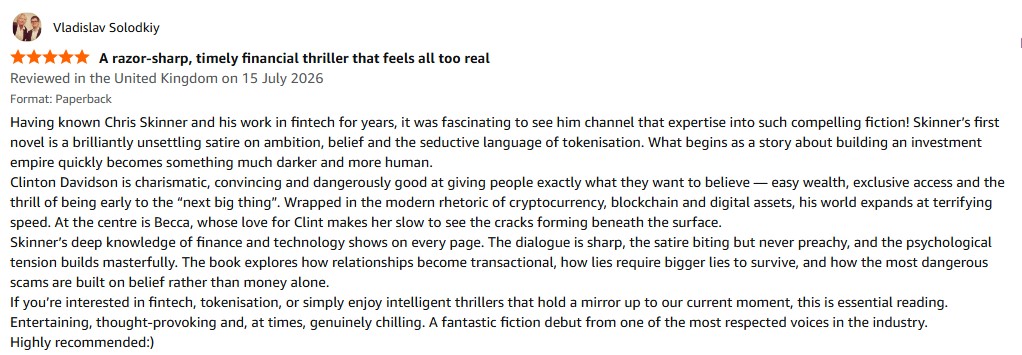
The idea is simple. Explain some of the most complicated concepts in banking and fintech through believable characters, real-world locations and compelling narratives rather than textbooks and technical diagrams, and the reviews are in:
Diary of a Ponzi Scheme is the first in a seven-book series currently in development with more to come.
Each book explores a different corner of modern finance through a fictional story rooted firmly in reality. The first tackles tokenisation, digital currencies, cryptoassets and CBDCs through the eyes of a charismatic fraudster who slowly builds an investment empire on little more than confidence, credibility and other people’s trust.
The early response has been incredibly encouraging.
Maincrest Media awarded the book five stars, describing it as “an entertaining, clever and thought-provoking novel” that combines financial intrigue, sharp wit and timely social commentary.

What particularly pleased me was that they understood exactly what I was trying to achieve.
Rather than simply reviewing the plot, they recognised that the novel explains cryptocurrency, blockchain, tokenisation and digital finance naturally through the conversations between the characters. Instead of interrupting the story with lectures, the financial concepts emerge organically as Clint Davidson persuades investors to believe in his vision.
They also picked up on what I believe is the book’s real subject.
Despite all the discussion of crypto and digital assets, Diary of a Ponzi Scheme is really about trust. Technology changes. Human nature doesn’t. Every successful fraud exploits exactly the same emotions: greed, fear of missing out, exclusivity, status and the desire to believe that everyone else has discovered something extraordinary before you.
As Maincrest concluded, the book is ultimately “less about cryptocurrency than human nature”, exploring why intelligent people continue to fall victim to confidence schemes regardless of whether the asset happens to be tulips, railway shares, property or digital tokens.
That observation was reinforced during a fascinating discussion hosted by The Banking Scene, where Julia Streets, Wasim Mushtaq, Rik Coeckelbergs, Andrew Vorster and I explored whether Pulp Finction might genuinely become a new way of explaining finance.
One of the recurring themes throughout the conversation was accessibility.
The panel agreed that one of the book’s greatest strengths is that readers absorb complex financial concepts almost without noticing. Rather than reading chapters explaining venture capital, behavioural finance, tokenisation or Ponzi schemes, these ideas emerge naturally through the experiences of the characters.
As Julia Streets observed, she learned a great deal despite already working in financial services. Wasim Mushtaq admitted something even more surprising. He rarely reads books cover to cover, preferring instead to skim through them, but this one compelled him to keep turning the pages because, in his words, he had “never read anything quite like it.”
The discussion repeatedly returned to trust.
The panel agreed that the novel isn’t really about cryptocurrency. It is about the mechanics of persuasion. Every Ponzi scheme depends upon social proof, credibility and the fear of missing out. Technology evolves, but the psychology remains remarkably constant. Whether the investment is tulips, internet shares, property or digital tokens, people continue to convince themselves that this time is different.
Another aspect the reviewers highlighted was authenticity.
Rather than inventing a fictional financial universe, the story unfolds across recognisable London restaurants, bars, networking events and fintech conferences. The settings are familiar because they are real, making the story feel plausible rather than sensational.
Andrew Vorster perhaps summarised the approach best when he described the novel as “teaching you along the way without it feeling like you’re sitting through a lecture.”
That, in many ways, was exactly the objective.
For years I’ve written books predicting the future of banking. This time I wanted to experiment with something different. Instead of writing about finance, I wanted readers to experience finance through the people, the decisions and the consequences.
If the early reviews are anything to go by, that experiment appears to have worked.
Rik Coeckelbergs perhaps captured it best: “It’s much more than a story about crypto, tokenisation or fraud. It’s a story about trust, ambition, greed, ethics and the timeless question of why intelligent people keep falling for the promise that this time will be different.”
Wasim Mushtaq agreed: “I’ve never read anything quite like it and I genuinely think this may be a new genre.”
Julia Streets concluded: “A great read, an entirely plausible storyline and one I would definitely recommend.”
Those are wonderful endorsements because they recognise exactly what Pulp Finction is trying to achieve.
It’s not about making finance simpler by dumbing it down.
It’s about making finance more understandable by making it more human.
If you’re looking for something to read over the summer, Diary of a Ponzi Scheme might be just the thing. Hopefully it will entertain you, make you laugh occasionally and perhaps make you think twice the next time someone promises extraordinary returns from the next revolutionary investment opportunity.
You can also watch or listen to the discussion with The Banking Scene on Spotify or YouTube, where we explore both the book and the wider idea behind Pulp Finction.
Spotify https://open.spotify.com/episode/5yO4FXgONgpkThBE1aiE5n
The Ponzi scheme may be fictional ... everything you learn from it is real.
Rik Coeckelbergs, founder and Managing Director of The Banking Scene
“Years ago, Chris Skinner was one of the people who fundamentally shaped how I viewed banking innovation. His blog was the first ever recommended to me at the beginning of my career, and I think I can count on one hand the number of his blogs I missed since then. So when Chris asked me to review his latest novel, Diary of a Ponzi Scheme, I didn’t need much time to think. I can’t wait for everyone to discover the book. Without giving too much away, it’s much more than a story about crypto, tokenisation or fraud. It’s a story about trust, ambition, greed, ethics and the timeless question of why intelligent people keep falling for the promise that this time will be different.”
Wasim Mushtaq, founder, 1CG
“I rarely read books in full from start to finish. I usually skim them and read in parts. This one felt different, I’ve never read anything quite like it and I feel this might be a new genre. I’m fully recommending it to my network.”
Julia Streets, MBE, founder and Chair of Streets Consulting
“This was a great read and is a very different genre: Pulp Finction. I learned a huge amount, it challenged my thinking and it was an entirely plausible storyline. Definitely recommend.”

Chris M Skinner
Chris Skinner is best known as an independent commentator on the financial markets through his blog, TheFinanser.com, as author of the bestselling book Digital Bank, and Chair of the European networking forum the Financial Services Club. He has been voted one of the most influential people in banking by The Financial Brand (as well as one of the best blogs), a FinTech Titan (Next Bank), one of the Fintech Leaders you need to follow (City AM, Deluxe and Jax Finance), as well as one of the Top 40 most influential people in financial technology by the Wall Street Journal's Financial News. To learn more click here...