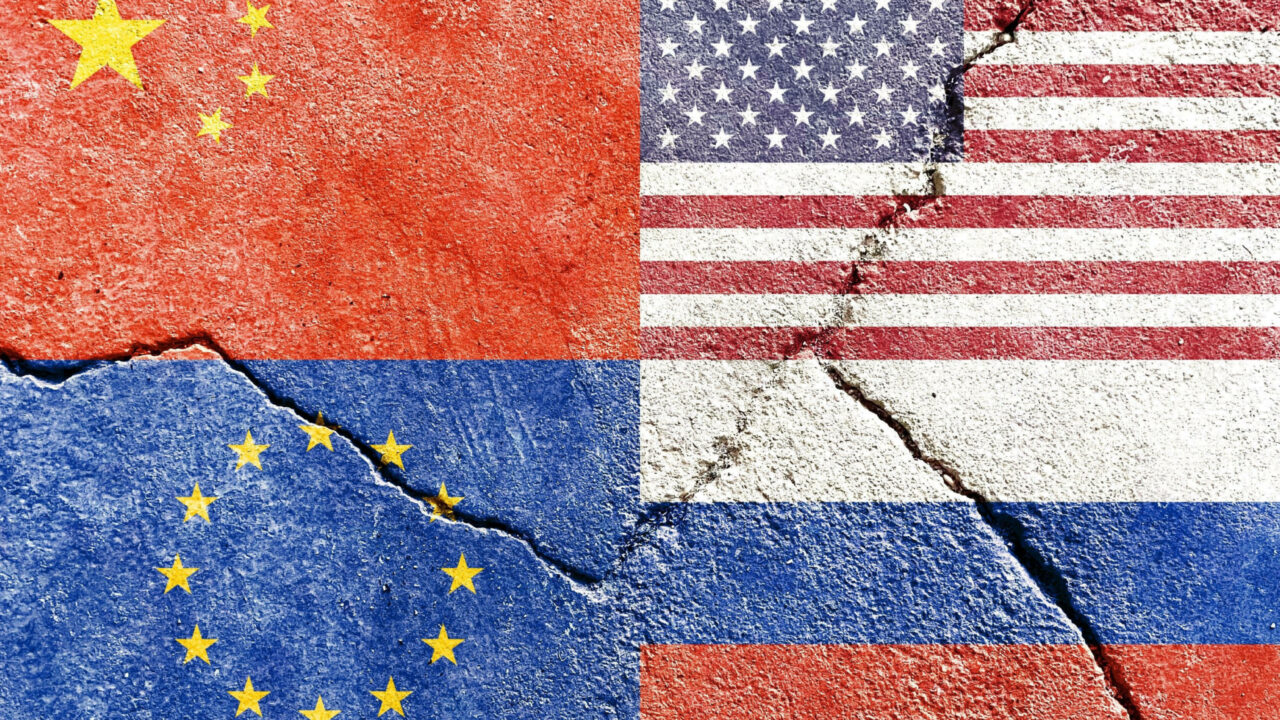
We often think wars are won with missiles, tanks and soldiers. In reality, they are won with banks.
Every shell that is fired, every drone that is launched and every factory that shifts from producing washing machines to artillery shells has to be financed by someone. Governments issue debt. Central banks manage liquidity. Commercial banks extend credit. The financial system quietly becomes another front line.
That is why one statistic from Russia caught my attention this week.
Half a million Russians go bankrupt as Putin risks banking crisis
More than half a million Russians declared personal bankruptcy during 2025, almost one-third more than the previous year.
At the same time, a European intelligence assessment reportedly warns that Russia faces an “explosive” banking risk as lenders become increasingly burdened by financing the country’s wartime economy. The report estimates that around 10% of corporate loans are now considered doubtful, while some major banks have seen retail non-performing loan ratios climb as high as 15%. It also claims that state programmes have encouraged more than 13 million Russians to hold three or more loans simultaneously.
Those are not just statistics. They are the fingerprints of an economy beginning to finance today’s survival with tomorrow’s income.
The remarkable thing about modern banking is that it can make almost any problem appear manageable for quite a long time. Extend the loan; restructure the repayment schedule; offer a state guarantee; subsidise the interest; move the exposure; roll it over. Everything continues to function and everyone can reassure themselves that nothing has really gone wrong.
Until one day it has.
History is full of banking systems that looked perfectly healthy until the precise moment they didn’t, and the common theme was never a lack of money. It was the illusion that debt was still productive.
That is the question Russia increasingly faces.
The war economy has undoubtedly been successful in one respect.
Defence spending has kept factories busy, unemployment unusually low and wages surprisingly resilient. Sanctions have hurt, but they have not produced the rapid collapse many in the West predicted. Trade has simply been redirected. China, India and other Asian partners continue buying energy, supplying goods and providing alternative commercial relationships. Russia has demonstrated far greater economic resilience than many expected in 2022.
But resilience is not the same thing as sustainability, as the difficulty with a war economy is that it eventually starts consuming its own financial infrastructure.
Banks become less concerned with lending to the businesses that generate future productivity and more concerned with supporting the industries that serve today’s political priorities. Capital slowly stops flowing towards innovation, entrepreneurship and private investment, and starts flowing towards preserving the existing system.
That changes the nature of banking.
Banks are no longer allocating capital according to economic return. They are allocating capital according to national necessity.
There is another warning hidden inside the bankruptcy numbers.
Half a million people going bankrupt is not simply a consumer credit issue. It represents hundreds of thousands of households that have effectively reached the limits of debt. Behind every bankruptcy sits unpaid credit cards, unsecured loans, mortgages, personal guarantees and small businesses struggling with cash flow. Every one of those becomes someone else’s impaired asset.
A bank’s assets are, after all, someone else’s liabilities.
When enough borrowers fail together, the banking system starts failing with them.
Perhaps the most striking figure in the intelligence assessment is not the bankruptcies themselves but the suggestion that millions of Russians now hold three or more separate loans.
That is rarely a sign of prosperity. It is usually a sign that new borrowing is increasingly being used to service old borrowing. Whether by households or governments, that is not a sustainable financial model.
Interestingly, the Russian authorities reject the pessimism. Deputy Governor Filipp Gabunia argues that vulnerabilities are “not critical”, pointing to the strongest capital cushion in three years and stable corporate bad-loan ratios. Russia’s largest banks have also emphasised their resilience, even as institutions such as Sberbank acknowledge that corporate loan quality is deteriorating and are increasing provisions for expected losses.
That tension is important because both things can be true simultaneously.
Banks can remain well capitalised while the quality of the economy they finance steadily deteriorates.
We saw exactly that before 2008. Capital ratios looked respectable, liquidity appeared abundant and markets continued functioning. The weakness wasn’t visible because accounting measures describe yesterday’s risks, whereas crises emerge from tomorrows.
This story is also much bigger than Russia.
Around the world, governments increasingly expect banks to become instruments of national strategy. During COVID, banks distributed emergency support. During the energy crisis, they financed subsidies. Today they are expected to fund net zero, artificial intelligence, semiconductor production, defence manufacturing and industrial resilience. Banks are no longer simply intermediaries matching savers with borrowers. They are becoming extensions of economic policy.
That works until politics begins pricing credit more aggressively than markets do.
Bankers have always liked to believe they price risk objectively. Politicians rarely have that luxury. Elections are won today. Credit losses emerge years later.
That is why banking crises rarely begin in banks. They begin in politics.
Whether Russia is genuinely approaching an “explosive” banking crisis remains open to debate. The intelligence report may prove too pessimistic. The Kremlin’s confidence may prove too optimistic. The truth, as always, probably lies somewhere in between.
This is perhaps the biggest lesson from the conflict so far.
Western policymakers have spent decades assuming that access to the dollar, the euro and the global banking system represented such an overwhelming advantage that exclusion from it would force countries to change course. It was a logical assumption.
The United States controls the world’s reserve currency. Europe sits at the centre of many of the world’s financial markets. Together they built the post-war financial architecture through institutions, payment networks and capital markets that almost every nation depends upon.
Russia has challenged that assumption.
The sanctions have undoubtedly imposed enormous costs. They have made imports more expensive, restricted access to technology, frozen sovereign assets and complicated international finance. Yet they have not delivered the decisive political outcome many expected. Instead, they have accelerated something altogether different: the fragmentation of global finance.
Rather than capitulating, Russia has spent the past four years building alternative trade routes; settling more transactions in yuan, rupees and roubles; deepening financial relationships with China, India, the Gulf states and the broader BRICS community; and investing in domestic payment infrastructure. Every sanction has become another incentive to reduce dependence upon Western finance.
That should concern Washington and Brussels.
Financial power is remarkably similar to military power. It only remains powerful while everyone believes participation is essential. The more frequently access to the financial system is weaponised, the greater the incentive for others to build alternative systems. The dollar has never dominated simply because America said it should. It dominated because it was the easiest, deepest and most trusted financial ecosystem in the world. Trust, however, is easier to erode than to rebuild.
This does not mean sanctions are ineffective. They have unquestionably weakened Russia’s long-term economic prospects and reduced growth. But sanctions are rarely a knockout punch.
They are economic attrition. Like military campaigns, they become wars of endurance rather than wars of manoeuvre. The question is no longer whether sanctions hurt, as they clearly do. The question is whether they hurt enough to change political decisions before new financial networks emerge to reduce their impact.
Ironically, Europe may have paid a higher short-term price than it expected. The loss of relatively cheap Russian energy contributed to inflation, forced governments into enormous subsidy programmes and accelerated a search for alternative energy supplies at considerable cost.
America, by contrast, benefited from becoming an even larger exporter of liquefied natural gas and from the continued global dominance of the dollar. Yet even the United States cannot assume that financial primacy is permanent if every geopolitical dispute encourages more countries to experiment with alternative currencies, payment systems and settlement networks.
That is perhaps the most overlooked consequence of the war. It has become the largest real-world experiment in financial decoupling since the Cold War.
The West still controls the world's most important financial system. The dollar remains dominant. European and American capital markets remain unmatched in depth and liquidity … but dominance is not the same as permanence.
Every sanction, every frozen reserve and every exclusion from SWIFT reminds the rest of the world that access to the global financial system can be conditional. The logical response is not necessarily to confront that system … it is to build another one. If that happens, history may conclude that the greatest consequence of sanctions was not the damage they inflicted on Russia, but the acceleration of a multipolar financial world. That would be an outcome neither Washington nor Brussels originally intended.
Chris M Skinner
Chris Skinner is best known as an independent commentator on the financial markets through his blog, TheFinanser.com, as author of the bestselling book Digital Bank, and Chair of the European networking forum the Financial Services Club. He has been voted one of the most influential people in banking by The Financial Brand (as well as one of the best blogs), a FinTech Titan (Next Bank), one of the Fintech Leaders you need to follow (City AM, Deluxe and Jax Finance), as well as one of the Top 40 most influential people in financial technology by the Wall Street Journal's Financial News. To learn more click here...