I was sitting this morning and thinking about how fantastic Agentic AI, autonomous commerce and programmable money is. It is the focus of my next Pulp Finction book Birth of a Unicorn being released in December.
The thing is that there is a wonderful problem with artificial intelligence in banking: almost everyone agrees it is going to change the industry, but no-one knows quite how far that change will go.
Will AI make banks more efficient? Absolutely. Will it reduce costs, improve fraud detection, personalise services and automate millions of mundane processes? Yep, but those are the easy bits.
The harder question is whether AI changes the nature of banking itself.
We have spent the past thirty years digitising banking. We took branches and put them on the internet. We took the internet and put it on a smartphone. We took human processes and automated them. Throughout all of this, however, the underlying model has remained remarkably familiar which is namely that the customer asks and the bank responds. AI is starting to turn that relationship around.
An intelligent financial agent can watch, analyse, predict, recommend and, increasingly, act. Agentic AI can move money, negotiate transactions, manage liquidity, rebalance portfolios, detect fraud, originate credit and interact with other agents without waiting for a human being to press a button.
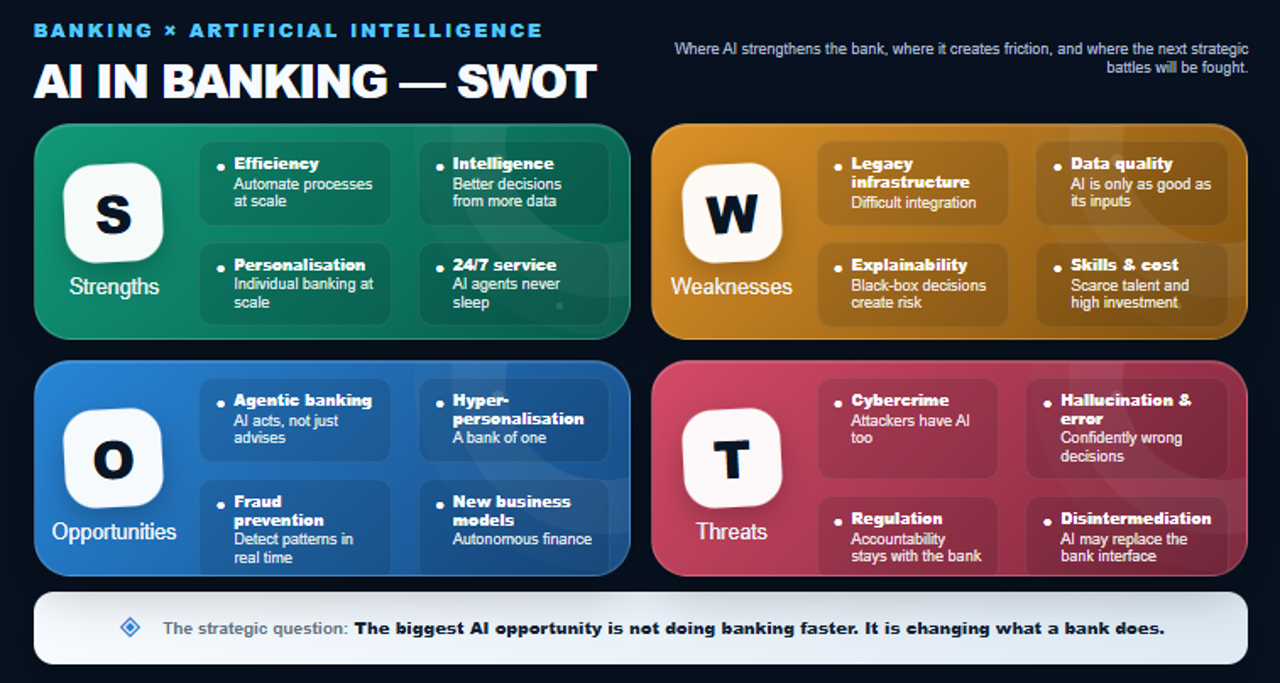
That takes us from digital banking to autonomous finance and that deserves a proper SWOT analysis.
STRENGTHS: banks are almost designed for AI
The first strength is obvious: banks are gigantic data machines. They know what you earn, what you spend, where you spend it, when you spend it, what you borrow, what you save, what you invest and, increasingly, how your financial behaviour changes over time.
That applies as much to a corporate as an individual.
For decades, banks have struggled to turn that mountain of data into useful intelligence. AI changes the equation because it can identify patterns across billions of interactions that humans and conventional systems would struggle to find.
This is why the immediate AI opportunity is efficiency.
Customer service, compliance checking, document processing, software development, fraud monitoring, credit analysis, financial crime investigation, reconciliation, reporting and administration can all be accelerated.
The Bank of England says firms are already reporting productivity improvements from AI, particularly in software development, finance, administration and customer service. Importantly, it also finds that the largest gains occur when skilled humans validate and refine AI outputs.
That last point matters.
The first generation of AI banking will not be AI replacing people. It will be people using AI replacing people who don't.
Then there is personalisation.
For twenty years banks have talked about delivering the right product to the right customer at the right time. Mostly, that meant dividing millions of customers into marketing segments but, what they all missed, is 1:1 Marketing … something I’ve been involved with for years ever after meeting Don Peppers, that father of 1:1 personalisation along with Martha Rogers.
AI can create a segment of one.
Imagine a bank that understands your cash flow, bills, savings, mortgage, investments, pension, tax obligations and spending patterns continuously. Instead of waiting for you to discover that you have a financial problem, it sees the problem developing and acts before it arrives.
Your bank stops being somewhere you go to manage money and becomes something managing money around you.
That is a profound strength because banks already occupy one of the most privileged positions in the economy: they sit between identity, money, data and trust.
WEAKNESSES: the twenty-first century brain attached to the twentieth-century bank
Unfortunately, putting AI into a bank is not the same thing as putting AI into a technology company because banks carry decades of technology history.
Core banking platforms, payments engines, risk systems, compliance databases, customer records and product platforms have often been built at different times, using different architectures, with data scattered across hundreds or thousands of systems.
AI may be intelligent, but it cannot magically repair bad architecture.
This creates the great irony of AI banking.
Banks may have more financial data than most industries, whilst being among the industry that finds it the hardest to use that data coherently.
Garbage in, garbage out has not disappeared because we invented large language models and, if anything, AI magnifies the problem. Give a human poor data and you may get one poor decision. Give an autonomous system poor data and you can generate millions of poor decisions at machine speed.
Then there is explainability.
Banking is not advertising. If an AI decides which advertisement you see, few people care how the algorithm reached the decision. If an AI refuses your mortgage, freezes your bank account identifies you as a potential money launderer, somebody needs to explain why.
That requirement sits uncomfortably beside probabilistic AI systems whose internal reasoning can be difficult to interpret and whose outputs are not always predictable.
This helps explain why the Bank of England's Financial Policy Committee found that advanced AI had yet to be widely adopted for core decisions such as underwriting and trading. Financial firms judged that problems around interpretability and predictability could outweigh the gains in these high-risk areas.
In other words, banks want the intelligence but are less enthusiastic about the unpredictability.
OPPORTUNITIES: welcome to the bank of one
This is where things become interesting. The biggest opportunity from AI is not reducing the cost of banking. It is reinventing banking.
We are moving from generative AI towards agentic AI: systems that do not merely answer questions but can plan and execute sequences of actions.
The Bank of England describes this as an inflection point. AI moved from creating content, to reasoning through requests, and now towards systems capable of autonomously chaining actions together. Sarah Breeden argues that the financial system could therefore evolve towards one operating more autonomously, with agents transacting for consumers and merchants and potentially devising and executing strategies in financial markets. (
Think about what that means.
Today you might ask: Can I afford to go on holiday?
Your banking app shows you your balance. A smarter bank analyses your salary, mortgage, bills and savings and tells you whether you can afford the holiday. An agentic bank could go much further. It could identify how much you can afford, move surplus cash into savings beforehand, search for appropriate travel options, optimise foreign exchange, arrange insurance, schedule payments and automatically adjust your monthly finances.
You don't bank.
Your agent banks for you.
Now extend that idea into business banking.
An SME AI agent could manage invoices, working capital, FX exposure, cash forecasting, credit lines, supplier payments, tax reserves and investment of surplus liquidity continuously.
Banking becomes embedded into the operating system of the business.
The opportunity is even larger when AI meets programmable money, tokenised assets, stablecoins and digital currencies as an AI agent that can reason and move money is transformative.
The Bank of England is already examining agentic payments because autonomous systems could initiate and optimise financial flows at far greater speed and scale. It notes the tension at the heart of this development: AI is probabilistic, while payment infrastructure demands deterministic, legally certain outcomes. Solve that problem and we enter an entirely different financial world.
Machine-to-machine commerce becomes possible. Software buys services from software. Cars pay charging stations. Supply chains negotiate payments automatically. Corporate treasury agents move liquidity around the world continuously. Money becomes increasingly programmable and autonomous.
That may be one of the largest opportunities banking has seen since the invention of electronic payments.
THREATS: unfortunately, criminals have AI too
Every technology that makes banking easier also makes attacking banking easier and AI is no exception. Fraudsters can use AI to create convincing emails, voices, identities, documents and increasingly sophisticated social-engineering attacks.
But frontier AI takes the problem further.
The Bank of England's July 2026 Financial Stability Report warns that advanced AI could increase the sophistication and impact of cyberattacks against financial institutions and infrastructure; more capable agents can identify vulnerabilities and chain together attack steps and operate at machine speed, compressing the time defenders have to respond.
So, we are entering an arms race where AI attacks banks, AI defends banks, AI attacks the AI defending banks and the cycle accelerates.
There is another threat that receives less attention: concentration.
Banks spent decades worrying about dependency on a handful of core technology suppliers. AI could create an even more concentrated infrastructure.
The UK regulators began direct oversight of the first designated Critical Third Parties in July 2026, covering major cloud and technology providers whose disruption could affect multiple financial firms simultaneously. Now, imagine banks around the world relying upon the same handful of foundation models, cloud platforms and AI infrastructure providers. We could create extraordinary efficiency while quietly creating extraordinary systemic concentration.
One software failure, model error, cyber compromise or infrastructure outage might no longer affect one bank … it could affect the financial system.
And then there is herd behaviour
Perhaps the most fascinating threat is what happens when AI starts making financial decisions.
Markets already contain algorithms trading against algorithms, but agentic AI introduces systems capable of interpreting information, developing strategies and acting autonomously. What happens when thousands of financial agents reach similar conclusions simultaneously?
Humans create herd behaviour because we watch each other so what happens when machines create herd behaviour because they have been trained on similar data, using similar models and optimised towards similar objectives.
Imagine a market shock at 10:00:00. Thousands of agents detect it at 10:00:00.001. They analyse it at 10:00:00.002. They decide to sell at 10:00:00.003. And they execute at 10:00:00.004. Where and when does the human regulator intervene?
We spent centuries building financial markets around human reaction times but AI operates on another clock.
The biggest threat to banks may not be AI risk
There is one final threat, and I suspect it is the one bank CEOs should think about most.
Disintermediation.
We’ve heard that word for years, but is it finally coming true?
Banks assume they will own the AI relationship with their customers. Why? If I have a trusted personal AI agent managing my financial life, perhaps I no longer care which bank holds my current account. My agent chooses the best deposit rate. It chooses the cheapest FX provider, the best savings rates, the lowest cost mortgage, the more effective insurance product for the price, etc, etc.
Suddenly the financial firm has a problem as the customer relationship no longer belongs to the bank. It belongs to the agent.
Banks could become regulated balance sheets and infrastructure providers sitting invisibly behind somebody else's intelligent interface.
We saw a version of this with smartphones.
Banks once believed customers belonged to the bank because customers visited branches.
Then the smartphone arrived and Apple and Google suddenly controlled the device through which customers accessed banking.
AI could repeat that transition at a far deeper level.
The battle may therefore not be about who has the smartest banking AI. It will be about who owns the financial agent.
So, what does the SWOT tell us?
The strengths are enormous: efficiency, intelligence, personalisation and continuous service.
The weaknesses are substantial: legacy technology, fragmented data, explainability, skills and governance.
The opportunities are potentially revolutionary: agentic banking, autonomous finance, intelligent payments and financial services built around an individual rather than a product.
And the threats are systemic: cybercrime, correlated machine behaviour, technology concentration, hallucination, regulatory uncertainty and the possibility that banks lose the customer interface altogether.
The bottom-line is that this is progress and innovation and it is a double-edged sword.
The internet created cybercrime and digital banking. Smartphones created mobile fraud and mobile banking.
Cloud computing created concentration risk and extraordinary scalability.
AI will do the same and the biggest AI opportunity is changing what a bank does whilst the biggest AI threat is that somebody else gets it right first.

Chris M Skinner
Chris Skinner is best known as an independent commentator on the financial markets through his blog, TheFinanser.com, as author of the bestselling book Digital Bank, and Chair of the European networking forum the Financial Services Club. He has been voted one of the most influential people in banking by The Financial Brand (as well as one of the best blogs), a FinTech Titan (Next Bank), one of the Fintech Leaders you need to follow (City AM, Deluxe and Jax Finance), as well as one of the Top 40 most influential people in financial technology by the Wall Street Journal's Financial News. To learn more click here...