
I love this chart.
Source: Avinash Kumar on LinkedIn
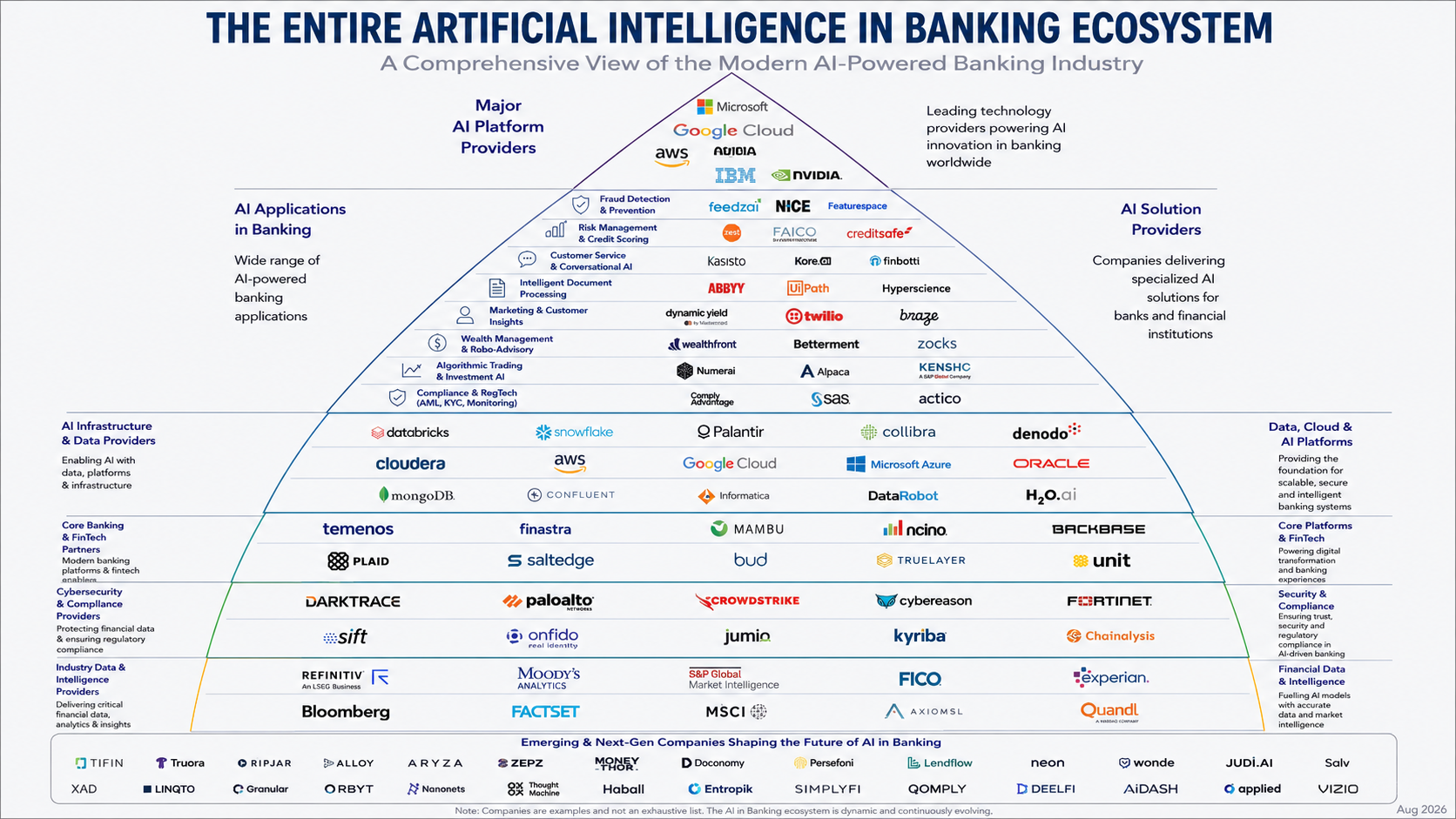
Not because it is perfect. It isn't. No ecosystem chart ever is, and this one shows the companies as examples rather than an exhaustive list. I love it because it takes something I have been writing about for years and makes it visible.
We keep talking about artificial intelligence in banking as though it were a technology that banks are installing. Buy some AI. Add a model. Deploy a copilot. Automate a process. Job done.
That completely misses the point because AI in banking is an ecosystem and this chart shows it. It’s not a thing. It is many things.
Look at the structure from the bottom upwards. At the foundations are the data and intelligence providers. Above them are cybersecurity and compliance specialists. Then come the core banking and fintech platforms. Then the data, cloud and AI infrastructure. Above that sits a huge and growing collection of specialised AI applications. Finally, at the top, you find the major technology platforms supplying much of the cloud computing to everything underneath.
The architecture of the intelligent bank becomes much easier to understand.
This connects directly with something I've been arguing on The Finanser for some time: you cannot be intelligent with dumb data.
An AI-native bank doesn't start with ChatGPT or a clever chatbot. It starts much further down the stack, with clean data, resilient infrastructure, modernised cores, APIs, cloud, cybersecurity, identity and governance. Only when those foundations exist can you start putting intelligence to work across the institution.
That is why the lower half of this chart may be more important than the glamorous top.
You have financial information and intelligence from firms such as Moody's, Bloomberg, S&P Global, Experian, FICO, FactSet and MSCI. You have cybersecurity, identity and compliance capabilities. You have core banking and fintech platforms. You then have Databricks, Snowflake, Palantir, Collibra, AWS, Google Cloud, Microsoft Azure, Oracle, MongoDB, Informatica and others building the data and infrastructure environment.
And only then do we reach the AI applications.
That layer is fascinating because it shows where the intelligence revolution is becoming operational. Fraud detection, risk management, credit scoring, customer service, conversational banking, intelligent document processing, marketing, wealth management, robo-advice, algorithmic trading and RegTech are no longer theoretical AI use cases. There are companies building businesses around each of them.
This is very consistent with what I found when I looked recently at what banks are doing with AI. The interesting activity isn't primarily replacing the core banking system with some gigantic artificial brain. AI is being layered around and above existing infrastructure and is particularly powerful in the middle and back office: AML, KYC, reconciliations, document processing, financial crime, exceptions, operational workflows and knowledge management.
That's why I think we need to stop drawing the intelligent bank as a bank.
Draw it as an ecosystem.
For most of the twentieth century, banks wanted to own the stack. They built the systems, ran the data centres, controlled the distribution and employed the people who operated everything. Even when technology was supplied by third parties, the bank remained the organising centre of the architecture.
The internet started breaking that model. Cloud accelerated it. APIs opened it. Fintech fragmented it. And now AI has blown it wide open.
The intelligent bank increasingly becomes an orchestrator of capabilities rather than the manufacturer of every capability it uses. That is also why cloud matters so much. As I've written before, cloud is no longer just an infrastructure decision. It enables banks to connect fintechs, marketplaces, embedded-finance providers, data platforms and third-party services, turning the bank itself into a platform operating across other platforms.
And this is where the chart becomes really interesting.
Microsoft appears at the top as an AI platform provider and further down through Azure. Google does the same with Google Cloud. AWS appears as both infrastructure and an enabler of the intelligence above it. NVIDIA supplies the computing architecture underpinning a growing amount of AI. Then hundreds of specialised providers occupy particular pieces of the financial-services value chain.
In other words, this isn't really a pyramid.
It's a network.
The lines between the layers are going to become increasingly blurred because an intelligent bank will constantly call upon capabilities across this network. A customer asks for a mortgage. An AI agent understands the request, verifies identity, retrieves financial information, assesses affordability, interrogates credit data, checks fraud signals, prices the risk, queries the core system, checks regulatory requirements and potentially executes the transaction.
The customer experiences one conversation.
Behind that conversation could be dozens of platforms, models, APIs, datasets and specialist providers working together in milliseconds.
That's the profound change.
It also explains why agentic AI matters so much. The next stage isn't merely AI helping humans operate these systems. It is AI agents beginning to orchestrate the systems themselves, exchanging information, invoking services, making decisions and potentially conducting transactions on our behalf. That takes banking beyond digitalisation and into delegated intelligence.
My old model for digital banking was relatively straightforward: move from products, processes and people towards apps, APIs and AI. Even that has moved on rapidly in the past decade. I've more recently argued that we are heading towards agents, tokens and data because the front end becomes intelligent, the infrastructure becomes programmable and the raw material underneath everything is data.
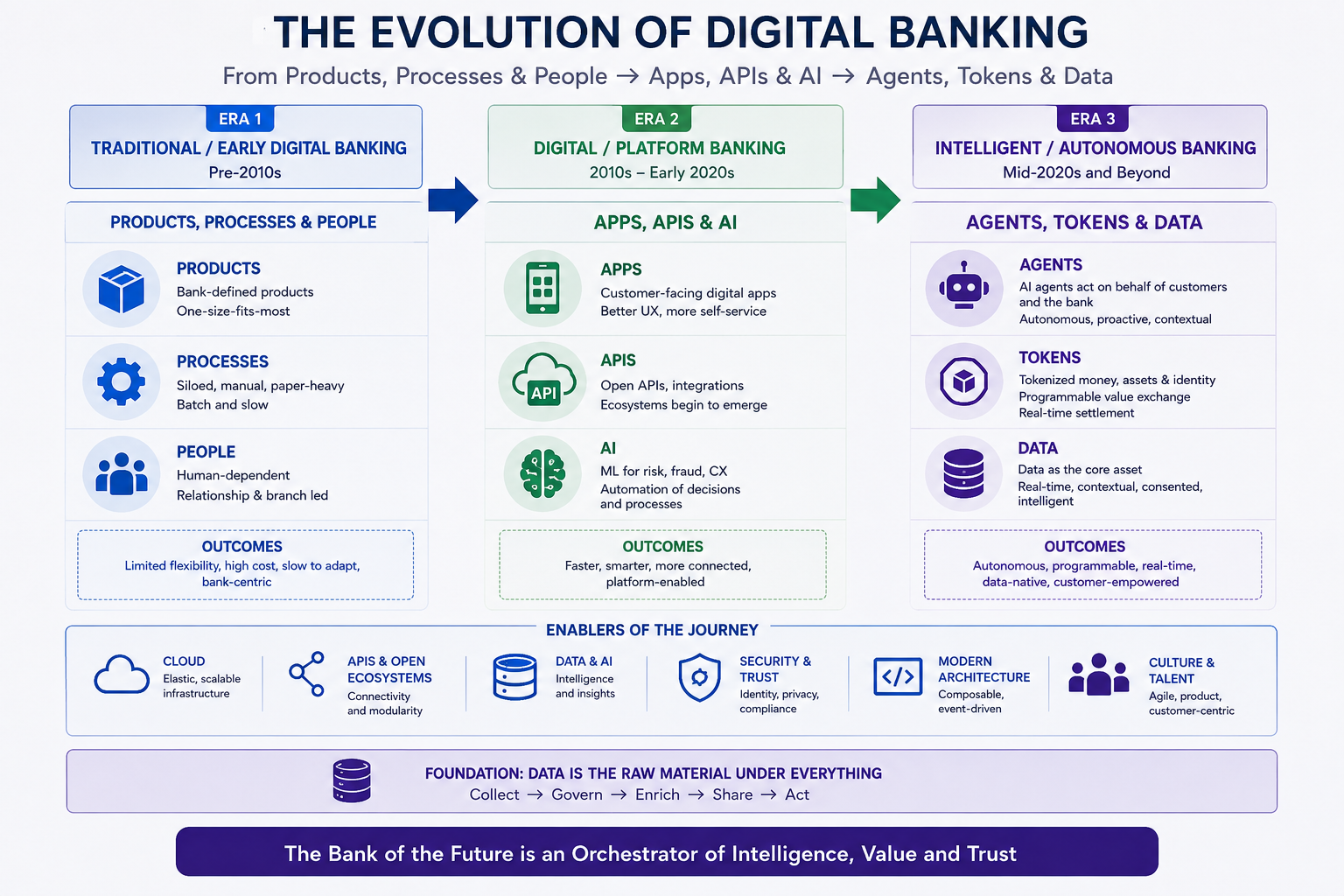
This chart adds another dimension to that thinking because it shows who is building all of those layers which creates a rather important question: Who owns the bank? Not legally. Architecturally.
If your data sits on one platform, your cloud on another, your models from another, fraud decisions from another, identity from another, customer conversations are handled by another and autonomous agents eventually orchestrate all of them, exactly where does the bank begin and the technology ecosystem end?
That question becomes even more important when many banks depend upon the same small group of technology providers. Regulators are increasingly concerned about concentration risk around cloud, foundation models and common technology infrastructure. If hundreds of financial institutions rely upon the same underlying intelligence and infrastructure, a problem inside one technology provider can become a problem across the financial system.
So, there are two sides to this wonderful picture.
The optimistic interpretation is extraordinary. We are watching banking become modular, intelligent, connected and increasingly real-time. A bank no longer needs to invent every capability itself. It can assemble the best capabilities available across a global ecosystem and orchestrate them around the customer.
The more challenging interpretation is that banks may be surrendering increasing amounts of their technological sovereignty to the companies supplying the ecosystem.
And that brings me back to why I like this chart so much.
For years we talked about digital banking. Then we talked about open banking. Then platform banking. Now we are talking about intelligent banking. But perhaps the biggest shift underneath all of them is this:
The bank is no longer the system. The ecosystem is the system.
And now we can finally see it.
The Finanser: What banks are doing with AI
The Finanser: What is an AI-native bank?
The Finanser: Banking on the Cloud

Chris M Skinner
Chris Skinner is best known as an independent commentator on the financial markets through his blog, TheFinanser.com, as author of the bestselling book Digital Bank, and Chair of the European networking forum the Financial Services Club. He has been voted one of the most influential people in banking by The Financial Brand (as well as one of the best blogs), a FinTech Titan (Next Bank), one of the Fintech Leaders you need to follow (City AM, Deluxe and Jax Finance), as well as one of the Top 40 most influential people in financial technology by the Wall Street Journal's Financial News. To learn more click here...