
I was playing around with some numbers the other day, comparing the world's biggest banks with the world's biggest fintech firms, when something struck me. We keep comparing them using all the obvious measures: customers, revenues, profits, assets and market capitalisation. Who's bigger? Who's growing faster? Are the fintechs really disrupting the banks or are the banks simply waiting for the challengers to discover how bloody difficult banking actually is?
Then I looked at the number of people they employ. That's when things got interesting.
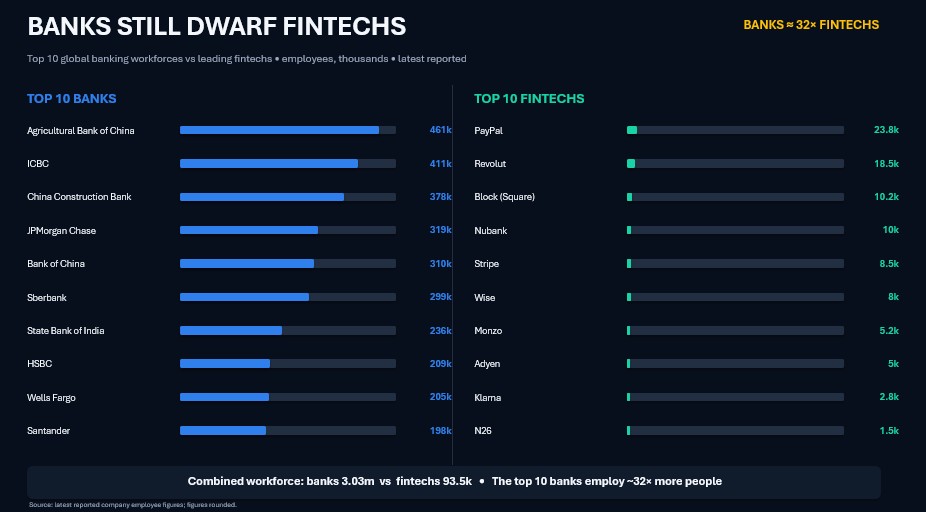
Take ten of the world's biggest banking employers and you are looking at around three million people. Agricultural Bank of China employs around 461,000, ICBC around 411,000, China Construction Bank around 378,000 and JPMorgan Chase around 319,000. Add Bank of China, Sberbank, State Bank of India, HSBC, Wells Fargo and Santander and the total comes to just over three million employees.
Three million people required to run a traditional bank.
Now take ten of the most prominent fintech firms: PayPal, Revolut, Block, Nubank, Stripe, Wise, Monzo, Adyen, Klarna and N26.
Together, they employ fewer than 100,000 people.
That's quite a contrast.
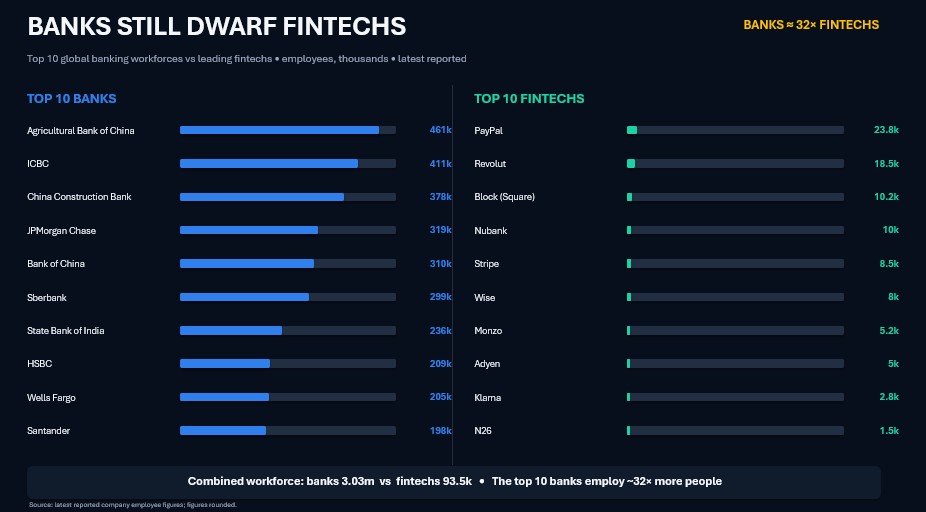
Three million people versus less than 100,000.
In other words, for every employee with a fintech there are 32 people working for a traditional bank.
Of course, I can already hear the objections. It’s not comparing apples with apples.
Agricultural Bank of China operates thousands of branches as does JPMorgan and others.
Banks run enormous operations in payments, lending, mortgages, corporate banking, investment banking, treasury, cash management and countless other areas.
They maintain legacy systems, physical networks and regulatory infrastructures that fintech firms simply don't have …. but that's the point.
Traditional banking was designed in an age when scale meant people. If you wanted more customers, you opened more branches and employed more tellers. More transactions required more operations people, more products created more departments and more countries meant more offices, management and infrastructure. That was simply how banking scaled, and you can still see the legacy of that model in the three million people employed by those ten banks. Digital firms scale differently because software doesn't demand another building, another regional manager and another thousand employees every time the customer base doubles.
The digital model breaks that relationship because software scales in a completely different way.
Then look at valuations.
The ten largest banks in my comparison have a combined market capitalisation of a little over $4 trillion. JPMorgan alone is approaching $1 trillion. Bank of America is worth more than $400 billion, while China Construction Bank, Agricultural Bank of China, HSBC and ICBC are all enormous financial corporations.
So, let's be clear: fintech has not replaced banking.
Not even close.
But now look at what is happening on the other side.
Stripe was valued at $159 billion in its 2026 employee share sale. Revolut has reportedly reached a valuation of around $115 billion. Ant Group is still valued at around $150 billion in various private-market estimates, while Robinhood, Nubank, PayPal, Block, Coinbase, Adyen and others are worth tens of billions.
Put my ten fintechs together and you get something approaching $800 billion of value.
The banks are still worth about five times more.
But remember the employees.
Three million versus fewer than 100,000.
That is where the comparison becomes interesting. The question is not whether fintechs are worth more than banks. They aren't. The question is how much organisational machinery is required to create value?
Take JPMorgan and Revolut.
JPMorgan has around 319,000 employees and a market capitalisation approaching $1 trillion. That works out at roughly $3 million of market value per employee.
Revolut has around 18,500 employees and has been valued at roughly $115 billion. That's more than $6 million of value per employee.
Then consider Stripe. With a valuation of $159 billion and a workforce measured in thousands rather than hundreds of thousands, its value per employee is on another level again.
You can turn the equation around.
Instead of asking how much value each employee creates, ask how many employees are needed to support $1 billion of corporate value.
For JPMorgan, the answer is roughly 336 employees for every $1 billion of market capitalisation.
For Revolut, it's around 161.
For Stripe, depending on which employee figure you use, it is somewhere around 50 to 60.
Now we are getting to the interesting part.
I am not suggesting that market capitalisation divided by employees is some wonderful new financial ratio that should replace return on equity. It isn't. Private valuations are not the same as public market capitalisations. A universal bank is not the same thing as a payments company. A regulated balance sheet is different from a technology platform, and the functions performed by a JPMorgan or HSBC extend far beyond those of most fintech firms.
Nevertheless, the direction of travel is impossible to ignore.
For decades banks have asked: how can technology make our people more productive?
Fintech asks: why do we need all these people?
Traditional banks scale through infrastructure. Digital financial firms scale through technology. That may turn out to be one of the most important differences between the two.
For decades, banks have thought about technology primarily as a means of making their existing organisations more efficient. Automate the back office. Offshore operations. Close branches. Move customers online. Introduce straight-through processing. Replace paper with digital workflows. Put the mainframe behind an app.
All useful.
But the fintech model starts somewhere else.
Instead of asking how technology can make 10,000 people more efficient, it asks why you need 10,000 people in the first place. That's a fundamentally different question … and then along comes artificial intelligence.
If cloud computing and smartphones allowed financial firms to reach millions of customers without building thousands of branches, AI potentially removes another layer of organisational scale. Customer service, fraud detection, coding, compliance, credit analysis, marketing, operations and even parts of financial advice can increasingly be augmented or automated.
This doesn't mean banks will suddenly fire millions of people. Banking is far more complicated than that but, what it does mean, is that the relationship between size and headcount is breaking down which creates an intriguing possibility.
The great battle of the next decade may not actually be banks versus fintechs.
It may be about what happens when banks learn the fintech productivity model.
Imagine JPMorgan with its capital, customers, licences, brand, balance sheet and global reach, but operating with dramatically greater technological leverage. Imagine HSBC, Santander or Bank of America discovering that growth no longer requires proportional growth in people and infrastructure. Equally, imagine Revolut, Nubank or Stripe continuing to grow without acquiring the organisational complexity of the institutions they were created to challenge.
That last part may be difficult.
As fintechs become bigger, they are discovering that financial services brings regulation, compliance, risk management, capital requirements, governance and operational resilience. In other words, as fintechs mature, they inevitably acquire some characteristics of banks.
Meanwhile, banks are moving in the opposite direction. They are trying to become technology companies.
The two models are converging.
So maybe I've been looking at the bank versus fintech debate the wrong way. I don't think Revolut replaces JPMorgan or Stripe replaces HSBC. That's never really been the point. What interests me far more is what happens when a JPMorgan learns to scale like a Revolut, while Revolut discovers whether it can become as large and complex as JPMorgan without ending up employing 300,000 people.
That's why I keep coming back to this strange little calculation. How many people does it take to create $1 billion of value?
It's crude. It's unfair. It compares apples with oranges and public market capitalisations with private valuations. Any decent analyst can spend an afternoon telling me why it doesn't work.
Fine.
But I still want to know the answer.

Chris M Skinner
Chris Skinner is best known as an independent commentator on the financial markets through his blog, TheFinanser.com, as author of the bestselling book Digital Bank, and Chair of the European networking forum the Financial Services Club. He has been voted one of the most influential people in banking by The Financial Brand (as well as one of the best blogs), a FinTech Titan (Next Bank), one of the Fintech Leaders you need to follow (City AM, Deluxe and Jax Finance), as well as one of the Top 40 most influential people in financial technology by the Wall Street Journal's Financial News. To learn more click here...