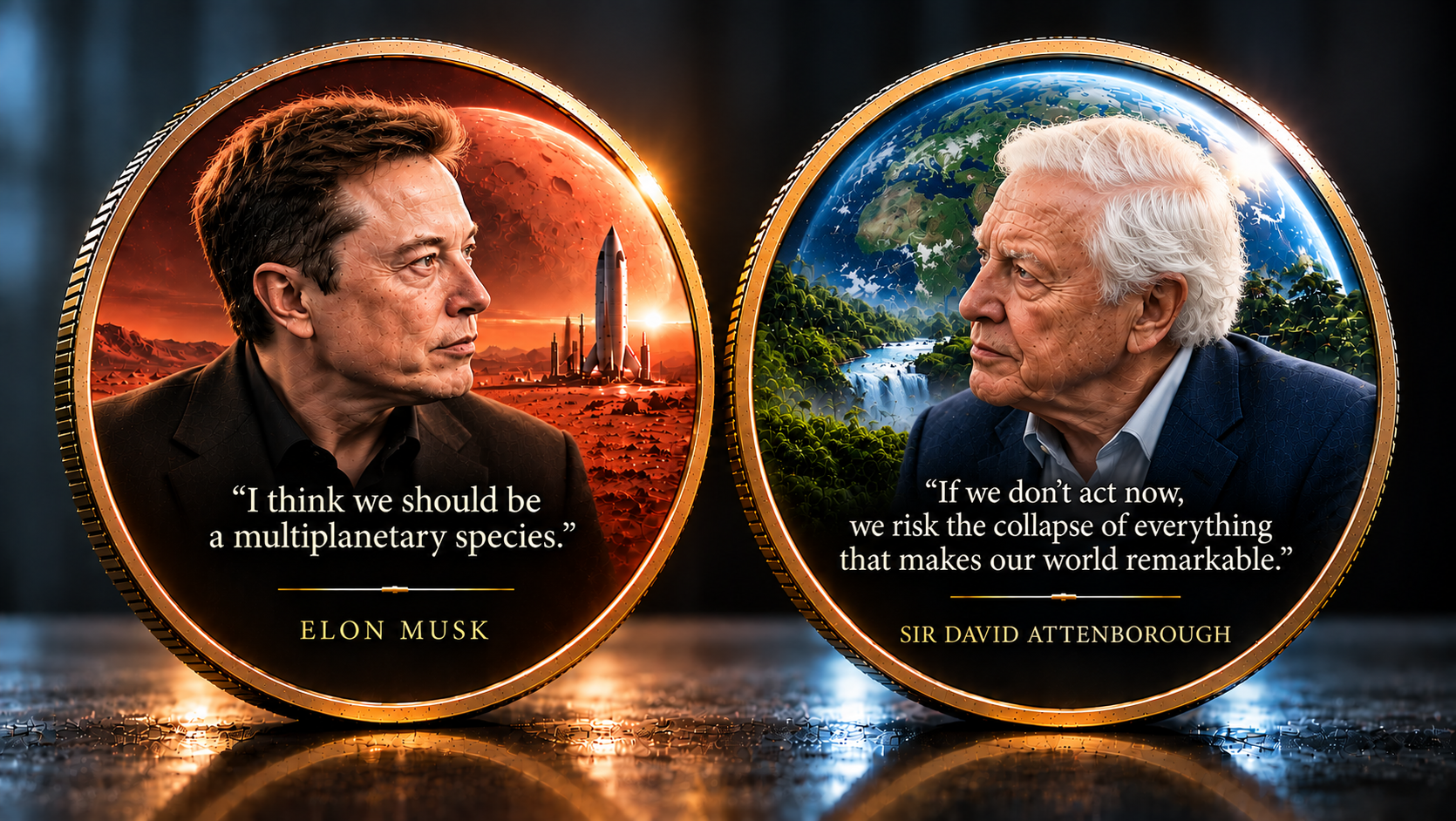
There are always two sides to a coin and, right now, the two sides of our technological future could hardly look more different.
On the one side are the technologists who want us to build more, compute more, automate more and move faster. Artificial intelligence will transform everything, robots will do much of the work, cryptocurrencies will reinvent money and, if we eventually exhaust the possibilities of this planet, perhaps we should become a multiplanetary species and head for Mars.
On the other side are people such as Sir David Attenborough and movements such as Extinction Rebellion asking a rather more fundamental question: what is the point of building an amazing technological future if, in doing so, we trash the only planet we currently have?
It is a question that has been nagging at me for some time, because every great technological revolution seems to arrive with the promise that it is somehow weightless. We talked about the internet as though it existed in the ether (ed: you mean Ethereum?), we moved everything to something called the cloud, we created digital currencies and now we are creating artificial intelligence that appears magically on our screens whenever we ask it a question.
Yet there is nothing weightless about any of this.
The cloud is millions of servers sitting in enormous buildings; bitcoin depends upon vast amounts of computing power; and artificial intelligence runs on data centres filled with GPUs, storage, networking equipment and cooling systems, all of which require electricity. The digital world turns out to be remarkably physical.
Bitcoin gave us an early warning.
The brilliance of bitcoin is that you can create a decentralised form of value without needing a government, central bank or commercial bank to stand behind it, but the proof-of-work mechanism that secures the network requires computers around the world to compete continuously to solve cryptographic problems.
That takes energy.
A lot of it.
This does not mean bitcoin is inherently environmentally destructive, because where the electricity comes from matters enormously.
A mining operation powered by renewable or otherwise curtailed energy is very different from one powered by coal, but bitcoin nevertheless exposed something we had conveniently ignored about our digital future: every digital transaction ultimately rests upon a physical infrastructure, and that infrastructure consumes resources.
Now we have artificial intelligence, and the numbers become far more interesting.
According to the International Energy Agency, data centres consumed around 415 terawatt-hours of electricity in 2024, roughly 1.5 per cent of global electricity consumption, and the IEA expects that figure to more than double to around 945 TWh by 2030. AI is the most important driver of that increase. A typical AI-focused data centre can consume as much electricity as 100,000 households, while the largest facilities under construction can consume many times that amount.
Think about that for a moment, because it changes the way we should think about AI.
When I type a question into ChatGPT, there is no smoke coming out of my laptop and I cannot hear a turbine spinning somewhere, so the interaction feels almost free. It isn't. Somewhere, processors are working, servers are communicating, cooling systems are running and electricity is being consumed.
Multiply my prompt by hundreds of millions of people, add businesses deploying AI across everything from customer service to software development, and then add image generation, video generation, reasoning models and autonomous agents, and suddenly the apparently weightless world of artificial intelligence becomes a very substantial industrial infrastructure.
Of course, there is another side to that coin, because it would be absurd to look only at the electricity AI consumes without considering what AI might achieve.
Artificial intelligence is being applied to medicine, scientific research, materials discovery, energy optimisation, transport, manufacturing, agriculture and almost every other major industry.
The IEA itself points out that AI can help optimise energy systems, improve efficiency and accelerate innovation, while the energy required for individual AI tasks continues to fall as chips and software improve.
The problem is that demand is growing faster than those efficiency gains. We make computation cheaper, discover thousands of new uses for it and then consume more computation than ever before.
This is where Sir David Attenborough enters my thinking, because he represents an almost completely different view of progress.
Attenborough has spent a lifetime showing us that the extraordinary system we are trying to improve already exists all around us.
Earth has forests that absorb carbon, oceans that regulate temperatures, insects that pollinate crops, ecosystems that recycle waste, soils that create food and an atmosphere that rather conveniently allows eight billion human beings to breathe. His argument is not that technology is bad, but that technological progress becomes meaningless if it destroys the natural systems upon which human civilisation depends.
Extinction Rebellion takes that argument further and makes it deliberately uncomfortable.
Its central demands – Tell the Truth, Act Now and Decide Together – reflect its belief that incremental environmental change is inadequate and that governments and societies need to confront the climate and ecological emergency far more aggressively. You can disagree with its tactics, and many people understandably do, but disliking protesters blocking a road does not make the underlying environmental question disappear.
The underlying question is: what we are optimising for?
For most of the industrial age, we optimised for growth. We wanted more factories, more production, more consumption, more trade, more GDP and more shareholder returns, while technology made the machine increasingly efficient and finance supplied the capital that allowed it to expand. Then digital technology arrived and appeared to offer us a different model because software seemed almost weightless. The cloud floated somewhere above us, bitcoin became digital gold and artificial intelligence became intelligence in a box, except none of those descriptions reflects the physical reality. The cloud is a building, bitcoin is a network of machines and AI is increasingly a warehouse filled with very expensive processors, and every one of them needs electricity.
That creates an interesting clash between the Elon Musk view of the future and the David Attenborough view.
Musk talks about humanity becoming a multiplanetary species because civilisation should not depend upon a single planet, while Attenborough argues that we are damaging the extraordinary planet we already inhabit and need to change our behaviour before that damage becomes irreversible.
I don't actually think those positions are as mutually exclusive as they appear.
The problem arises when Mars becomes an excuse for ignoring Earth, just as environmentalism becomes unrealistic when it assumes that humanity will somehow stop inventing, building and progressing.
Telling humanity to stop innovating is neither realistic nor desirable.
Technology has increased life expectancy, reduced poverty, connected billions of people, transformed medicine and created opportunities previous generations could barely imagine, and artificial intelligence has the potential to create another transformation of similar scale.
Equally, believing that technology will automatically solve every problem created by technology is a dangerous article of faith.
We cannot simply assume that better batteries, nuclear power, fusion, carbon capture, renewable energy or some technology that has not yet been invented will arrive just in time to clean up whatever mess we create along the way.
For me, therefore, the answer is not technology or the planet. It is technology for the planet, and that requires us to stop treating the environmental consequences of computation as somebody else's problem.
If an AI model requires huge amounts of electricity, that should form part of its economics. If a bitcoin mining operation is powered by fossil fuels, that should form part of its economics. If a new data centre requires the electricity supply of a city, the source of that electricity matters. If a technology company can increase its profits while society absorbs the environmental costs of the energy it consumes, then the price of that technology is not reflecting its true cost.
And, actually, I have been arguing this for some time. In 2022, I published Digital for Good: Stand for Something… or You Will Fall, which asked a simple question: how can technology and finance work together to create a better society and a better planet?
The book explored everything from financial inclusion and purpose-driven banking to cryptocurrencies, stakeholder capitalism and the climate emergency, with contributions from people on very different sides of the debate including Gail Bradbrook, co-founder of Extinction Rebellion, and Brock Pierce, Chair of the Bitcoin Foundation.
My point then was not that we should reject technology to save the planet, but almost exactly the opposite: we should use the extraordinary power of digital technology and finance to make society and the planet better.
In fact, I wrote that I wanted my children and grandchildren to enjoy the beauty of Earth as I had enjoyed it, adding that Elon Musk might want to send them to Mars, but I wanted them here.
Four years later, with AI creating a new explosion in demand for computing power and electricity, that question feels even more relevant. The challenge is not whether we choose digital or good. The challenge is whether we are clever enough to make digital do good.
This is where the discussion comes straight back to finance, because technology creates possibilities, but finance decides which possibilities get built.
Banks decide what receives credit, investors decide where capital flows, pension funds decide which companies receive the savings of millions of people, insurers determine which risks can be underwritten and governments influence the entire system through taxation, subsidies and regulation.
A technologist can invent something extraordinary, but turning that invention into infrastructure requires capital, which means the debate about technology and climate is also a debate about money.
That, to me, is the really interesting part of this argument.
We spend a great deal of time asking whether AI will change the world, whether bitcoin will change money, whether robots will change employment or whether humans will eventually live on Mars, but perhaps the more important question is what sort of world we are financing while all of this happens. What do we value, what do we finance, what costs do we recognise and, most importantly, what costs do we conveniently leave outside the calculation because recognising them would make the economics less attractive?
Which brings me to my latest publication: The Bank Who Sold The World.
If Digital for Good explored these questions through the real world of banking, technology, climate and capitalism, my new financial thriller explores them through fiction, because sometimes a story allows us to confront uncomfortable questions far more effectively than another hundred-page ESG report.
What happens when a bank that has spent decades financing growth is forced to confront what that growth has created? What happens when the pursuit of returns collides with the environmental consequences of the investments producing those returns? What happens when bankers, investors, activists, corporations and governments all believe they are doing the right thing, but their definitions of the right thing are completely different?
That is the world of The Bank Who Sold The World, and perhaps that is why the image of the two coins works so well for me.
Elon Musk looks towards Mars while David Attenborough looks towards Earth, and both are asking us to think about the future. One sees humanity's destiny in expanding beyond the planet and the other sees our responsibility in protecting the planet we already have. Somewhere between those two visions sit technology, money, power and the financial system that will decide which future receives the capital to become real.
There are always two sides to a coin, but there is only one Earth.
Digital for Good
https://www.amazon.com/Digital-Good-Chris-Skinner-ebook/dp/B0B2Q18X2Q
The Bank Who Sold The World
https://www.amazon.com/gp/product/B0HG63ZTPD
Chris M Skinner
Chris Skinner is best known as an independent commentator on the financial markets through his blog, TheFinanser.com, as author of the bestselling book Digital Bank, and Chair of the European networking forum the Financial Services Club. He has been voted one of the most influential people in banking by The Financial Brand (as well as one of the best blogs), a FinTech Titan (Next Bank), one of the Fintech Leaders you need to follow (City AM, Deluxe and Jax Finance), as well as one of the Top 40 most influential people in financial technology by the Wall Street Journal's Financial News. To learn more click here...