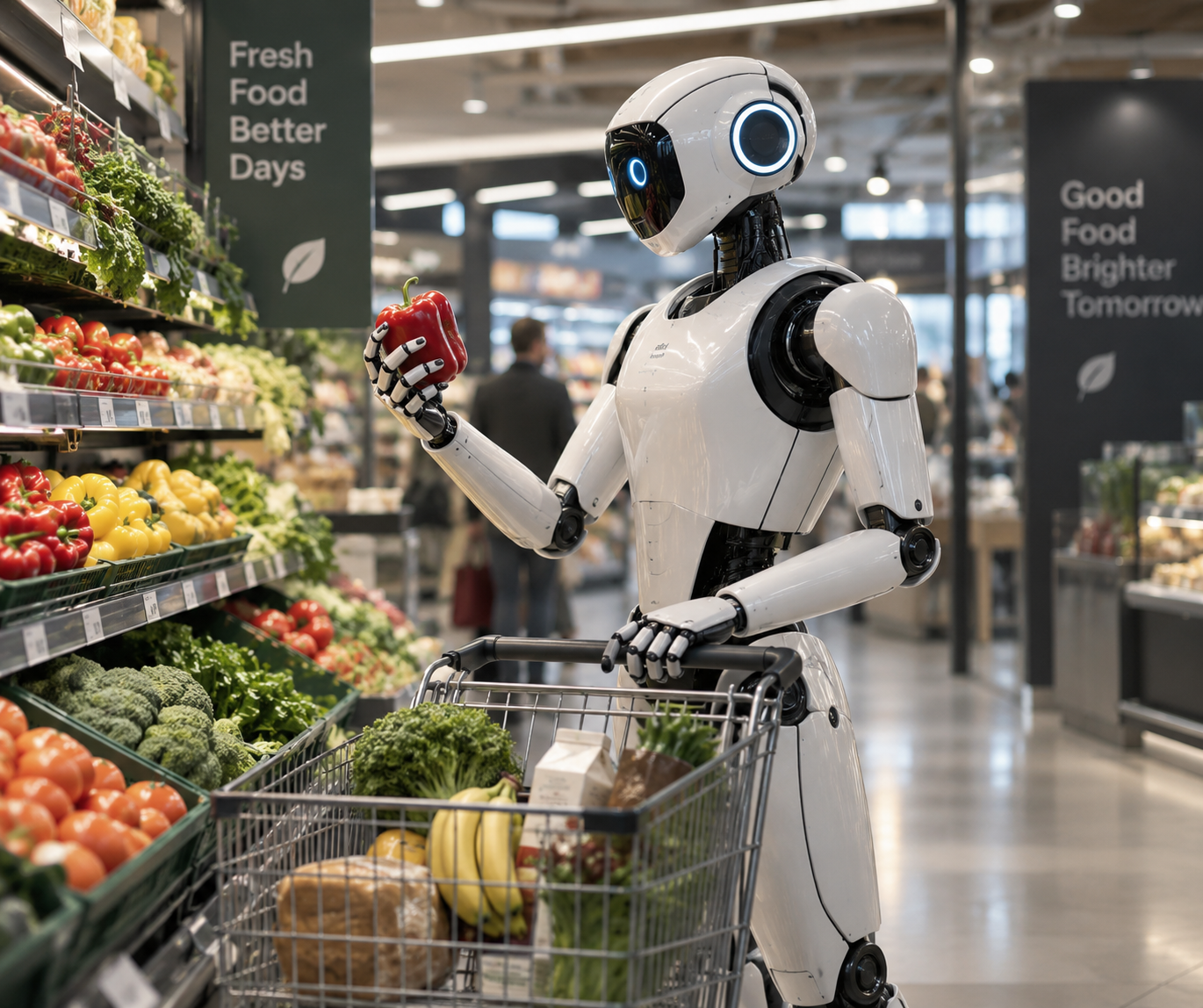
MasterCard just produced an interesting range of views about the future of shopping and money using visionaries like my friend Theo Lau, who alerted me to the report.
A quick summary.
We have spent the last years talking about artificial intelligence as though the big change is that we will have a cleverer chatbot. Ask it a question, get an answer. Ask it to write something, get some words. Ask it where to go on holiday, get some recommendations. Useful, certainly, but that is not where this is heading.
The bigger change comes when artificial intelligence stops answering and starts doing.
Instead of asking an AI to find the cheapest flight to New York, you tell it when you want to travel, what airports you prefer, whether you want business or economy, what your budget is and where you like to sit. The agent searches the airlines, compares the alternatives, negotiates where it can, books the flight, chooses the seat, enters your passport details and pays. You don't shop. Your machine shops for you.
That is the central message of Mastercard's A Short History of the Future of Shopping and Payments, and some of its predictions are worth thinking about because they point towards something far bigger than another improvement in e-commerce. They point towards a world of machine customers, machine merchants and machine payments.
The report predicts that 300 million shoppers will routinely use AI agents by 2030, led by markets including the United States, United Kingdom, China, South Korea and the Netherlands. More interestingly, many will not realise they are using an agent because the intelligence will disappear inside the shopping experience. Products will be searched, compared, selected and, increasingly, purchased without the customer clicking through dozens of screens.
In other words, the internet taught us to shop online. Agentic AI starts removing the shopping.
That sounds strange until you think about how much work shopping involves.
We search, compare, check reviews, investigate delivery dates, enter addresses, remember passwords, type payment details, track deliveries and deal with returns. The report makes the rather nice comparison that agentic AI could do for shopping what the washing machine did for laundry. We still decide what we want, but much of the labour involved in getting it disappears and that changes retail profoundly.
One key prediction is that speed becomes brutal.
By 2030, the report believes a website taking more than three seconds to load could lose up to 80 per cent of its visitors. That sounds extreme until you recognise that the customer is no longer comparing one website with another. The customer's agent is comparing everything with everything, instantly. Friction isn't irritating in that world. Friction makes you invisible.
Then search changes.
Today's search engine gives you a list of places where you might buy something. Tomorrow's search agent will want to complete the transaction. Find me this microwave at the lowest price, buy it and have it delivered tomorrow.
Search therefore starts colliding with retail, which is why the report expects regulatory pushback by 2028 and predicts governments will demand some form of wall between AI-powered search and the actual purchase. Otherwise, whoever controls discovery could control the transaction as well.
This becomes even more interesting with complicated purchases. Flights, hotels, insurance and car hire are perfect agentic markets because humans hate navigating hundreds of combinations of price, date, location, excess, baggage, cancellation rights and terms. An agent doesn't get tired or bored. Give it the mandate and it works through the combinations until it finds the answer.
The problem then moves from technology to law: if my agent buys the wrong non-refundable flight, who made the contract? Me, my agent, the airline or the company providing the agent?
The report identifies this question of responsibility as one of the hurdles that has to be resolved, but this is where the story takes another turn, because the customer is not the only one getting an agent. The retailer gets one too.
Imagine walking into a pharmacy in 2030, except you don't walk in. Your care bot does. It carries your identity, prescription, payment authority, loyalty history and instructions. It meets the pharmacy's AI, which understands inventory, margins, supplier costs, promotions and cash flow. Your machine asks for a discount on a blood-pressure monitor. The pharmacy's machine refuses but offers a free flu vaccination and loyalty credit instead. Your agent checks its mandate, decides that is acceptable and completes the transaction in less than a second. Meanwhile, the human pharmacist is talking to a worried patient about their medication.
That is a fascinating vision because it turns much of what we call retail upside down. The machines handle the functional stuff while the humans handle the human stuff.
It also means something we abolished more than a century ago comes back: haggling.
Fixed prices were useful because negotiating every transaction was expensive. Now, when machines negotiate with machines, the marginal cost of negotiation approaches zero. Suddenly the price tag is an opening offer. The buyer's agent asks for a better deal and the seller's agent responds, not just through price but through warranties, delivery, bundles, service levels and loyalty rewards.
The report points to Walmart's experience with AI supplier negotiation, where its system closed 68 per cent of deals without human intervention and achieved an average gain of around three per cent.
Now take that another step.
Your agent doesn't just know your budget. It knows what you care about. Maybe you want locally produced food, sustainable clothing, repairable electronics or products made under particular labour standards. The merchant can claim anything it likes today, but tomorrow your agent checks. It interrogates supply-chain data, returns behaviour and product passports and compares what the company says with what the company does. As the report puts it, values-washing starts dying when machines can verify the claims.
This creates something even stranger: the machine customer develops an organisational structure.
The report imagines corporate purchasing where one AI agent cares about price, another about sustainability, another about waste and another about regulatory compliance, all orchestrated by another agent deciding which objective matters most. On the other side of the table sits an equivalent collection of seller agents representing margins, inventory, customer relationships and commercial strategy. By 2030, the report argues, commerce starts looking like two machine organisations negotiating with each other.
Think about what that does to payments.
Today, a payment is an event. I decide to buy something, authenticate myself and press PAY. In an agentic economy, payment becomes a consequence. My agent has already been authenticated, has a tokenised payment credential, knows its spending limits and understands when it can transact independently and when it needs to ask me. The important question therefore changes from "did Chris authorise this payment?" to "did Chris authorise this agent to make this decision under these circumstances?"
That is why the most important word in Mastercard's report isn't artificial, intelligence, agent or even payment.
It is trust.
If I allow software to spend £20 replacing washing powder, I don't care very much. If I allow it to spend £2,000 booking a holiday, I care enormously. If my company's autonomous procurement system is signing million-pound contracts with another company's autonomous sales system, identity, authority, intent and accountability become the foundations of the transaction.
Mastercard therefore sees tokenisation, trusted identities, authentication and explicit authorisation as the infrastructure underneath agentic commerce. The card number increasingly disappears, replaced by a token that allows an authorised agent to transact without exposing the underlying payment credentials. The agent receives boundaries around how much it can spend, where it can spend, what it can buy and when it has to come back to the human for permission.
And there lies the bigger prediction.
We’ve talked a lot about invisible payments. Agentic commerce goes further because it makes commerce itself increasingly invisible. You don't search, click, compare, authenticate and pay. You define an outcome and a set of rules, and your digital representative gets on with it.
That doesn't mean shops disappear. In fact, the report predicts that online retail will stabilise below a third of total retail sales in most European countries because people still enjoy physical experiences, browsing and human interaction. The more virtual life gets, the report argues, the greater the premium we place on authentic physical experiences.
So, the future isn't machines replacing humans. It is machines replacing process.
That distinction matters.

Chris M Skinner
Chris Skinner is best known as an independent commentator on the financial markets through his blog, TheFinanser.com, as author of the bestselling book Digital Bank, and Chair of the European networking forum the Financial Services Club. He has been voted one of the most influential people in banking by The Financial Brand (as well as one of the best blogs), a FinTech Titan (Next Bank), one of the Fintech Leaders you need to follow (City AM, Deluxe and Jax Finance), as well as one of the Top 40 most influential people in financial technology by the Wall Street Journal's Financial News. To learn more click here...