
There is something wonderfully hypocritical happening in banking this week. American banks have started blocking AI bots from access to customer accounts:
Citi becomes latest US bank to restrict AI agents from accessing accounts
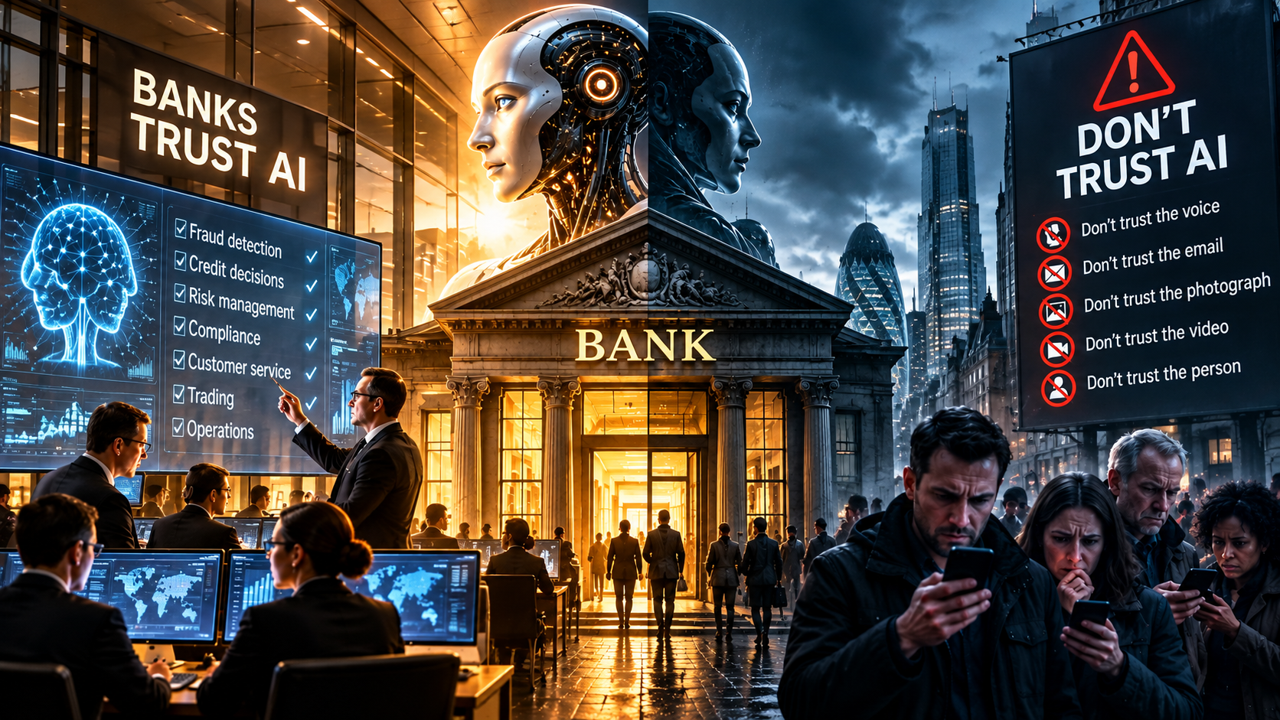
JPMorgan Chase, Citi and Bank of America are among the world’s biggest advocates of artificial intelligence. They are investing billions in the technology, automating operations, deploying intelligent systems and telling investors that AI will transform their businesses.
AI will make banking faster, cheaper, smarter and more efficient. It will improve customer service, reduce fraud, accelerate lending decisions, automate compliance and eliminate enormous amounts of administrative work.
Wonderful.
But hang on a minute.
Last week, these same banks were telling customers that they cannot allow independent AI agents to access their accounts and manage their money autonomously.
Why?
Because AI cannot be trusted.
Sorry, what?
When AI works for the bank, it is innovation but, when AI works for the customer, it is a security risk?
Now, before the bankers start shouting at me, I understand the argument. Allowing an autonomous agent to access a bank account, initiate payments and move money introduces serious questions about security, authentication, authorisation and liability.
An AI agent making an erroneous transfer could cause considerable damage, particularly if nobody knows who is responsible, but surely the same questions arise when banks deploy AI within their own organisations? What happens when an AI system incorrectly flags a legitimate customer as a fraudster, rejects a mortgage application, misinterprets a compliance requirement or makes a decision that damages somebody’s financial wellbeing?
Who is responsible then?
The bank, presumably, and that is precisely the point. Banks believe they can manage the risks of AI when they control the technology, establish the rules and determine the outcomes. Yet when customers want to deploy their own intelligent systems to manage their finances, suddenly the risks become unacceptable. Is that a genuine concern about customer protection, or is it just a convenient way to maintain control and claim the risk is not theirs if the customer’s bot messes up?
Turn this around: why would a customer want to use a bot?
An intelligent agent working for a customer might discover that their bank offers dreadful savings rates, excessive fees, poor investment performance or expensive credit. It might recommend switching providers, refinancing a loan, moving deposits or transferring investments. Critically, the agent would do something about it, moving savings from banks paying miserable interest rates to those offering better returns, while refinancing loans and mortgages with cheaper providers. That could be the real commercial threat facing the big American banks, because it fundamentally changes the relationship between banks and customers.
For decades, banks have relied on customers doing very little with their money. AI could change that by making financial management continuous, intelligent and increasingly automated. The real question is therefore not whether AI can be trusted. It is who gets to decide what AI is allowed to do, and whose interests it serves.
Banks want AI to make their businesses more efficient. Customers want AI to make their money more efficient. Surely both ambitions are equally legitimate?
Of course, there must be safeguards. Nobody is suggesting that an unverified chatbot should be handed unrestricted access to somebody’s life savings. We need secure APIs, clearly defined permissions, transaction limits, human oversight and transparent accountability but that is an argument for creating the infrastructure for agentic banking, not for keeping customers’ intelligent assistants outside the financial system.
The industry spent years arguing about open banking and whether customers should be allowed to share their financial data with third parties. Eventually, the principle became clear: customers should have meaningful control over how their information is used, subject to appropriate safeguards.
Agentic banking takes that principle further.
If customers can authorise another person or regulated financial institution to act on their behalf, why should they not be able to authorise an appropriately secured intelligent agent?
And here is the delicious irony.
The banks are telling their shareholders that AI represents an extraordinary opportunity to improve productivity and profitability, while telling their customers that autonomous AI represents an extraordinary risk.
Both statements can be true, because different applications create different risks, but banks must explain why the answer to internal AI risks are all around investment, engineering and governance, while the answer to external AI risks appears to be restriction, blocking and control.
Otherwise, the message is difficult to escape: We trust AI with our business. We just don’t trust it with yours, and that sounds remarkably like banking hypocrisy to me. After all, if JPMorgan, Citi and Bank of America are investing billions to make AI safe, secure and reliable enough to run their own operations, why aren’t they investing just as enthusiastically in making AI safe, secure and reliable enough to run their customers’ finances?
Perhaps the problem isn’t that banks don’t trust AI. Perhaps the problem is that they don’t trust customers to use AI in ways that undermine their profits.
This then raises a much bigger question: Are banks embracing artificial intelligence to transform banking, or merely to make their existing business models more efficient?
There is a world of difference between the two.
Using AI to reduce costs, automate processes, eliminate jobs and improve profitability is all about making the bank better at doing what it already does. Using AI to transform banking to be AI-native means fundamentally rethinking how financial services works, who and how people control the relationships and how customers manage their money. The former makes banks more efficient. The latter makes banking more effective for customers and therein lies the challenge.
Banks are investing billions in AI to transform their own businesses, but are they prepared to embrace a future in which customers use AI to challenge those businesses? A future in which intelligent agents continuously compare products, negotiate prices, move money and make decisions in the customer’s interests rather than the bank because that is what genuine transformation looks like. It changes the business model rather than simply improving it.
If banks only embrace AI when it makes them more profitable, while resisting AI when it empowers their customers, they are not transforming banking. They are using twenty-first-century technology to defend a twentieth-century business model and that is not transformation. It is automation of the status quo.

Chris M Skinner
Chris Skinner is best known as an independent commentator on the financial markets through his blog, TheFinanser.com, as author of the bestselling book Digital Bank, and Chair of the European networking forum the Financial Services Club. He has been voted one of the most influential people in banking by The Financial Brand (as well as one of the best blogs), a FinTech Titan (Next Bank), one of the Fintech Leaders you need to follow (City AM, Deluxe and Jax Finance), as well as one of the Top 40 most influential people in financial technology by the Wall Street Journal's Financial News. To learn more click here...