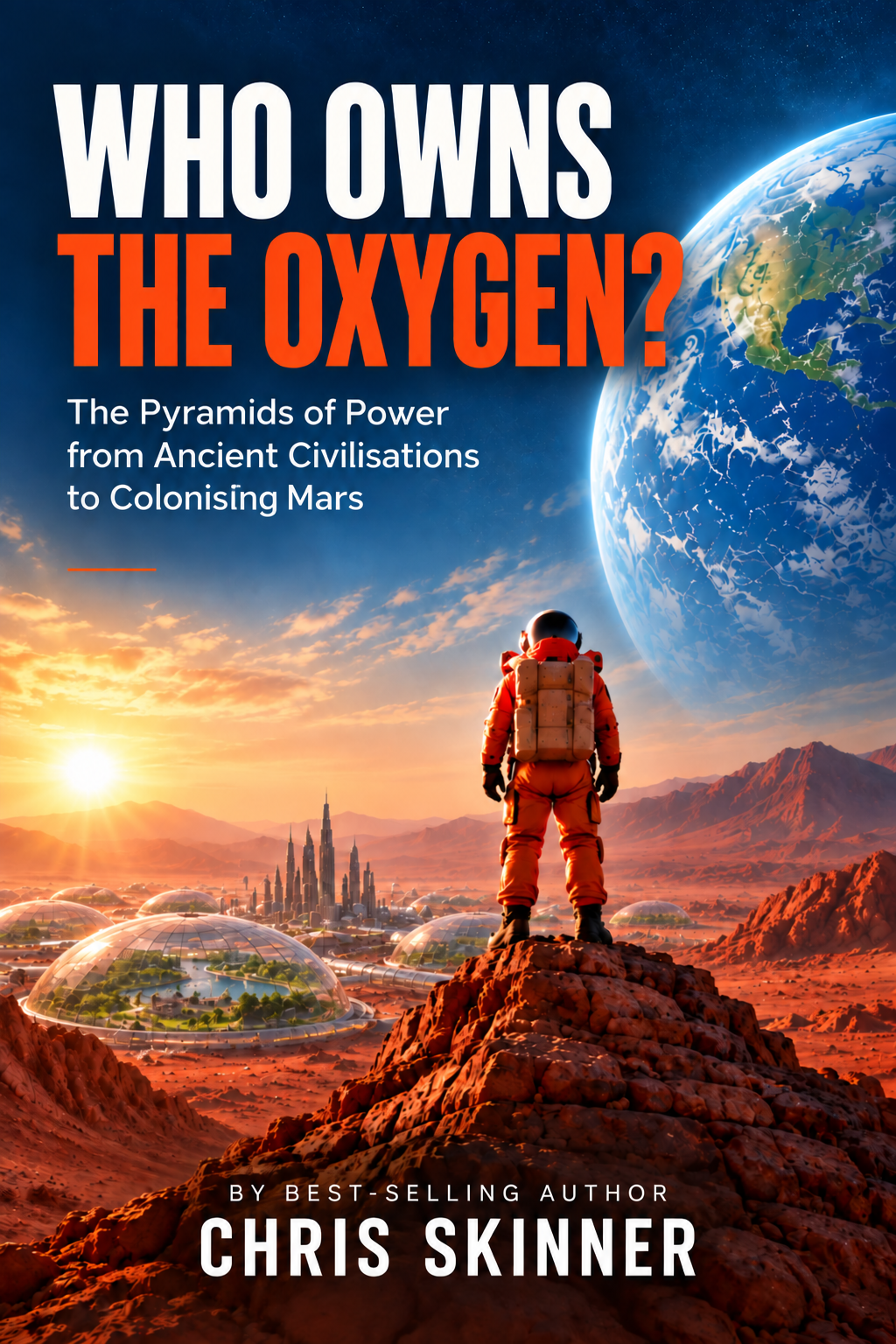
I've been a little bit prolific in writing this year, what with two books in Pulp Finction and Intelligent Bank consistently in the top 10 on Amazon. Now, I have one more new book. It started with a question in my head: how come Pharaohs had so much power? It ended with the colonisation of Mars.
The new book Who Owns the Oxygen? has just been released this week. For a few days you can get the Kindle version for free, so click the link: https://www.amazon.com/dp/B0HNH579ZT. What's the book about? Well, what if everything you need to survive belongs to somebody else, and how much would you pay to stay alive?
Sounds outrageous? Look around you.
We live in a world where a handful of corporations and billionaires control an increasing share of the things we depend upon, from the information we consume to the technology we use, while governments struggle to keep up with the extraordinary concentration of wealth and power.
Throughout history, the greatest fortunes have been made by people who understood one fundamental principle: control what people cannot live without and you control the world.
Look at oil. The confrontation between Iran and America over the Strait of Hormuz demonstrates why control of essential resources determines global power. A narrow stretch of water becomes a battleground for economic influence because the world's energy supplies depend upon the ships that pass through it. The struggle isn't simply about who owns the oil beneath the ground. It's about who controls its movement, its availability and ultimately its price.
Now consider what is happening with data.
We have handed technology companies extraordinary amounts of information about our lives, relationships, spending, movements and desires. They have turned that information into some of the greatest fortunes in human history, and artificial intelligence is taking this concentration of wealth and power to another level.
More than this, we have created an extraordinary concentration of risk. Banks, airlines, hospitals, governments and entire industries increasingly depend upon the same handful of technology companies for cloud computing, data processing and artificial intelligence. The infrastructure that keeps modern society functioning is becoming concentrated in fewer and fewer hands. When one of these systems fails, the consequences spread across industries, economies and borders.
Data tells companies who we are and what we do. Artificial intelligence increasingly determines what we see, what we buy, how we work and which decisions are made on our behalf.
And who owns the infrastructure behind this revolution?
We used to worry about who controlled our money and energy. Now we face a far more disturbing question: who controls us?
My new book, Who Owns the Oxygen? takes you on a provocative journey through the past, present and future of wealth and power, revealing the extraordinary connections between capitalism, technology, ownership and freedom.
It challenges the way we understand the world, asks some deeply uncomfortable questions and takes the reader towards a future that is both astonishing and disturbing.
Because the most valuable thing in the world isn't money, gold, oil or data. It is whatever everyone needs to survive, and whoever controls it controls the price.
Who owns the oxygen and how much are you willing to pay to survive?
Chris M Skinner
Chris Skinner is best known as an independent commentator on the financial markets through his blog, TheFinanser.com, as author of the bestselling book Digital Bank, and Chair of the European networking forum the Financial Services Club. He has been voted one of the most influential people in banking by The Financial Brand (as well as one of the best blogs), a FinTech Titan (Next Bank), one of the Fintech Leaders you need to follow (City AM, Deluxe and Jax Finance), as well as one of the Top 40 most influential people in financial technology by the Wall Street Journal's Financial News. To learn more click here...