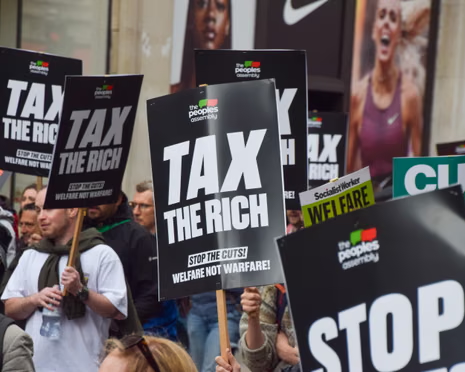
I was thinking about trickledown economics and tax, as it seems to be debated in the news almost daily. The core debate is whether to tax the rich more or less and the answer depends upon whether you are right or left of centre. This is why every election falls into the same argument. One side says we should tax the rich because they can afford it and society needs the money. The other says we should lower taxes on the rich because they create jobs, invest in businesses and drive economic growth.
The debate has become so familiar that it almost feels like a law of nature. Yet perhaps the most surprising thing is that, after decades of economic research, neither side appears to have won the argument. In fact, both may be asking the wrong question.
The idea that cutting taxes for the wealthy benefits everyone has been around for decades.
Give entrepreneurs, investors and business owners more of their own money, the theory goes, and they will invest it wisely. New companies will be created, existing businesses will expand, more people will be employed and rising prosperity will eventually spread throughout society. It is an attractive story because it suggests that helping those at the top ultimately helps everyone else. Politicians like it because it promises growth without sacrifice. Business leaders like it because it rewards success. Economists even gave it a respectable name: supply-side economics.
The problem is that reality has proved far more stubborn than theory.
One of the most comprehensive studies ever conducted examined tax reforms across eighteen developed economies over a period of fifty years. The conclusion was difficult to ignore. Tax cuts for the wealthy made wealthy people wealthier, but there is little evidence that they generated faster economic growth, created more jobs or reduced unemployment. What they did produce was greater inequality.
In other words, trickledown economics trickles to the rich, powerful and wealthy.
That finding has encouraged many people to reach what seems like the obvious conclusion. If cutting taxes for the rich doesn’t work, then surely taxing the rich more heavily must be the answer. Yet this is where the debate often becomes just as simplistic. Governments do not become wealthier simply because billionaires become poorer. Taking money from one part of the economy and moving it somewhere else does not automatically create new wealth.
Redistribution changes where money sits. It does not necessarily increase the amount of value being created. A country can collect more tax and still become less productive if that money is spent inefficiently. Equally, a country can collect less tax and fail to grow if businesses simply use the savings to buy back shares, acquire competitors or inflate asset prices instead of investing in innovation.
Perhaps the real question is not whether we should tax rich people more or less. Perhaps we should be asking what behaviour we are trying to encourage.
Tax is not simply a mechanism for raising revenue. It is one of the most powerful tools governments possess for shaping economic behaviour. Every tax system creates incentives. It rewards some activities and discourages others. If taxes encourage productive investment, research, education and entrepreneurship, they can strengthen an economy. If they encourage speculation, short-term thinking or tax avoidance, they can weaken it. The debate should therefore be less about who pays tax and far more about what the tax system is designed to achieve.
This becomes even more interesting when viewed through the lens of the digital economy.
Much of our tax policy was designed for an industrial world where wealth came from factories, machinery and physical labour. Today’s most valuable companies operate very differently. Microsoft, NVIDIA, Alphabet, Meta and Stripe derive much of their value from software, algorithms, intellectual property, data and network effects. Their greatest assets often cannot be touched, and much of their economic activity crosses borders almost effortlessly.
We continue trying to tax a twenty-first-century digital economy using frameworks designed for twentieth-century manufacturing.
It is hardly surprising that governments struggle to keep up.
Artificial intelligence makes the challenge even greater.
As software agents begin negotiating contracts, purchasing services and moving money without human intervention, traditional assumptions about labour, productivity and taxation begin to look increasingly outdated.
If intelligent machines perform more of the economic work, should governments continue relying so heavily on taxing human income? If value increasingly comes from data rather than labour, what exactly should be taxed?
These are questions that barely existed when trickle-down economics first entered political vocabulary, yet they may prove far more important than arguments over the top rate of income tax.
There is another assumption embedded in the traditional debate that deserves scrutiny. Both sides often behave as though money itself creates growth. It does not. Capital is only useful when it is deployed productively. A billionaire with another hundred million pounds sitting in financial assets is not creating jobs. Equally, a government with another hundred million pounds in tax receipts is not improving society. The outcome depends entirely on how that capital is used.
Productive investment creates growth. Unproductive investment merely changes ownership.
Perhaps that explains why some of the world’s most successful economies rarely fit neatly into either political narrative. Countries such as the Nordic nations maintain relatively high taxes while remaining globally competitive because they invest heavily in education, digital infrastructure and innovation. Singapore combines relatively low taxes with exceptional public investment and efficient government. Estonia has built one of the world’s most advanced digital societies despite its small size. None of these countries became successful because of tax policy alone. They succeeded because taxation formed part of a much broader strategy for building productive, trusted and competitive economies.
That, to me, is the lesson politicians continue to miss. The debate has never really been about taxing rich people. It has always been about how societies create wealth in the first place.
Wealth comes from innovation, productivity, education, infrastructure, entrepreneurship, trusted institutions and increasingly from intelligent technology. Tax policy can encourage or discourage those things, but it cannot replace them.
So perhaps it is time to stop asking whether we should tax the rich more or less. The more interesting question is whether our tax systems are encouraging the behaviours that create long-term prosperity. Tax should not be about punishing success, nor should it be about rewarding wealth for its own sake. It should be about directing capital towards the activities that make an economy stronger, more innovative and more productive.
Money does not magically trickle down. Nor does it magically flow upwards. It moves wherever incentives take it. The real challenge for governments is not deciding who should pay more tax. It is designing a system where capital, wherever it comes from, is consistently put to work creating opportunity for everyone else.
Chris M Skinner
Chris Skinner is best known as an independent commentator on the financial markets through his blog, TheFinanser.com, as author of the bestselling book Digital Bank, and Chair of the European networking forum the Financial Services Club. He has been voted one of the most influential people in banking by The Financial Brand (as well as one of the best blogs), a FinTech Titan (Next Bank), one of the Fintech Leaders you need to follow (City AM, Deluxe and Jax Finance), as well as one of the Top 40 most influential people in financial technology by the Wall Street Journal's Financial News. To learn more click here...