This is quite a long blog: TLDR?
The headline is the that language is what creates the concentration of power and Britain has done a good job there, as has France in the past. The question is whether AI will destroy all of this?
From Viking invaders and French aristocrats to American technology and artificial intelligence.
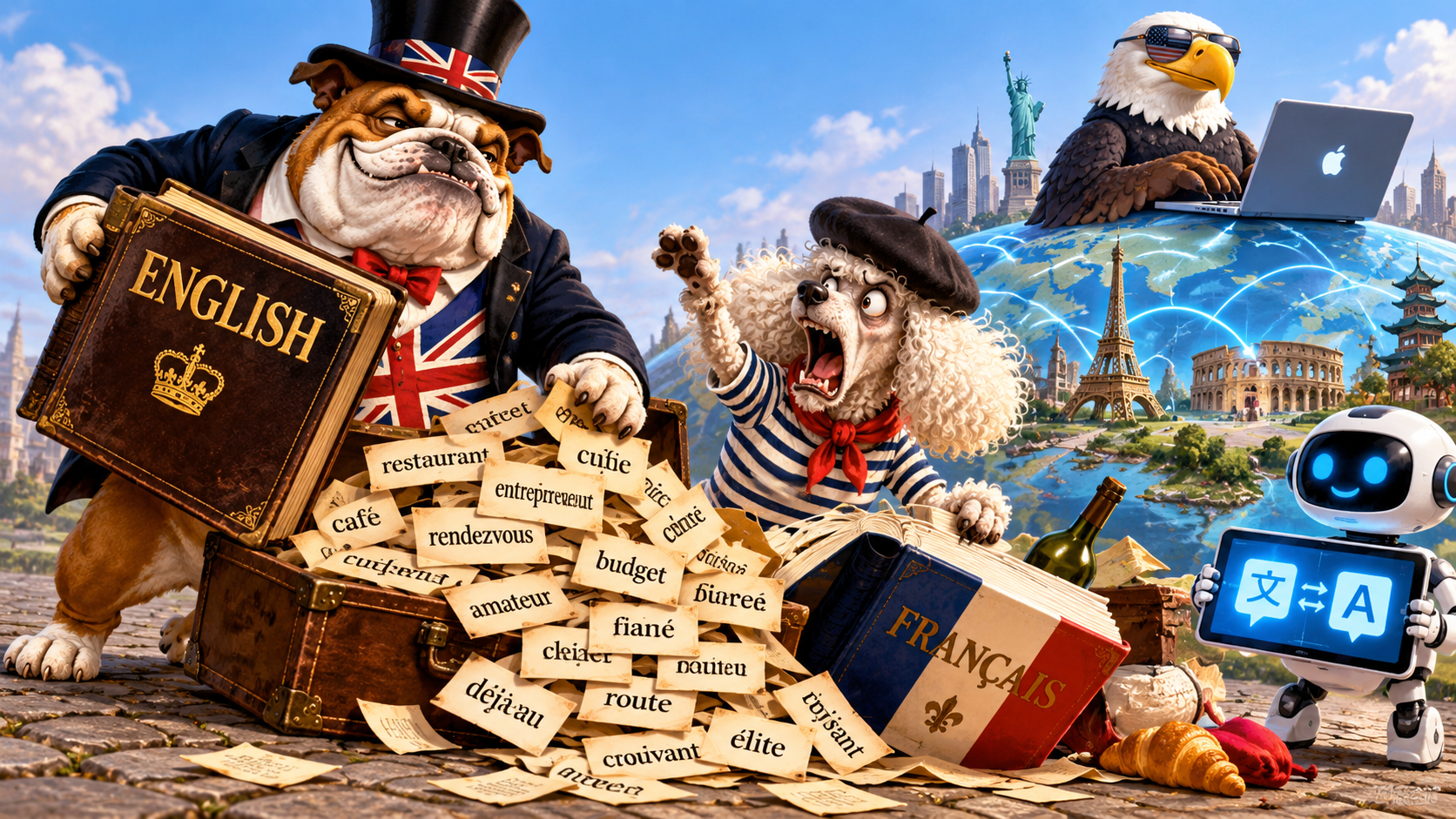
There is something wonderfully ironic about the English language. It has spent more than a thousand years stealing words from everyone else, absorbing foreign expressions, borrowing grammatical ideas, adapting pronunciations and generally behaving like a linguistic pickpocket, yet somehow, it has emerged as the dominant international language of business, science, technology and much of the internet.
The French gave us sophistication, our Germanic ancestors gave us much of our linguistic foundation, the Vikings contributed everyday vocabulary, the Dutch share the ancestry of some of our finest swear words, the Romans and Greeks provided the language of scholarship, and the Americans eventually gave us Silicon Valley and the internet.
Having borrowed so much from everyone else, the English-speaking world now has the audacity to expect everyone else to speak English.
How did that happen, and why has English become so successful when other languages, particularly French, once occupied the position it enjoys today? The answer is an amazing story of immigration, invasion, trade, empire, social snobbery and technological revolution, beginning in a country that barely resembles the England we know today.
Welcome to Engla-lond
One of my favourite explorations of history is The Year 1000 by Robert Lacey and Danny Danziger. In their chapter, Welcome to Engla-lond, the authors explore the language spoken by the Anglo-Saxons around the year 1000, when England was a collection of communities connected by farming, trade, religion and the constant threat of invasion. What makes their discussion particularly interesting is that, although most modern English speakers would struggle to understand a conversation conducted in Old English, they would recognise a surprising number of its words.
Take the hundred most frequently used words in modern English and we find that almost all descend from Old English or related Germanic roots, including the everyday building blocks of communication such as the, and, I, you, he, she, we, man, wife, child, house, bread, water, eat, drink, live and die.
These are not the elaborate expressions of lawyers, academics or politicians, but the words people use to describe their families, their homes, their food and their lives. The foundations of English were established long before Shakespeare, the British Empire or Silicon Valley, and the essential vocabulary of everyday existence remains remarkably recognisable a thousand years later, even though the grammar and pronunciation have changed dramatically.
The interesting thing is that England in the year 1000 was anything but linguistically isolated. The Anglo-Saxons had originally arrived from Germanic-speaking regions of continental Europe, bringing languages that developed into Old English, while the Vikings had spent generations settling, marrying, raiding and trading across large parts of the country. There were Celtic-speaking communities, Latin-speaking churchmen and merchants crossing the North Sea from regions that would eventually become the Netherlands, Germany and Scandinavia. England was already a meeting place for people who spoke different languages, although many of those languages shared common Germanic ancestry.
Imagine an English village a thousand years ago, where a Viking arrives wanting to buy a horse, a trader from the Low Countries wants to purchase wool and a traveller from another kingdom needs somewhere to sleep. Each speaks differently, but they all want to communicate, negotiate and do business. The English villager does not have Google Translate, a language-learning application or an artificial intelligence assistant, so he has to work with whatever words he understands, whatever similarities exist between the languages and whatever expressions he has picked up through experience. Over generations, these encounters help languages influence one another, with words being borrowed, pronunciations changing and different ways of expressing ideas becoming familiar.

This does not mean that English was deliberately invented as a common language for Vikings, Germans and Frenchmen, or that everyone in medieval England could understand everyone else. The language spoken in the year 1000 was still overwhelmingly Germanic, and the great influx of French vocabulary had yet to arrive. Nevertheless, the story illustrates something that would become one of English’s defining characteristics: its extraordinary willingness to absorb vocabulary from other languages while retaining much of its existing linguistic identity.
English became a linguistic magpie, collecting useful words from wherever it found them and showing remarkably little concern about their origins. Over the centuries, this habit would create one of the richest and most varied vocabularies in the world.
Twenty words for everything
There is a popular observation that English has twenty different words for everything, which is obviously an exaggeration but captures something distinctive about the language. We can ask, question, enquire, interrogate, investigate or examine, and although these words have different shades of meaning, they allow us to express closely related ideas with extraordinary precision. We can describe something as kingly, royal or regal, using words inherited through Germanic, French and Latin routes, while freedom and liberty describe related concepts through different linguistic traditions.
The same richness appears in everyday conversation, where we can help someone or assist them, buy something or purchase it, begin a meeting or commence proceedings, and end a relationship or terminate an association. The meaning changes subtly with the choice of word, but so does the social impression we create. Someone who says they want to help sounds friendly, while someone who offers to facilitate assistance sounds as though they are preparing to send an invoice.
This is particularly noticeable in business, where the straightforward Germanic vocabulary of everyday English frequently disappears beneath an avalanche of French- and Latin-derived terminology. A normal person wants to know what something costs, whereas a management consultant wishes to undertake a comprehensive evaluation of the financial implications. A customer wants their money back, while a banker explains that the institution is initiating a structured reimbursement process in accordance with established operational procedures. Both are describing the same thing, although the consultant and the banker have managed to make the process sound considerably more expensive.
The enormous vocabulary of English developed because successive generations borrowed foreign words without consistently abandoning the ones they already possessed. Instead of replacing one expression with another, English often kept both, allowing speakers to choose between simple, direct vocabulary and more elaborate alternatives. This created a language that can be wonderfully expressive, infuriatingly inconsistent and occasionally ridiculous, but one that offers an extraordinary range of possibilities to anyone who wants to communicate.
The French arrive and make everything complicated
Then came 1066, when William the Conqueror crossed the Channel, defeated Harold at Hastings and established a new ruling elite that transformed English society and, eventually, the English language.
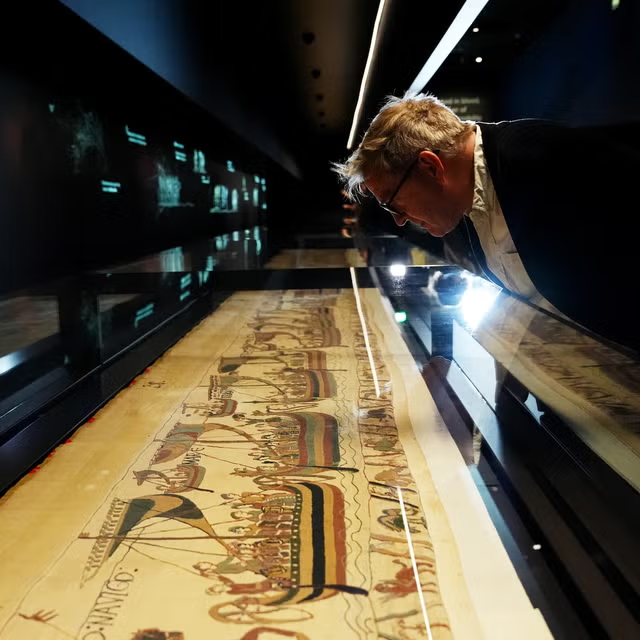
For centuries afterwards, varieties of French occupied powerful positions in government, law and aristocratic life, while Latin remained central to religion, scholarship and administration. English survived as the language of much of the population, but it gradually absorbed an enormous amount of French vocabulary, creating a linguistic division that still reveals the social structure of medieval England.
Many of our shortest, most direct words come from Old English, while much of our longer and more elaborate vocabulary entered through French and Latin. This is why some of the most powerful speeches in history rely upon extraordinarily simple language. Martin Luther King did not announce that he wished to communicate an aspirational vision of future societal transformation. He said, "I have a dream."
Four words, all rooted in the oldest layers of English, and considerably more powerful than anything a management consultant could have produced.
And the Dutch taught us to swear … or did they?
Lacey and Danziger also draw attention to the earthy Germanic vocabulary that English shares with languages such as Dutch and Low German, which provides another entertaining illustration of how different linguistic traditions contributed to modern English. Some of our bluntest expressions, including words associated with bodily functions, sex and insults, have close relatives across the North Sea, reflecting the common ancestry of English, Dutch and German rather than a single historical moment when Dutch sailors arrived and taught the English how to swear.
It would be wonderful to imagine that medieval English peasants spent their days politely swearing upon their honour and allegiance until a Dutch sailor arrived in port, stubbed his toe and introduced them to a whole new vocabulary of colourful abuse. Unfortunately, the historical evidence suggests that the English were perfectly capable of being offensive without foreign assistance. The Dutch did not invent our swear words, but they share a magnificent Germanic tradition of expressing displeasure in language that requires remarkably little translation.
Shakespeare, of course, took the art of insulting people to another level, and some of his finest efforts remain wonderfully effective four centuries later.
- "Thou art a boil, a plague sore." King Lear
- "Thou cream-faced loon." Macbeth
- "I am sick when I do look on thee." A Midsummer Night’s Dream
- "Away, you three-inch fool!" The Taming of the Shrew
- "Thou hast not so much brain as ear-wax!" Troilus and Cressida
- "More of your conversation would infect my brain." Coriolanus
- "Thy face is not worth sunburning." Henry V
Admittedly, these are insults rather than conventional swear words, but they demonstrate how wonderfully inventive English had become when it came to telling someone exactly what you thought of them. Shakespeare could insult a man’s intelligence, appearance, parentage and personal hygiene without needing to resort to a single modern four-letter word, although his plays contain plenty of earthy language when the occasion demands it.
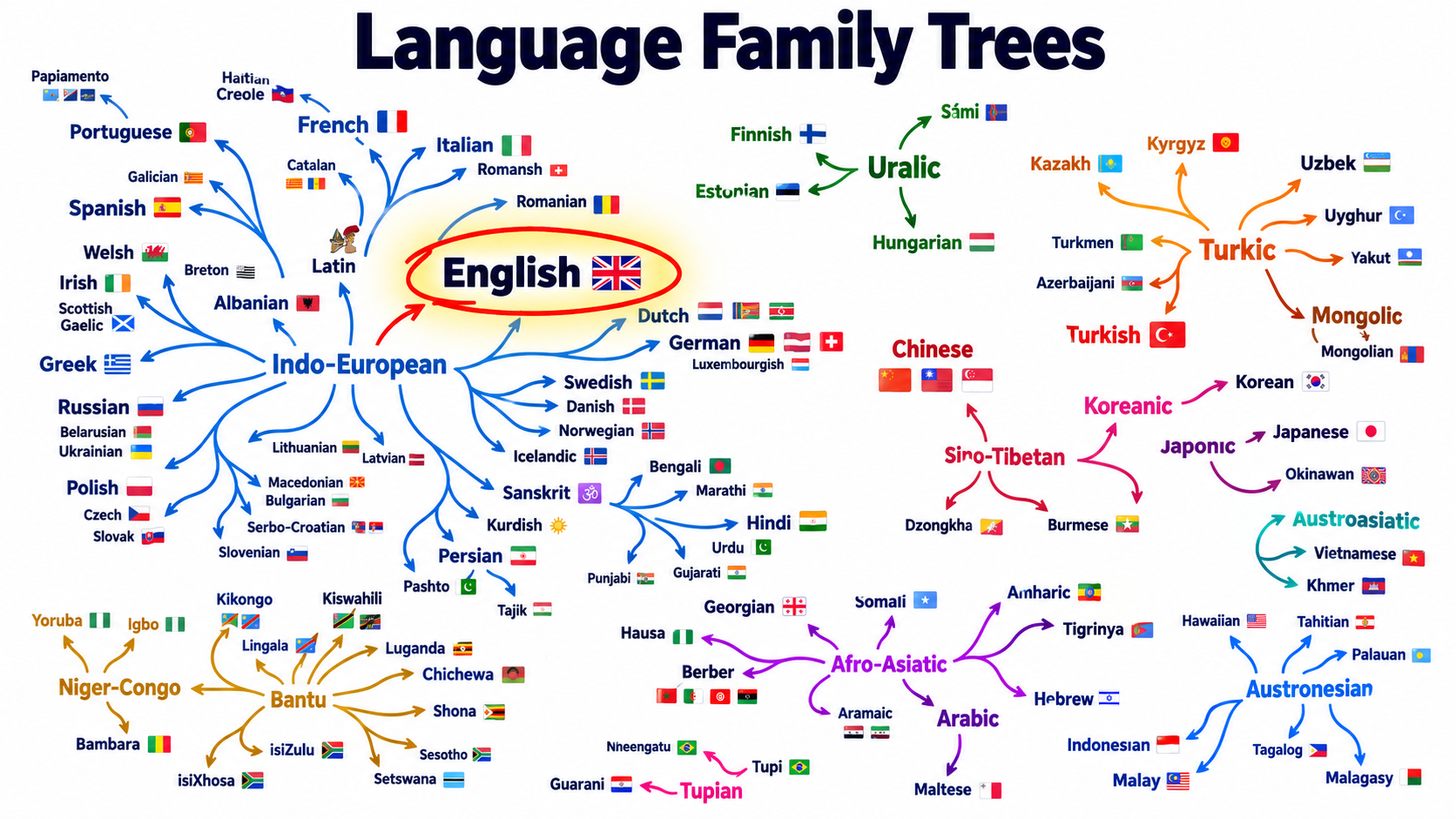
The relationship between English and Dutch is particularly notable because both belong to the West Germanic branch of the Indo-European language family, sharing vocabulary inherited from common linguistic ancestors. Centuries of maritime trade, migration and cultural contact reinforced those connections, while the Norman Conquest introduced a further distinction between the everyday language of the population and the French-influenced vocabulary of the ruling classes.
There is something wonderfully revealing about this distinction, because when an Englishman wishes to sound educated, sophisticated or professionally important, he frequently reaches for a French- or Latin-derived word, but when he hits his thumb with a hammer, discovers that his train has been cancelled or realises that his bank has charged him another inexplicable fee, he generally returns to his Germanic roots.
The French helped us sound sophisticated, while our Germanic inheritance ensures that we can still express exactly what we think when sophistication is the last thing on our minds.
When French ruled Europe
For centuries, however, the language of international prestige was not English but French. By the seventeenth and eighteenth centuries, French had become the dominant language of diplomacy and elite international society across much of Europe, enjoying a position that English could not begin to match. If you wanted to participate in European diplomacy, impress an aristocrat or demonstrate that you were educated and cultivated, French was the language to know, and the ability to speak it became an important marker of sophistication.
The influence was so powerful that European aristocrats frequently used French when communicating across national boundaries, while diplomatic correspondence and international negotiations increasingly adopted it as a common language. French became associated with refinement, intellectual achievement and cultural superiority, and those who could not speak it risked being regarded as provincial, regardless of their other accomplishments.
Consider Carl Gustaf Emil Mannerheim, the Finnish military leader who became one of the most important figures in Finland’s history. Born in 1867, when Finland was part of the Russian Empire, he rose to become a lieutenant general in the Imperial Russian Army before returning to Finland following the Russian Revolution. He commanded the victorious White forces during the Finnish Civil War of 1918 and subsequently became the military leader who helped preserve Finnish independence against the Soviet Union.
His defining moment came during the Winter War of 1939–1940, when Finland resisted a Soviet invasion despite being vastly outnumbered. He later commanded Finnish forces during the Continuation War, when Finland fought alongside Nazi Germany against the Soviet Union, before becoming President in 1944 and negotiating an armistice with Moscow. What makes Mannerheim a very specific historical figure is that he became one of the most decorated military leaders in modern history, receiving honours from Imperial Russia, Nazi Germany, Britain, France, Sweden and numerous other nations, many of them bitter enemies. His career spanned the collapse of empires and two world wars, while his controversial role in the Finnish Civil War complicated a legacy that remains central to Finland’s national identity.
In other words, when all nations were at war, he was the leader who negotiated peace and every nation recognised him for that.
Why do I mention this?
Because the last time I was in Helsinki, I used TripAdvisor to look up things to do. There wasn't much that caught my attention, except a recommendation to visit Mannerheim's house and museum. It was something where I learned a lot, as I had never heard of him before.
He was a spy, politician, leader and soldier. During the tour, I came across an entry in Mannerheim's diary describing his meeting with Robert Baden-Powell, the distinguished British soldier and founder of the Scout movement. Mannerheim considered Baden-Powell unsophisticated and provincial because he could not speak French.

Imagine the irony of a distinguished British soldier who had travelled extensively, commanded troops, written books and established an international movement being considered insufficiently cultivated because he could not conduct a conversation in French. Military achievements, international experience and intellectual accomplishments were apparently not enough to compensate for the inability to order dinner in the language of Paris.
Yet the world has changed so dramatically that the situation is now almost completely reversed. A French business executive who cannot speak English faces considerable disadvantages in international commerce, while a British executive who cannot speak French can still conduct business across much of the world. The language that once demonstrated European sophistication has been overtaken by a language that the European aristocracy previously regarded as comparatively provincial.
And, if you want a particularly delicious illustration of how far the tables have turned, consider Jacques Chirac and the French CNN.
In the early 2000s, the French President revived an ambition to establish an international television news network that would challenge the dominance of CNN and the BBC. France had its own culture, its own political perspectives, its own international interests and, naturellement, its own language, so why should Anglo-American broadcasters dominate the way the world received its news?
Chirac wanted a French international news channel that would project French influence around the globe and provide an alternative to the English-speaking media organisations that had become so powerful. The project had been discussed for years, with research commissioned and plans debated, but there was one rather embarrassing commercial reality: if France wanted to compete internationally with CNN and the BBC, it would have to communicate with audiences who did not speak French.
In other words, France needed to defend the French view of the world by broadcasting it in English.
This was not just my interpretation. As France 24 prepared to launch in December 2006, its president, Alain de Pouzilhac, acknowledged that most of the network’s intended international audience spoke English and that delivering a French perspective therefore required broadcasting partly in English. The eventual result was a French international news network launching simultaneously in French and English.
Imagine the conversation in the Élysée Palace, where the President wants to defend French culture and international influence against Anglo-American domination, only to discover that one of the most effective ways of achieving his objective is to speak English.
For centuries, an Englishman had been considered uncultured if he could not speak French yet, by the twenty-first century, the French were broadcasting in English because they wanted the rest of the world to listen.
C’est la vie.
The British Empire spreads the language
The first great transformation in the international position of English came through the expansion of the British Empire, which carried the language across North America, the Caribbean, Africa, Asia and the Pacific. English became associated with colonial administration, international commerce, education and law, spreading through ships, soldiers, merchants, settlers, schools and institutions rather than through any inherent linguistic superiority.
Yet the British Empire alone does not explain why English dominates international communication today, because empires eventually decline and their languages do not always retain their positions of influence. Latin survived the Roman Empire as the language of scholarship and religion for centuries, while French enjoyed an extraordinary period of diplomatic and cultural prestige before losing much of its international dominance.
English enjoyed a remarkable historical advantage because, just as Britain’s imperial power began to decline, another English-speaking superpower emerged on the other side of the Atlantic.
The United States.
America’s rise to economic, military and cultural dominance transformed English from the language of a global empire into the principal language of international commerce and, eventually, the digital economy. Hollywood, Wall Street, multinational corporations, scientific research, universities and popular music carried American influence into almost every corner of the world, encouraging people to learn English not because they admired British history but because they wanted to participate in the opportunities created by American economic power.
International aviation adopted English as the standard language for communications between pilots and air traffic controllers in international operations, while scientific publishing increasingly favoured English as researchers sought to reach the widest possible audience. Multinational corporations adopted it as a common working language, and international financial markets increasingly operated through English-language contracts, documentation and communication.
The more people learned English, the more useful it became, and the more useful it became, the greater the incentive for others to learn it. Economists would recognise this as a network effect, in which the value of participating in a network increases as more people join it, and the same principle helps explain why English became so deeply embedded in international commerce.
A language does not need to be the most elegant, the most logical or the easiest to learn to become internationally dominant. It needs to be the language that enough other people already use, because once that position becomes established, the advantages reinforce themselves.
Then came the internet.
The development of modern computing and the internet, heavily influenced by American universities, government research programmes and technology companies, meant that the emerging digital world inherited much of its vocabulary, documentation and commercial culture from English-speaking institutions. Programming languages, software manuals, technical standards and early online communities were disproportionately English-speaking, reinforcing the position of English as the language of technology.
As the internet expanded, English became deeply embedded in the digital economy through search engines, online marketplaces, social networks, international business communications and the enormous influence of American technology companies. The internet did not create English dominance, but it amplified an international language that already enjoyed powerful economic and institutional advantages.
Of course, the internet is now far more multilingual than it was during its early development, and billions of people communicate online in Chinese, Spanish, Arabic, Portuguese, Hindi and countless other languages. English is not the language of every internet user, nor does it account for most of the world’s population, but it continues to occupy a particularly influential position in international online communication, technical documentation, scientific research and cross-border business.
A software developer in Bangalore, a banker in Frankfurt, a designer in Seoul and an entrepreneur in São Paulo can collaborate through English without needing to learn one another’s native languages. The common language allows people from different cultures and countries to participate in the same economic and technological networks, reducing the friction that would otherwise make international collaboration more difficult.
There is something rather wonderful about comparing this with the English village of a thousand years ago, where the Anglo-Saxon farmer, the Viking trader and the merchant from across the North Sea needed enough shared language to negotiate the price of wool, exchange goods and establish trust. Today, the village has become the world, and the conversations that once took place around a market stall now take place through video conferences, digital platforms and international financial networks.
The language that borrowed words from everyone else has become the language that everyone else is expected to understand.
And then artificial intelligence arrives
There is, however, one final irony in this story, because artificial intelligence is beginning to challenge one of the fundamental assumptions that has sustained the international dominance of English. For centuries, the ability to speak another language has been a source of education, social status, economic opportunity and political influence, with French once distinguishing the cultivated European from the provincial Englishman and English now providing access to international business, technology and education.
Artificial intelligence is changing the economics of language by making translation faster, cheaper and increasingly accessible. Real-time translation systems, multilingual language models and AI-powered communication tools are reducing the practical barriers between people who speak different languages, creating the possibility that international communication will no longer require everyone to learn the same one.
An English speaker can increasingly communicate with a Japanese speaker without either person mastering the other’s language, while a Chinese entrepreneur can conduct business with a German customer through translation technology that operates almost instantaneously. These systems are not perfect, particularly when dealing with humour, cultural references, specialist terminology or the subtleties of human emotion, but their capabilities are improving rapidly.
The consequences could be profound because the value of English as an international language depends partly upon the advantage it provides in communicating with people who do not share a native language. If technology removes much of that advantage, the incentive to learn English purely for practical international communication could weaken, even though the language will retain enormous cultural, educational and institutional importance.
This does not mean that English is about to disappear from international business, any more than the arrival of the telephone meant that people stopped meeting one another. Languages are embedded in cultures, institutions, professional relationships and educational systems, and those connections are difficult to displace. Nevertheless, artificial intelligence introduces a fascinating possibility that would have been almost unimaginable throughout most of human history.
Perhaps the future of global communication is not everyone speaking English, French, Mandarin or any other dominant language, but everyone speaking their own language and understanding everyone else.
That would represent a fundamental change in the relationship between language and power. Throughout history, the people who controlled international commerce, political institutions and cultural influence enjoyed enormous advantages in determining which languages other people needed to learn. French followed the influence of European aristocracy and diplomacy, English followed the expansion of the British Empire and American economic power, and the internet reinforced the position of English through the network effects of global technology.
Artificial intelligence could begin to separate international communication from the need for a single dominant language, allowing people to participate in global conversations without abandoning their native linguistic identities. Instead of requiring everyone to adapt to the language of the most powerful economic or political institutions, technology could increasingly adapt communication to the languages people already speak.
And that brings us back to the English village in the year 1000, where the Anglo-Saxon farmer, the Viking trader and the visitor from across the Channel were all trying to solve the same fundamental problem: how to understand one another well enough to live, trade and get along. They did it through shared vocabulary, borrowing, adaptation, gestures and the gradual development of ways to communicate across linguistic differences.
A thousand years later, we are still trying to solve exactly the same problem, except that we now have artificial intelligence to do it for us.
English conquered the world by borrowing everyone else’s words, but artificial intelligence is changing the world by making it unnecessary to learn English and somewhere, I suspect, Carl Gustaf Emil Mannerheim would be horrified to discover that Robert Baden-Powell could now speak perfect French simply by pressing a button.

Chris M Skinner
Chris Skinner is best known as an independent commentator on the financial markets through his blog, TheFinanser.com, as author of the bestselling book Digital Bank, and Chair of the European networking forum the Financial Services Club. He has been voted one of the most influential people in banking by The Financial Brand (as well as one of the best blogs), a FinTech Titan (Next Bank), one of the Fintech Leaders you need to follow (City AM, Deluxe and Jax Finance), as well as one of the Top 40 most influential people in financial technology by the Wall Street Journal's Financial News. To learn more click here...