I have always thought insurance has a marketing problem. You buy something you hope you will never use, pay for something whose value may not become apparent for decades and, with life assurance, buy a product whose payout you will not even be around to enjoy.
It is hardly surprising that insurers have spent more than a century trying to make protection feel relevant and immediate, but few have done it quite as brilliantly as William Castle.
Castle was an American horror-film director and producer who became famous in the late 1950s and early 1960s, not because he made particularly great films but because he was an extraordinary marketer. He understood something many financial firms still struggle with today: people do not buy the product. They buy the experience around it, the story it creates and the feeling it leaves behind.
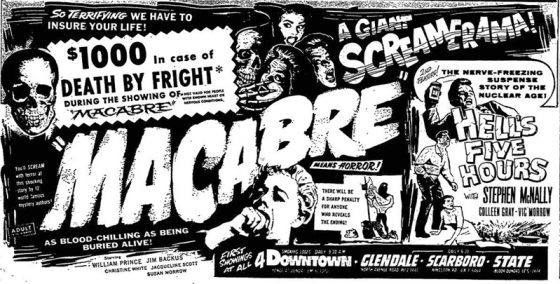
His masterpiece arrived with Macabre in 1958. Castle decided that the film was so terrifying that every cinema-goer should receive $1,000 of life assurance in case they died of fright while watching it, with the cover underwritten through Lloyd’s of London. He parked hearses outside cinemas and stationed nurses nearby, so before audiences had seen a single frame, they were already being told that this film might actually kill them.
It was ridiculous, but it was also brilliant because Castle had effectively invented embedded insurance almost seventy years ago. Buy the cinema ticket and the protection comes with it, except his real insight went further than much of today’s discussion about embedded insurance because the insurance itself became part of the experience. Castle was not really selling $1,000 of life assurance. He was using insurance as independent evidence for his marketing claim: this film is so frightening that you might die.
Once he realised audiences would pay for an experience rather than merely a film, Castle kept going. For House on Haunted Hill, a skeleton flew over the cinema audience on a wire. For The Tingler, selected seats were fitted with vibrating motors so that the creature supposedly escaped from the screen and attacked the audience. For 13 Ghosts, cinema-goers were given coloured viewers that allowed them to choose whether or not they wanted to see the ghosts.
Long before we talked about immersive entertainment, personalisation or customer engagement, Castle was turning passive consumers into participants.
There is a lesson here for financial services because we spend enormous amounts of money digitising products without changing the experience of using them. We take insurance forms and put them online, put bank accounts into apps, and place investment portfolios onto dashboards.
Castle would have asked a more interesting question: what does the customer actually feel?
My favourite example came with Homicidal in 1961.
Shortly before the climax, Castle stopped the film for a Fright Break and offered anyone too terrified to get their money back.
Unfortunately, people started taking the refund, so Castle increased the psychological cost of claiming it by making them walk out in front of the audience through Coward’s Corner, where everyone could see that they had bottled it.
In other words, William Castle had invented an insurance claim with a social excess.
The financial cost of claiming was zero because you got your money back, but the emotional cost was substantial because you had to admit publicly that the film had beaten you.
Castle understood incentives, behavioural friction, embarrassment and social signalling decades before behavioural economics became fashionable. Imagine applying that to modern insurance: Your claim is fully covered, but before receiving payment you must stand in Coward’s Corner while Susan from Claims announces your decision to everyone in the building. Claims ratios might improve dramatically.
What fascinates me is that Castle understood the economics of attention.
He could not compete with Hollywood studios on budgets, stars or production values, so he changed the basis of competition. Instead of asking whether his film was better than the blockbuster down the road, he asked whether people would talk about it afterwards.
That is a very different question, and one financial firms should probably ask more often.
We talk endlessly today about embedded insurance, contextual insurance, parametric insurance, microinsurance and personalised insurance, but Castle demonstrated something more fundamental in 1958: insurance can change the perceived value of another product. The insurance industry tends to think about protection as a contract. Castle thought about it as part of the story.
There is a wonderful irony in that William Castle was selling fear while insurers sell reassurance, yet he may have understood the emotional mechanics of insurance better than many insurers do. Fear creates the need for protection, reassurance provides the answer and theatre makes the whole thing far more memorable.
Perhaps that is what insurance needs: fewer twenty-page explanations of exclusions and underwriting criteria, and a little more William Castle.
Although Coward’s Corner might cause a few problems with the regulator.
If you are interested, there's a lot more about William Castle here.
Chris M Skinner
Chris Skinner is best known as an independent commentator on the financial markets through his blog, TheFinanser.com, as author of the bestselling book Digital Bank, and Chair of the European networking forum the Financial Services Club. He has been voted one of the most influential people in banking by The Financial Brand (as well as one of the best blogs), a FinTech Titan (Next Bank), one of the Fintech Leaders you need to follow (City AM, Deluxe and Jax Finance), as well as one of the Top 40 most influential people in financial technology by the Wall Street Journal's Financial News. To learn more click here...