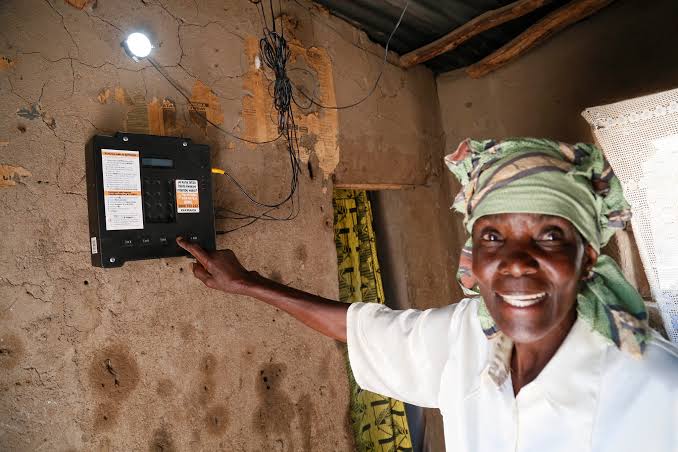
For decades, we've treated poverty as an economic problem. Increasingly, I think it's a technology problem.
That sounds like a strange statement until you realise that the single biggest driver of financial inclusion over the past fifty years has not been governments, charities or banks. It has been technology.
Governments, banks and charities have spent decades trying to tackle poverty through policy, aid and subsidies, and whilst all of these have an important role to play, none has transformed lives on the same scale as giving people access to a mobile phone, a trusted digital identity and an inexpensive way to move money. Once someone can participate in the digital economy, they are no longer excluded from it. They can earn, save, borrow, invest and build a financial history. In other words, they gain access to opportunity.
Almost a decade ago, I asked: When will banks stop seeing financial inclusion as charity? And then I remember standing on the stage at the United Nations seven years ago arguing that the future of financial inclusion wasn't another aid programme, but the smartphone.
Back then, I was talking around the world at conferences about financial inclusion through technology and claimed that everyone could now access the network, trade, make payments and become included. People laughed. Today, everything has changed. Today, everyone has the ability to become an entrepreneur.
This is why some of the most important financial innovations of the past fifty years have come out of Bangladesh, Kenya, India, China and Brazil, where necessity has driven innovation far more effectively than abundance ever could. Each country solved a different problem yet, together, they tell a remarkable story about how technology is becoming one of humanity’s most effective tools for reducing poverty. It is a story that began with a simple question asked by an economics professor in rural Bangladesh who I was lucky enough to meet in 2012.
His question: why can’t people who need finance get fair finance?
Financial Inclusion 1.0: Credit
In the mid-1970s, Muhammad Yunus visited villages in Bangladesh and met women making bamboo stools who remained trapped in poverty despite working extraordinarily hard. They did not need large sums of money. Often, they needed the equivalent of just a few dollars to buy raw materials, yet because they had no collateral, no formal employment and no credit history, the banking system regarded them as unworthy of a loan. The result was that many became dependent upon local moneylenders charging extortionate rates of interest, leaving them permanently caught in a cycle of debt.
Yunus recognised that the problem was not the people but the system. Banks viewed poverty as evidence of financial risk, whereas he viewed poverty as evidence that finance was missing. His response was to establish the Grameen Bank, lending very small amounts of money to people who had previously been excluded from the formal financial system, particularly women.
Conventional banking predicted widespread defaults. The opposite happened. Repayment rates were exceptionally high because these borrowers were determined to build better lives for themselves and their families. Across thousands of villages, tiny loans funded sewing machines, fishing nets, livestock, market stalls and workshops. Small businesses grew, incomes increased and entire communities became more resilient.
The significance of Grameen Bank extended far beyond Bangladesh. It fundamentally changed the world’s understanding of poverty.
The poor were not unbankable because they lacked ambition or discipline. They were unbankable because the financial system had been designed for people who already possessed wealth.
By demonstrating that access to capital could unlock entrepreneurship on a massive scale, Grameen inspired the global microfinance movement and eventually earned Yunus and the bank the Nobel Peace Prize. Yet it also exposed the limitations of traditional financial inclusion. Reaching millions of people through branches, paperwork and loan officers was expensive and time-consuming. To reach billions rather than millions would require something entirely different.
Financial Inclusion 2.0: Payments
That next chapter began in Kenya with M-PESA. When Safaricom launched the service in 2007, it did not attempt to build another bank. Instead, it recognised that almost everyone owned a mobile phone, even if they had never owned a bank account. By allowing customers to convert cash into digital value through local agents and send that value instantly to another mobile phone, M-PESA removed one of the biggest barriers to economic participation: the ability to move money safely and cheaply.
The elegance of the idea lay in its simplicity.
A construction worker in Nairobi could send wages home to family members in a rural village without travelling for hours or entrusting cash to a bus driver. A market trader could receive payments electronically without investing in expensive point-of-sale equipment. Families facing emergencies could receive financial support within minutes rather than days. For many users, the mobile phone became their first experience of formal financial services, even though they had never walked into a bank branch.
Research later showed that the impact extended well beyond convenience. Mobile money increased household resilience, encouraged savings, helped women establish businesses and measurably reduced extreme poverty. M-PESA demonstrated that financial inclusion did not have to begin with a current account. It could begin with something far more universal: a phone number. More importantly, it proved that digital networks could scale financial services far more rapidly than physical infrastructure ever could.
Financial Inclusion 3.0: Platforms
India took these lessons and turbo-charged them to a completely different level. Rather than seeing payments as a product, it saw them as public infrastructure. The combination of Aadhaar digital identity, the Jan Dhan financial inclusion programme and the Unified Payments Interface (UPI) created what is now known as the India Stack, a shared digital foundation upon which banks, fintech companies and technology firms could all innovate. Instead of every institution building its own proprietary network, the country invested in common infrastructure, much like roads, electricity or telecommunications.
That approach has transformed everyday commerce.
Today, a street food vendor can display a QR code and accept a payment from anyone with a mobile device. Government benefits can be transferred directly into citizens’ accounts without intermediaries. Small businesses build transaction histories that make it easier to access credit, while consumers enjoy instant payments at almost no cost. The truly revolutionary aspect is not the payment itself but the data created by each transaction. For generations, banks asked whether someone owned property before deciding whether they deserved a loan. Increasingly they can ask whether someone has demonstrated consistent economic activity. Data, in many respects, is becoming the new collateral.
India was not alone. Brazil reached a remarkably similar conclusion through a different route.
In 2020, the Central Bank of Brazil launched PIX, an instant payment network available to every bank, fintech and payment provider in the country. Like UPI, it dramatically reduced the cost and friction of moving money, allowing individuals and businesses to send and receive payments instantly, twenty-four hours a day, seven days a week, at little or no cost.
The impact has been extraordinary. Within just a few years, PIX became the default way millions of Brazilians paid one another, overtaking cash, bank transfers and, in many cases, even debit cards. Small merchants who had previously relied upon expensive card acceptance could display a simple QR code and receive immediate payment. Informal businesses found it easier to participate in the formal economy, while consumers gained a fast, secure and universally accepted payment method that worked regardless of which financial institution they used.
What India and Brazil demonstrated, independently of one another, is that payments should no longer be viewed as proprietary banking products. They are national infrastructure.
Just as governments invest in roads, railways and telecommunications because every business depends upon them, digital payment rails have become essential infrastructure for a modern economy. Once those rails exist, banks and fintech firms compete not by building different payment systems but by building better services on top of them. That shift may prove to be one of the most important lessons in financial inclusion.
Financial Inclusion 4.0: Intelligence
Then there is China.
Whilst India built Digital Public Infrastructure, China demonstrated something equally important. Artificial intelligence and cloud computing could dramatically reduce the cost of serving customers who traditional banks had ignored.
The best example is WeBank.
Founded in 2014 by Tencent, WeBank has no branches, almost no paper and very few people compared with a traditional bank of its scale. Everything is digital. Customers open accounts through their mobile phone, identify themselves electronically and receive financial services without ever visiting an office.
What makes WeBank remarkable is its size.
Today, it is serving over 440 million retail customers and tens of millions of small businesses whilst maintaining one of the lowest operating costs in banking (WeBank manages consumer accounts for less than fifty cents a year). Rather than relying upon manual underwriting, relationship managers and branch staff, much of the decision making is automated using artificial intelligence, machine learning and data analytics.
This matters because traditional banking economics have always struggled with very small customers. If it costs £100 to assess a £200 loan, the business model makes little sense. If artificial intelligence reduces that cost to pennies, suddenly millions of customers become commercially viable.
That changes the economics of financial inclusion. Instead of viewing poorer customers as a social obligation, they become sustainable customers who can be served profitably.
WeBank has shown that AI is not simply about making banks more efficient. It can make inclusion economically scalable. Small loans can be approved in minutes rather than weeks. Credit decisions can draw upon hundreds or thousands of data points rather than a handful of documents. Small businesses receive working capital when they need it rather than after the opportunity has disappeared.
If the third generation of financial inclusion connected people to the digital economy, the fourth generation is all about making inclusion intelligent, as evidenced by WeBank.
India's UPI and Brazil's PIX demonstrated that once digital public infrastructure is in place, the challenge is no longer connecting people to the financial system. The challenge becomes using the data generated by those connections to deliver better financial outcomes. That is where the fourth generation begins.
Every payment made through UPI, PIX, M-PESA or any other digital network creates data.
Individually, those transactions are simply records. Collectively, they become a living picture of a person’s economic life. For the first time, financial institutions can understand behaviour rather than merely measuring wealth.
This changes the way we think about financial services.
For more than a century, banks have based decisions on assets and history. Do you own property? Do you have a permanent job? How long have you banked with us? Artificial intelligence allows an entirely different conversation. Can you demonstrate consistent income? Do you pay suppliers on time? Is your business growing? How resilient are your finances?
Now, instead of judging people by what they own, AI can increasingly assess what they do.
The implications are profound. Someone running a successful market stall may never have owned a house, yet thousands of digital transactions can demonstrate that they are a lower credit risk than someone with significant assets but erratic income. Insurance can become personalised rather than generic. Savings can be automated according to individual spending patterns. Fraud can be detected before losses occur rather than investigated afterwards. Perhaps most importantly, sophisticated financial advice, once reserved for wealthy clients with private bankers, can become available to anyone with a smartphone.
This is why I believe the next revolution in financial inclusion is not digital payments. It is intelligent financial services. The challenge is no longer giving people access to money. It is helping them make better financial decisions.
Once AI understands our financial lives, the obvious next question is whether it should simply advise us... or actually act for us. That is the transition from intelligence to autonomy.
Financial Inclusion 5.0: Autonomy
The next step is even more significant because people will gradually stop making many routine financial decisions themselves. Instead, they will delegate them to trusted artificial intelligence. Just as we already allow software to navigate our journeys, filter our emails and recommend our entertainment, we will increasingly ask intelligent agents to manage our financial lives.
Imagine an AI that knows your salary arrives tomorrow, that your electricity bill is due next week, that your mortgage can be refinanced at a lower rate and that your insurance renewal is overpriced. Rather than waiting for you to discover these things, it quietly negotiates with providers, compares alternatives, moves your savings into the highest-yielding account and ensures that every bill is paid on time. It works continuously, learning your preferences while acting within the limits you have authorised.
For someone living on a tight budget, this could be transformational. Missed payments, unnecessary fees and poor financial decisions disproportionately affect those with the least money. An intelligent financial assistant could reduce those costs automatically, giving everyone access to the sort of financial management that today is available only to wealthy households or large corporations. Financial inclusion therefore evolves beyond access and advice into delegation. The question is no longer whether everyone can use financial services. The question becomes whether everyone can trust software to use them on their behalf.
That shift demands a new layer of trust. Identity, consent, accountability and transparency become just as important as the payment itself. If AI agents are going to act for us, we must know exactly who authorised them, what they are allowed to do and how every decision can be explained and reversed. The future of financial inclusion will depend as much upon governance as it does upon technology.
Financial Inclusion 6.0: Participation
Ultimately, financial inclusion ceases to be about including people in banking and becomes about enabling every participant in the economy to interact securely and intelligently. The digital economy will no longer consist solely of individuals and businesses. Autonomous vehicles will pay for charging. Factories will order components from other factories. Solar panels will sell excess electricity directly to the grid. Intelligent software agents will negotiate contracts, arrange logistics, purchase computing power and settle invoices without human intervention.
At that point, money becomes part of a much larger trust infrastructure. Every participant, whether a person, company, robot or AI agent, will require a verifiable identity, defined permissions, a reputation and the ability to exchange value. Payments become almost invisible because they are simply one outcome of trusted economic relationships. What matters is not moving money. It is enabling economic participation.
This represents the logical conclusion of the journey that began with Muhammad Yunus lending a few dollars to women in rural Bangladesh. Financial inclusion started by asking whether poor people deserved access to credit. It evolved into giving everyone access to digital payments and then into building national digital infrastructure. The next chapters are about intelligence, autonomy and universal participation, where trusted networks allow every legitimate economic actor to contribute to prosperity.
When we reach that point, financial inclusion will no longer be measured by the number of bank accounts that have been opened or the number of payment transactions processed. It will be measured by something far more meaningful: how many people, businesses and intelligent machines are able to participate confidently, safely and productively in the global digital economy. That, to me, is the real destination of this fifty-year journey.
SUMMARY
Looking back over the past fifty years, the evolution is remarkably clear. Grameen showed that poor people are creditworthy. M-PESA showed that everyone could carry a bank in their pocket or purse. India proved governments can build digital public infrastructure. Brazil showed that instant payments can become a public utility. WeBank demonstrated that artificial intelligence can make serving hundreds of millions of ordinary people commercially viable.
The next generation will not simply make finance intelligent. It will allow that intelligence to act. The generation after that will connect every trusted participant whether human, business or machine, to the global economy.
Financial inclusion began as a conversation about giving poor people access to loans. It has become a conversation about giving everyone access to opportunity.
Perhaps that is the real lesson of the past fifty years. Technology has not eliminated poverty, but it has dismantled many of the barriers that kept people outside the economic system. That may turn out to be one of the greatest technological achievements of the twenty-first century.

Chris M Skinner
Chris Skinner is best known as an independent commentator on the financial markets through his blog, TheFinanser.com, as author of the bestselling book Digital Bank, and Chair of the European networking forum the Financial Services Club. He has been voted one of the most influential people in banking by The Financial Brand (as well as one of the best blogs), a FinTech Titan (Next Bank), one of the Fintech Leaders you need to follow (City AM, Deluxe and Jax Finance), as well as one of the Top 40 most influential people in financial technology by the Wall Street Journal's Financial News. To learn more click here...