It was an actuary who first introduced me to Fermat’s Last Theorem. Now, I have to confess that mathematics is not my strong point. I struggle with Pythagoras, let alone some seventeenth-century French mathematician who set a challenge that defeated the greatest mathematical minds on the planet for more than three centuries.
Nevertheless, the story intrigued me.
In 1637, Pierre de Fermat scribbled a note in the margin of a book claiming that he had discovered the proof of a mathematical theorem. Unfortunately, he said, the margin was too small to contain his proof. He died without ever revealing it, leaving generations of mathematicians wondering whether he really had solved the problem.
What was the theorem?
No positive integers a, b, c satisfy aⁿ + bⁿ = cⁿ for any integer n > 2.
Don't worry if that seems like gobbledygook as I don't understand it but I asked ChatGPT to explain it to my children and here is what it said.
Imagine you have a big box of Lego bricks.
You build a square that is three bricks wide and three bricks long. You use nine bricks. You then build another square that is four bricks wide and four bricks long. You use sixteen bricks. If you put all those bricks together, you have twenty-five bricks – exactly enough to build a bigger square that is five bricks wide and five bricks long.
3x3 + 4x4 = 9 + 16 = 25 and 5x5 is 25.
Now imagine building cubes instead of squares. A cube has height as well as width and length.
Fermat claimed that you could never build two solid cubes, take them apart and use all their bricks to build one bigger solid cube without having bricks left over or needing extra bricks.
The cube of 3 is 27. The cube of 4 is 64. Now cube 5, which is 125.
27 + 64 = 91 bricks. You need 125 to build the bigger cube.
It doesn't matter how big or small you make your cubes. You could have a million Lego bricks, a billion Lego bricks or a trillion Lego bricks. Fermat said you would never find a combination that worked. He also claimed that the same rule applied to fourth powers, fifth powers and every higher whole-number power.
The problem is that numbers go on forever. You cannot test every possible combination, so how can you prove that none will ever work?
In my simple mind, it is the difference between two-dimensional, a flat square, and three, a cube.
Fermat’s Last Theorem has tested maths folks for over 350 years, could anyone prove that it was true or false, and what followed was extraordinary. Entire branches of mathematics developed during the centuries in which people tried to prove his theorem. Generations of mathematicians devoted themselves to the challenge, and some spent years of their lives pursuing something that ultimately defeated them.
Entire branches of mathematics developed during the centuries in which people tried to prove his theorem. Generations of mathematicians devoted themselves to the challenge, and some spent years of their lives pursuing something that ultimately defeated them.
To put that into historical perspective, when Fermat made his claim, Britain had yet to fight its Civil War, America had yet to declare its independence and Isaac Newton had not even been born. Humanity subsequently went through the Industrial Revolution, fought two world wars, split the atom, invented the computer and landed men on the Moon, all before someone finally proved Fermat’s Last Theorem.
That someone was British mathematician Sir Andrew Wiles, who, with a crucial contribution from Richard Taylor, published the proof in 1995. Wiles had spent seven years working largely in secret on the problem, only to discover a flaw in his original proof that took another year to resolve.
The proof was that there is no way to take cubed numbers and find a way to add the results, unlike squared numbers.
By way of example, with squares (power of 2), it works:
3² = 9 4² = 16 5² = 25
5² = 25 12² = 144 13² = 169
6² = 36 8² = 64 10² = 100
In every example, the first two results add up to the third.
With cubes (power of 3), it never works:
3³ + 4³ 91 5³ = 125
5³ + 12³ 1,853 13³ = 2,197
6³ + 8³ 728 10³ = 1,000
There is one wonderfully close example:
9³ + 10³ = 12³
If we calculate it:
9³ = 729
10³ = 1,000
12³ = 1,728
729 + 1,000 = 1,729
Just one number away!
Fermat's theorem proves that you can get close, but you can never ever get an exact match using positive whole numbers and powers greater than two.
I cannot pretend to understand the mathematics involved, but I can appreciate the scale of the intellectual achievement.
Now, in September 2026, Anthropic announced something extraordinary. Its artificial intelligence engine, Claude, working through dozens of collaborating AI agents, completed a computer-verifiable formalisation of Fermat’s Last Theorem in eleven days.
The project involved 13 million lines of mathematical code and 29,500 intermediate theorems. What had been expected to take years of specialist mathematical work was accomplished largely autonomously by artificial intelligence in less than a fortnight.
There is an important distinction here. AI did not independently discover the solution to Fermat’s Last Theorem. It took the accumulated intellectual achievements of generations of mathematicians and translated their work into a form that a computer could independently verify.
Nevertheless, consider the implications. We are developing machines capable of processing, connecting and verifying centuries of human intellectual endeavour within extraordinarily compressed timescales.
You do not need to understand Fermat’s Last Theorem to understand why that changes the world.
When we talk about artificial intelligence, we tend to focus on fairly mundane things. It can write my emails, summarise my meetings, create my presentations and tell me how to cook a chicken.
All very useful, although the chicken might disagree.
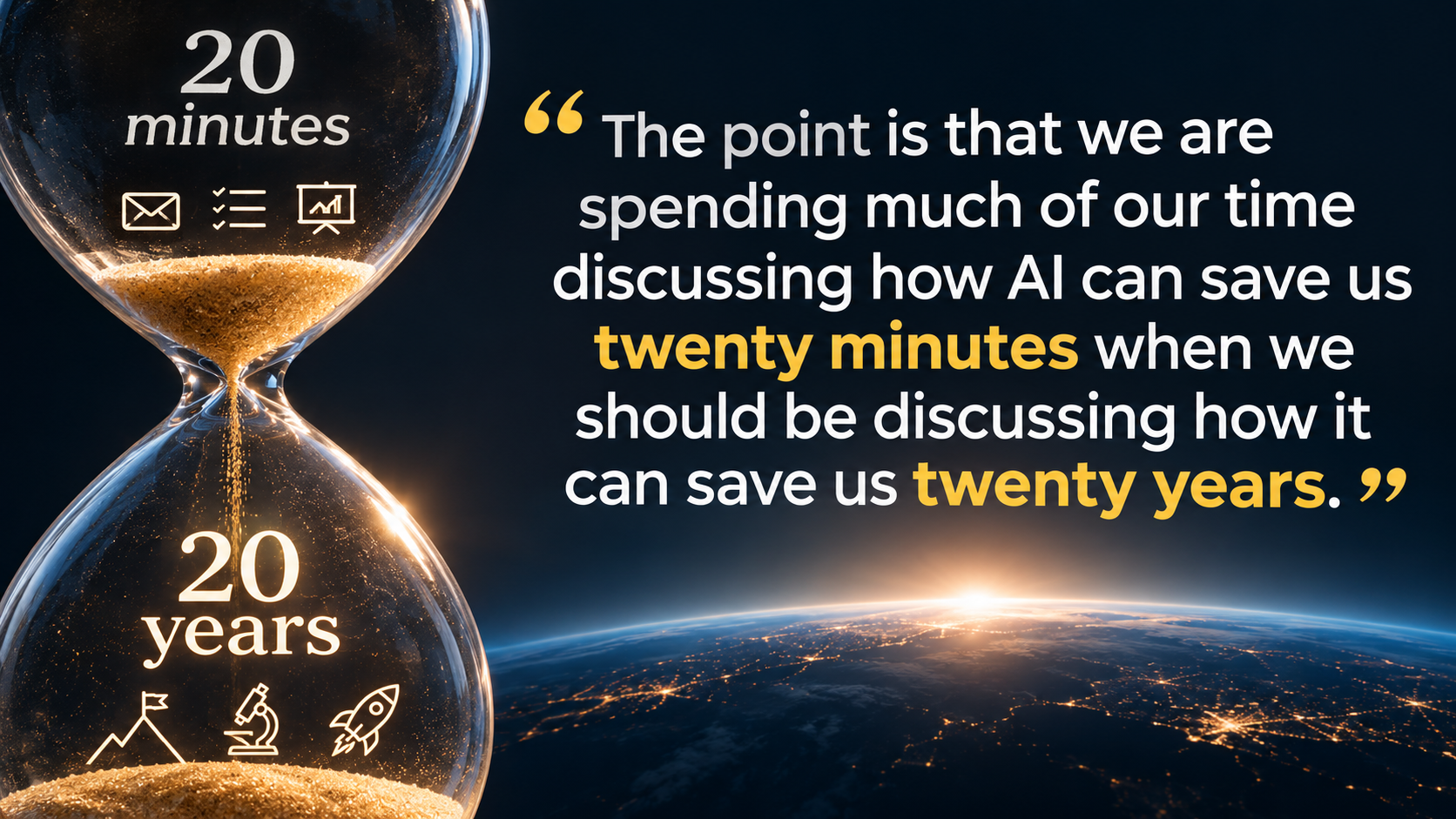
The point is that we are spending much of our time discussing how AI can save us twenty minutes when we should be discussing how it can save us twenty years.
Imagine bringing together some of the greatest mathematicians in history. Put them all in a building, give them access to everything humanity has ever learned about mathematics, allow them to work simultaneously on thousands of different problems and ensure that every discovery made by one is immediately available to all the others.
Then remove the need for sleep, holidays, retirement, departmental budgets and meetings about meetings.
That gives you some idea of what a collaborative network of AI agents can achieve.
Interestingly, one of the challenges of the Fermat project was getting the AI agents to work effectively together. Having lots of intelligence available did not automatically translate into intelligent outcomes. The agents needed a way to coordinate their activities, share their discoveries and build upon each other’s work.
The difference AI is making today is between having thousands of intelligent individuals working for an institution and having an institution that is itself intelligent.
There is, of course, a problem with all of this.
Anyone who uses generative AI regularly knows that it can be like having dinner with someone who is extraordinarily knowledgeable, endlessly articulate and occasionally completely wrong.
The trouble is that they sound equally convincing whether they are right or wrong.
That is mildly irritating if you are asking for the name of an actor in a film. It is rather more concerning if you are calculating the capital requirements of a global bank.
This is where the Fermat project becomes particularly interesting for financial services. Claude generated the mathematical reasoning, but an independent mathematical proof assistant called Lean verified it.
In other words, the machine had to show its working.
Remember being told to do that at school? It was never enough to write down the right answer. Your teacher wanted to know how you got there, partly because you could have guessed the answer and partly because you could have copied it from the person sitting next to you.
We are now applying a similar principle to artificial intelligence, albeit with rather more sophisticated mathematics.
Imagine an AI developing the mathematical logic behind a new insurance product and another system verifying that logic. Imagine AI agents examining millions of lines of banking software and producing mathematical evidence that certain critical processes operate as intended. Imagine smart contracts that come with formal proofs of specified behaviours, rather than assurances from the people who wrote them.
The interesting development is not that formal verification exists, as it has existed for decades, but that artificial intelligence could make it dramatically faster, cheaper and more accessible.
We move from artificial intelligence to verifiable intelligence.
For an industry built upon trust, that is a rather significant development which brings me back to my actuarial friend.
What happens to the actuary?
There is a lovely old joke that an actuary is someone who found accountancy too exciting. Having known a few actuaries over the years, I suspect they would appreciate that joke, although they would probably want to calculate the probability of everyone else finding it funny.
The serious point is that actuaries spend years learning how to apply mathematics to uncertainty. If artificial intelligence can undertake increasingly complex mathematical work in a fraction of the time, where does the value of the actuary lie?
I would argue that it lies increasingly in understanding uncertainty rather than performing calculations.
A machine can verify that the mathematics of a financial model is correct, but that does not mean the model accurately represents the world. You could construct a mathematically impeccable model of the housing market based upon the assumption that house prices never fall.
We all know how well that worked out in 2008.
The value of human expertise increasingly lies in knowing which assumptions to challenge, which questions to ask and whether the answers make sense in the context of the real world.
Artificial intelligence can help us get the mathematics right. Human intelligence still has to decide whether we are doing the right mathematics. In fact, the more I think about Fermat’s Last Theorem, the more I wonder whether we are seriously underestimating the implications of artificial intelligence. We measure the benefits of AI in terms of hours saved, employees replaced and costs reduced. These are the measurements of an industrial economy trying to understand a revolution in intellectual capacity.
What if we measured the benefits differently?
What if a medical research programme that would normally take twenty years could be completed in two days? What if a technology transformation that would normally take a decade could be completed in a week? What if mathematical and scientific knowledge that would normally take generations to formalise and verify could be processed in a fortnight?
None of this is guaranteed, and not every problem can be accelerated in the same way.
You cannot compress twenty years of observing human behaviour into eleven days just by throwing more computing power at it.
Nevertheless, there is an extraordinary opportunity to accelerate those aspects of human progress that are constrained by our capacity to process, connect and verify knowledge.
For centuries, we have built economies around the scarcity of capital, labour and expertise. Now we are beginning to discover the implications of intellectual capacity becoming increasingly abundant. That is a much bigger story than AI writing my emails. It is also a much bigger story than banks reducing their cost-income ratios by replacing people with machines. The opportunity is to create financial institutions capable of undertaking intellectual work that was previously too complex, too expensive or too time-consuming to contemplate.
We should not just be asking how much money artificial intelligence can save us. We should be asking how much human progress it can enable.
After all, in 1637, Pierre de Fermat left humanity a mathematical homework question that took us more than 350 years to solve. It took artificial intelligence eleven days to formalise and verify our solution.
I wonder what homework we should set it next.
Postnote: This blog is a companion piece to my 2025 mathematical exploration of Fibonacci and financial markets, where I also discussed The Collatz Conjecture, Goldbach’s Conjecture and the Riemann Hypothesis. Add to these Schrödinger’s Cat, Black-Scholes and Zero Knowledge Proofs. Meanwhile, AI still has some way to go.
Chris M Skinner
Chris Skinner is best known as an independent commentator on the financial markets through his blog, TheFinanser.com, as author of the bestselling book Digital Bank, and Chair of the European networking forum the Financial Services Club. He has been voted one of the most influential people in banking by The Financial Brand (as well as one of the best blogs), a FinTech Titan (Next Bank), one of the Fintech Leaders you need to follow (City AM, Deluxe and Jax Finance), as well as one of the Top 40 most influential people in financial technology by the Wall Street Journal's Financial News. To learn more click here...