
If you want to build a global bank, stop thinking like a banker
TL;DR: Revolut’s recruitment strategy reveals a company built around engineers, technology specialists and a culture of rapid execution rather than traditional banking expertise. Now AI is challenging even that model, raising fundamental questions about how banks recruit, organise and manage their people. This isn’t a love letter to Revolut. Nubank, Monzo, Starling, Chime and Ant are also challenging conventional banking. The bigger lesson? Traditional banks have spent billions transforming their technology, but have they done enough to transform their culture?
If you were building a new global bank from scratch, where would you recruit your people? JPMorgan Chase? HSBC? Barclays? Goldman Sachs? Maybe McKinsey, Deloitte or Accenture?
What about Amazon, Yandex, Glovo, Tinkoff and EPAM?
It sounds like an odd collection of companies from which to recruit people to run a bank, but that is exactly what Revolut has been doing. In fact, a fascinating analysis by Freesbee Ventures, using data from Harmonic, reveals something extraordinary about how one of the world’s most valuable fintech companies builds its workforce.
Before going any further, I should make something clear. This is not a love letter to Revolut.
I seem to be writing about the company rather a lot recently, but that’s largely because it keeps making headlines. Whether it’s expansion into New Zealand, ambitions in the United States, new markets elsewhere in the world or the latest pronouncements from founder Nik Storonsky, Revolut seems determined to dominate the fintech conversation.
That doesn’t mean I think Revolut is perfect. Far from it. I’ve been critical of the company in the past, particularly when it comes to culture, governance and the challenges of operating a global financial institution. There are also plenty of questions about whether its management philosophy can sustain a business that is becoming increasingly large, complex and regulated.
Nevertheless, whether you admire Revolut or dislike it, there is no denying that the company is challenging many of the assumptions on which traditional banking has been built. That makes it worth studying, not worshipping and the latest research reveals something particularly interesting. If you want to build a global bank, don’t hire bankers. Hire engineers.
The analysis examined the previous employers of 2,557 Revolut employees, covering engineers, senior managers and executives. The findings are revealing.
Engineers come predominantly from technology companies and IT outsourcing businesses, particularly in Central and Eastern Europe. EPAM supplied 48 people, Yandex 38, Glovo 36 and Tinkoff 32.
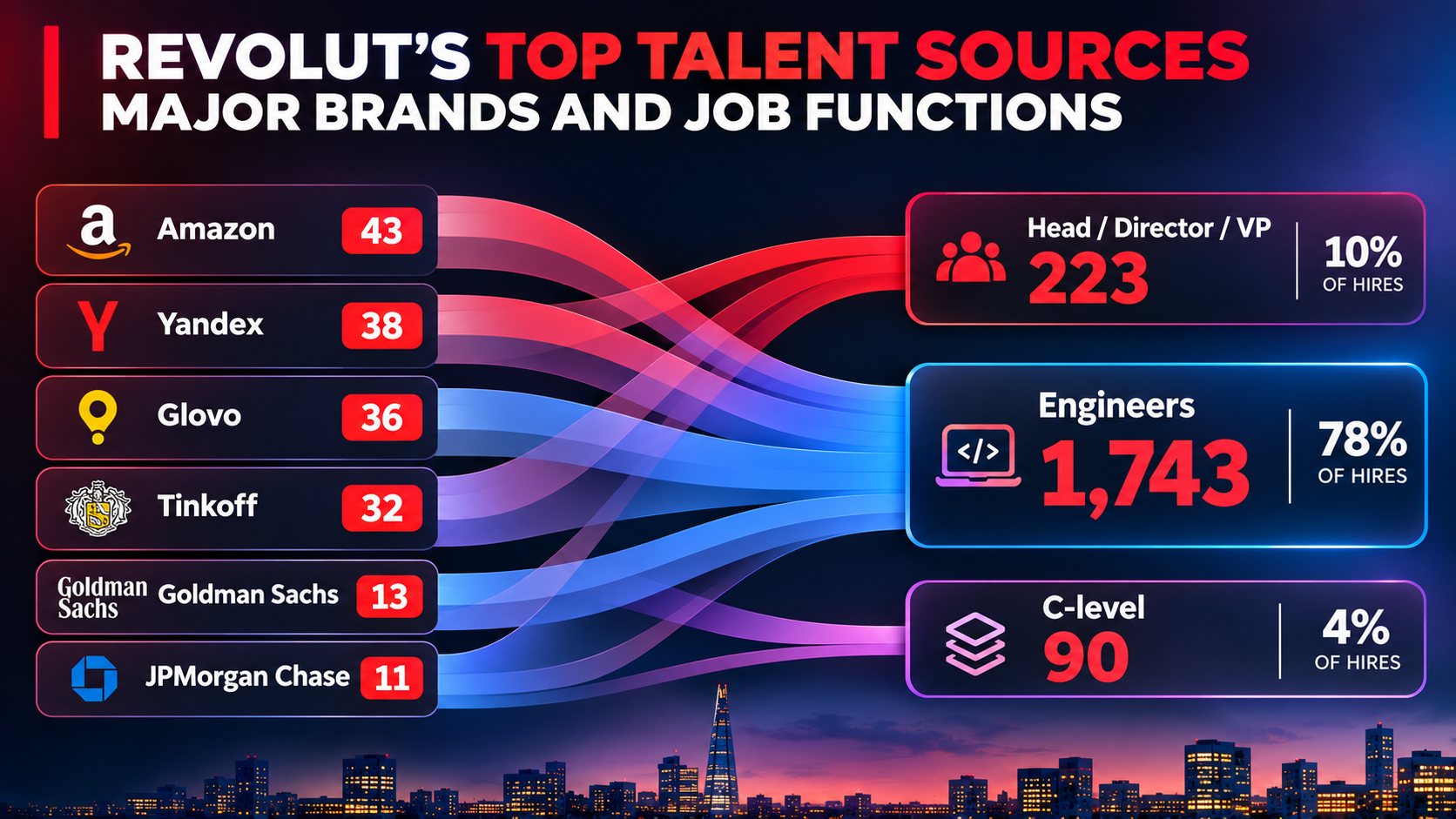
Meanwhile, senior executives and managers come from a different world, including Amazon, investment banks and major consultancies.
Amazon alone supplied 24 Heads, Directors or VPs, considerably more than any individual bank or consultancy in the analysis.
This means that Revolut is building a global financial institution, yet many of the people building its technology have never worked in a bank.
This reinforces something I’ve been arguing for years, and Revolut provides an interesting case study of the move from old banking to new. It’s not just who you hire. It’s how they think.
There is another dimension to this story, and it concerns culture.
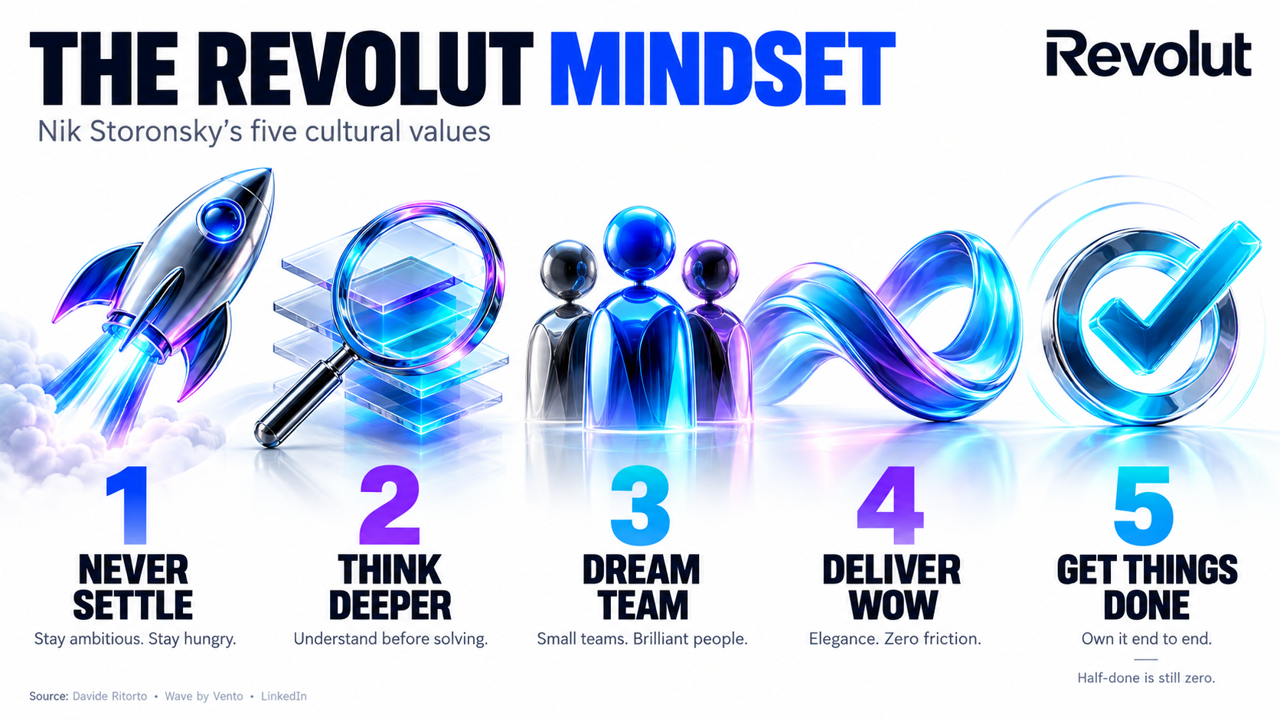
In a recent presentation at Wave by Vento, Revolut founder Nik Storonsky outlined the five values that define the company’s approach to building and managing its organisation. They are Never Settle, Think Deeper, Dream Team, Deliver Wow and Get Things Done.
On the surface, these sound like the sort of corporate values you might find displayed on the walls of any large company. Every bank claims to value innovation, teamwork, customer experience and accountability.
The difference lies in whether those values genuinely determine how the business operates.
Take Dream Team. Storonsky believes in small teams of exceptional people rather than large teams of average performers. Combine that with Get Things Done, where individuals take responsibility for delivering results from beginning to end, and you begin to understand why Revolut recruits differently.
Revolut is not looking exclusively for people who know how banks work. It places considerable emphasis on people who know how to build things, solve problems and deliver results. That is a fundamentally different approach to recruitment.
Traditional banks have historically recruited people who understand banking and then tried to teach them technology. Revolut recruits people who understand technology and then teaches them banking.
Of course, this is a generalisation. Revolut employs experienced bankers, compliance specialists, risk managers and financial professionals, just as traditional banks employ thousands of excellent engineers. The difference is where the organisation places its emphasis and what sort of thinking dominates its culture.
I was struck by this during Nik Storonsky's conversation with Stripe co-founder John Collison on the Cheeky Pint podcast, which I discussed in a recent blog. For someone running a global financial institution, Storonsky spends remarkably little time talking about banking. Instead, he talks about product development, experimentation, artificial intelligence, customer relationships, recurring revenues and operational efficiency. He explained why he dislikes the economics of lending and why he would prefer Revolut to generate income from transactions, subscriptions and services rather than taking substantial credit risk. He also described an approach to innovation in which small teams launch new products, measure their performance and allocate resources according to the results.
This is not how most banks operate.
Traditional banks tend to organise themselves around products, business divisions, risk committees, compliance functions and management hierarchies. Revolut has approached the challenge from the opposite direction, building a technology company that progressively acquires the licences, capabilities and responsibilities of a financial institution. In fact, Storonsky said recently that the ideal team is two or three people. Wow!
The distinction matters because the way you organise a company determines how it behaves.
If you recruit people who have spent their careers in traditional banks, you inevitably bring some of the industry’s established thinking with them. They understand the products, regulations, processes and risks, which is valuable, but they also understand how things have always been done.
If you recruit engineers from technology companies, you bring a different perspective.
They are accustomed to building platforms, developing software, automating processes, experimenting with products and scaling digital services. They approach problems through technology and data rather than established banking procedures.
Neither background guarantees better decisions, but the starting assumptions are different.
This becomes even more interesting when you consider Revolut’s ambitions.
Storonsky doesn’t just want Revolut to compete with traditional banks. His ambitions extend towards creating a global technology platform that provides financial services and, potentially, much more.
That explains why Amazon is such an important source of senior management talent. Amazon knows how to operate digital platforms at enormous scale, manage complex international operations and build businesses around customer behaviour, data and technology.
Those capabilities are valuable when your ambition is to serve hundreds of millions of customers across multiple markets.
The question is whether traditional banks can adopt the same thinking when their organisations have been designed around very different priorities.
There is, however, a fascinating twist to this story.
Revolut has spent years recruiting engineers to build its business, and now Storonsky is questioning how many engineers it will need in the future.
During his conversation with Collison, he explained how artificial intelligence is increasingly being used across Revolut, from customer service and marketing to engineering and product development. He explained that teams previously requiring eight or ten specialists could eventually operate with just two people, as AI enables individual developers to work across multiple disciplines. He even questioned whether the performance management structures, KPIs and organisational processes that Revolut has spent a decade developing will remain relevant in an AI-native organisation.
That is quite a statement.
Most traditional banks are asking how AI can make their existing employees more productive. Revolut is asking whether the jobs, departments and management structures themselves need to change.
In other words, the next revolution isn’t just about hiring engineers instead of bankers. It is about redesigning the organisation around human expertise working with artificial intelligence.
Now consider those five cultural values again.
Never Settle encourages continuous improvement. Think Deeper demands a better understanding of problems. Dream Team prioritises exceptional talent. Deliver Wow focuses on customer experience, and Get Things Done demands accountability for results.
Put those values together with artificial intelligence, and you begin to see why Revolut’s recruitment strategy, management culture and AI ambitions are connected. The implications go far beyond reducing headcount. They challenge the organisational model of banking itself.
Traditional banking has always involved considerable operational complexity, with large workforces supporting payments, customer service, compliance, technology, risk management and administration. Technology has reduced some of those costs, but many institutions still operate with organisational structures inherited from an earlier age.
An AI-native bank could challenge those assumptions.
There are, of course, reasons to be cautious about treating Revolut as a blueprint for the entire banking industry as banking is not just a technology business. Financial institutions hold people’s savings, safeguard their payments, protect them against fraud and operate within demanding regulatory frameworks. Engineering excellence does not automatically create sound credit judgement, effective financial crime controls or responsible governance.
There is also a harder side to Revolut’s management philosophy.
A relentless emphasis on performance, individual accountability and exceptional talent can create enormous pressure. Small teams of brilliant people sound wonderful in theory, but such a demanding culture needs to accommodate mistakes, provide support and recognise that even exceptional people sometimes fail to meet expectations. A culture built around Get Things Done can deliver extraordinary results, but it can also become unforgiving if performance is valued above everything else.
This matters particularly in banking, where doing things correctly is often more important than doing them fast.
An engineer supported by AI might create a new financial product in a fraction of the time previously required, but that doesn’t mean the product should be launched without appropriate controls. A payment platform might process millions of transactions efficiently, but it still needs effective fraud prevention, operational resilience and customer protection.
The real challenge is combining the speed and creativity of a technology company with the accountability and trust required of a financial institution.
Revolut has demonstrated the potential of that model, but it has also faced regulatory and operational challenges as it has grown. The success of its technology-led approach does not mean that every aspect of traditional banking can be discarded.
It means the balance needs to change.
One final finding from the Freesbee Ventures analysis caught my attention.
Only 1.5% of the employees studied had previously founded a company before joining Revolut, while 4.9% of Revolut alumni had subsequently founded one. Although the comparison doesn’t prove that Revolut itself caused the increase, it does suggest that the company is developing people who go on to create businesses of their own.
There is something interesting about that.
Traditional banks have historically trained bankers who go on to work for other banks.
Technology companies develop engineers and entrepreneurs who go on to create new companies.
Revolut is operating much more like the latter.
This is particularly relevant when we think about the future of financial services. The next generation of fintech companies will be founded by people who have grown up building digital platforms, working with AI and operating in environments where experimentation and execution matter more than established hierarchies.
They will not necessarily think of themselves as bankers, even when the businesses they create perform functions that banks have provided for centuries.
That is a significant cultural change.
Finally, before anyone accuses me of becoming a Revolut cheerleader, it’s worth remembering that this transformation is not just happening with them, but across the whole financial services industry. Revolut just happens to be the poster child for the revolution, but look at Nubank in Latin America, which has demonstrated how a digital-first financial institution can scale to serve more than a hundred million customers. Look at Starling and Monzo in Britain, which have challenged the traditional banking model through technology, customer experience and different approaches to building financial services. Look at Chime in America, which has shown how a mobile-first financial services business can attract millions of customers without following the conventional banking playbook.
Then there is Ant Group in China, which has demonstrated the potential of building financial services around a vast digital ecosystem, integrating payments, commerce, data and technology in ways that traditional banks have struggled to replicate.
These companies are not identical.
Their business models, regulatory structures, markets and cultures differ enormously. Some have achieved profitability, others have faced significant challenges, and none offers a perfect blueprint for the future of banking.
What they share is a willingness to challenge the assumption that the best way to build a financial institution is to start with the traditional banking model and add technology.
In fact, I could just as easily have written this article about several of these companies, but Revolut happens to be making the headlines at the moment, because it is providing transparency in its thinking led by Nik Storonsky who, until recently, didn’t do much media.
Now, he is everywhere.
Storonsky's ambition is to build a company that operates on the global scale of Amazon, Google and Microsoft, with financial services at its heart. That brings me back to the original question. If you were building a global bank today, would you recruit primarily from the existing banking industry or from the world's most successful technology companies?
I would argue that you need both, but the balance is changing.
You need bankers who understand financial risk, regulation, capital, liquidity and trust. You need engineers, data scientists, product designers and people who understand how to build global digital platforms. Increasingly, you need people who can work with artificial intelligence to redesign the business itself.
The question is not whether banks need bankers, because of course they do. The question is whether bankers should continue to dominate the thinking, organisation and culture of institutions whose future will be determined by technology.
For decades, traditional banks have recruited bankers and tried to teach them technology. Neobanks have recruited technologists and taught them banking.
Revolut, Nubank, Monzo, Starling, Chime, Ant and others are demonstrating that financial services can be designed, built and delivered in fundamentally different ways. They don’t all have the answers, and they certainly don’t all get everything right, but they are forcing the established industry to reconsider what a bank should look like.
The future of banking will not be determined solely by who has the best technology. It will be determined by who has the people, culture and leadership willing to use that technology to build an entirely different kind of bank.
Which leaves one final question: if you want to build the bank of the future, why are you still thinking like a banker?
More information and sources:

Chris M Skinner
Chris Skinner is best known as an independent commentator on the financial markets through his blog, TheFinanser.com, as author of the bestselling book Digital Bank, and Chair of the European networking forum the Financial Services Club. He has been voted one of the most influential people in banking by The Financial Brand (as well as one of the best blogs), a FinTech Titan (Next Bank), one of the Fintech Leaders you need to follow (City AM, Deluxe and Jax Finance), as well as one of the Top 40 most influential people in financial technology by the Wall Street Journal's Financial News. To learn more click here...